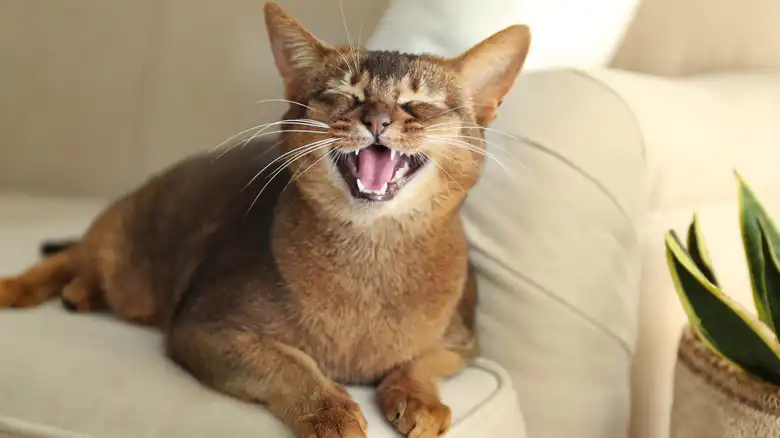
The 13 Noisiest Cat Breeds (And What They're Trying To Tell You)
CatsCat BreedsThe 13 Noisiest Cat Breeds (And What They're Trying To Tell You)ByColt DoddFeb. 25, 2025 9:05 am ESTLiudmila Chernetska/Getty ImagesWill a cat's meows wake up the entire neighborhood? Unlikely. But are some cat breeds noisier than others, making their needs known with meows, chirps, and trills? Absolutely. In fact, many people would argue that some cat breeds are louder than some dogs! Cats boast 21 unique vocalizations, though every single cat might not be able to tap into each of them, and humans who are especially in sync with their feline friends can tell what they mean. To the trained ear, a meow for attention will sound very different than a yowl that screams, "Hey! Someone stepped on my tail!"So, what are the noisiest cat breeds? Those originating from Asia, such as the Siamese and the Oriental shorthair, are known for being especially vocal. Certain designer breeds, like the hairless sphynx, are also reputed for being talkative. That said, whether a cat is conversational or not ultimately boils down to individual temperament, as even some of the loudest cat breeds have some quiet members, and a cat's age, disposition, and environment arguably play a larger role in their noise level than breed. Still, if you're looking for a conversational kitty, checking out these breeds that are notoriously louder than their peers can't hurt.1. Siamese cats are known for being chattyAnton Vakhrushev/ShutterstockOne of the Siamese cat breed's most notable characteristics is its reputation for being noisy, although nobody's exactly sure why. Some speculate that these cats are so talkative because of their long relationship with humans, with the earliest record of Siamese cats dating back to 1350 A.D. Siamese cats may have developed their love of conversation through wanting to bond with humans for hundreds of years. After all, if you were faced with two cats, one meowing and one silent, which would you pet? This is an incredibly social breed that will make itself known by any means possible. With the Siamese cat, it just happens to be trills, meows, and purrs.So, what does a meowing Siamese cat want? It largely depends on context, but more often than not, a Siamese cat, thanks to its loyalty and friendliness, emits its distinctive meow because it wants snuggles, attention, playtime, or all three. If you're looking for an independent cat breed, steer clear of Siamese. Many breed enthusiasts describe them as dog-like, even known to loudly protest when their owners want some alone time!2. Some Bengals are big on conversationeugenehill/ShutterstockAs a breed, Bengals can be something of a wildcard because there's lots of variation among individuals. The reason? Some members of the Bengal cat breed have closer ties to their wild ancestors than others. Domesticated Bengal cats are classified by filial generation, signified by the letter "F" and a subsequent number. The higher the number, the further the cat is removed from their wild ancestor.For example, F1 Bengal cats are 50% Asian leopard cat and 50% domestic cat. They share many traits with their wild parents, which may lean toward being silent and stealthy. On the other hand, F3 Bengals, which are only about 13% Asian leopard cat, may vocalize more because they're more closely related to domestic cats, and research shows that domesticated cats evolved to adjust and increase their vocal patterns to communicate better with humans.But even then, genetic makeup isn't an indicator of how noisy a Bengal cat will be because every cat is an individual. Still, when Bengals do vocalize, it's largely to engage with their human owners, whether that's requesting attention or demanding food. It's tempting to give into a Bengal cat's demands, but stay strong! Giving in too frequently could cause your Bengal to think they run your household.3. Oriental shorthairs are a people-oriented breedVittoriaChe/ShutterstockSiamese cats are among the oldest cat breeds, and consequently, they have served as the foundation of other breeds, including the Oriental shorthair — yet another noisy cat breed. Known for being incredibly social, once you bring one of these broad-eared cats home, you'll basically have a second shadow. Driven by their natural curiosity and attachment to their owners, Oriental shorthairs will concern themselves with every aspect of your routine, emitting a soundtrack of chirps, trills, and meows. Upon sitting down, your Oriental shorthair is likely to curl in your lap, purring the entire time.So, how loud are Oriental shorthair cats? There isn't necessarily one cat breed that's louder than the rest. However, there is some data regarding how loud cats are in general. Cats' vocalizations generally reach around 45 decibels, the same volume as an ambient refrigerator. However, some cats (such as those in distress or in heat) can exceed 80 decibels, which is about as loud as a lively restaurant. An Oriental shorthair might not wake up your apartment building in the middle of the night, but a demanding kitty could certainly prevent you from sleeping soundly.4. Maine coons have a wide vocabularyShirlaine Forrest/Getty ImagesMaine coons aren't just loud; they have an expressive lexicon that alerts owners to their many whims and wants. From meowing and trilling to hissing and chattering, the massive Maine coon always has something to talk about. And they're not just noisy; these cats are known for being demanding. You might have to shut your bedroom door to prevent your needy Maine coon from talking your ear off!It's important to note that while the Maine coon is a breed with a lot to say, if you notice an increase in vocalizations in yours, you should consider the reason. For instance, an un-neutered male Maine coon will become consumed by reaching a queen in heat, even if that means tearing through a screen door or escaping through a cracked-open window. If he can't get outdoors, he'll yowl, scream, and make his frustrations known to everyone in earshot. This is one of many reasons why cat owners neuter their male cats.In another situation, a cat suffering from medical problems (such as an injury) may vocalize more as a way to express pain and get attention from their owners. Understanding your Maine coon's normal behavior and recognizing the signs of distress can help you act quickly.5. Sphynx cats make noise to demand food, love, and attentionSashkaB/ShutterstockPicture this: You're a hairless, 8-pound cat, and you rely on external heat sources to keep warm. Not only is your skin sensitive to temperature fluctuations, but years of selective breeding have also left you as an affectionate, people-centered cat. So, what's your favorite heat source? Your owner. Unfortunately, they're busy at the moment. Your best bet? Start making noise. It's for reasons like this that sphynx cats are among the noisiest cat breeds. With a sphynx cat, you'll never be left wondering about their needs, wants, or overall state of mind; they'll let you know. This is why sphynx cats don't make great companions for everyone. They're not low-maintenance pets, requiring specialized grooming needs for their fragile skin. These cats don't enjoy being left alone for long periods, which is why some owners elect to get a pair. Even then, two sphynx cats mean double the attention and double the noise!6. Japanese bobtail cats are legendarily loudNancyayumi/Getty ImagesThe Japanese bobtail is an affectionate breed that goes as far back as the Middle Ages, when they were imported from Korea to Japan to hunt vermin. Because of their origins working and living alongside humans, Japanese bobtails evolved into the deeply devoted cats that people know and love today. And how do these cats profess their dying love? Through a series of soft, almost lyrical chirps. These sounds aren't necessarily loud, but they can certainly create a lot of chatter!This unique voice has cemented the Japanese bobtail's place in folklore and other storytelling traditions in its native country. Some legends tell of singing Japanese bobtails — and if you've ever heard this cat's melodic meow, you would see why. Japanese bobtails are also a symbol of good fortune, commonly portrayed as a calico cat lifting one paw. That portrayal originates from a legend in which a man, who was sitting under a tree, was beckoned from his resting place by a Japanese bobtail. Moments later, a giant branch crashed down where the man was sitting. The cat had saved him from being crushed! Ultimately, if you're lucky enough to welcome a Japanese bobtail into your home, your days will more than likely be punctuated by its cheerful, musical voice.7. Burmese cats talk to everyoneTatyanatitova/Getty ImagesWhen you adopt a Burmese cat, you're not just getting a four-legged companion; you're getting a mini housekeeper. These tenacious cats will concern themselves with every aspect of your household, supervising your day-to-day routine with their massive, globe-like eyes. While not known for being loud, a Burmese won't hesitate to alert you when something is wrong, rivaling the closely related Siamese and Tonkinese in terms of chattiness. Unlike some one-person cat breeds (meaning a cat learns to deeply trust one human but might be hesitant of others), Burmese will typically talk to anyone who will listen, brightening visitors' days with curious chirps that encourage interaction.Burmese cats aren't for everyone. They're best suited to households teeming with activities that the Burmese can join. Yet, their vocalizations can be just as loud as a baby's crying, and they have a quaint-yet-deep meow that some find irritating. When choosing the ideal cat breed, it's important to consider your expectations, routine, and experience owning attention-loving cat breeds. These reflections will provide insight into what cat best suits you.8. Tonkinese make their needs knownYehoshua Halevi/ShutterstockThe Tonkinese breed originates from two very chatty cats: the Siamese and the Burmese. But there's something unique about how noisy Tonkinese cat breed is; these cats are known to chirp, trill, and meow in full sentences! They make a seemingly endless array of noises that leave nobody wondering about how they feel. Because of this, it's not uncommon to hear a Tonkinese before they even walk into a room. Not only are these cats known for their love of conversation, but they also adapt easily to multi-pet households and those with small children. In fact, many love this cat for its dog-like nature. They're known to eagerly greet their owners when they come home from work with a chorus of inquiring purrs and meows.While Tonkinese are generally vocal, it's important to know the distinction between a chatty kitty and one that's in distress. You don't want to attribute signs of an underlying illness to your Tokinese's social nature! For example, Tonkinese are genetically inclined to develop feline lower urinary tract disease, which refers to an increased risk of bladder stones and infections. If you notice a sudden increase in your Tonkinese's vocalizations (along with other concerning signs), consult your veterinarian.9. Singapura: small cats, loud meowsViktor/Getty ImagesMeet the Singapura, one of the smallest purebred cats. Averaging between 4 and 7 pounds, these relatively rare cats retain their kitten-like traits well into adulthood, making them a favorite companion in quiet, stable households. Yet, make no mistake: Big things do come in small packages, and that's certainly the case for the Singapura's meow. When these cats decide to speak up, it can leave you wondering what your cat's noises really mean. This breed emits a distinctive sound that's sure to rouse anyone's attention, as a Singapura won't hesitate to speak its mind and will voice its opinion whenever it suspects something is wrong (such as you being a few minutes late with its dinner).If you have your heart set on getting this small cat breed, it's important to exercise caution when vetting potential breeders. Always ask for genetic testing and information about the parents' health before putting a deposit down on a kitten. Singapura cats are prone to progressive retinal atrophy, which can cause blindness with age. By only conducting business with ethical breeders, you can rest assured that your kitten has everything they need to live a long life, which, for Singapura cats, is generally 11 to 15 years.10. Ocicats persistently (but not annoyingly) demand attentionSyed Zohaib152/ShutterstockIt's easy to see why the ocicat cat breed is commonly mistaken for Bengals, but make no mistake: Despite their leopard-spotted coats and love of conversation, they're not that similar. The biggest difference lies in their breeding. Bengal cats are the offspring of Asian leopard cats and domestic shorthairs, while ocicats are 100% domestic cats that have been selectively bred from Siamese cats, Abyssinians, and American shorthairs over time. Ocicats may have inherited their vocal nature from their Siamese ancestors, as they're undeniably among the most talkative cat breeds.Ocicats may demand their owner's attention for many reasons, but the most common is generally snuggles and affection. However, they're not reputed for being overly needy, unlike the dog-like Tonkinese that can even be trained to walk on a leash. An ocicat will meow for its owner, relish the attention, and then disappear for a few hours, only to continue the cycle at its whim.Weighing anywhere from 6 to 15 pounds, ocicats suit a variety of households, meshing well with socialized children and pets. Because of their parent breeds, ocicats are known for being healthy and vigorous, living up to 18 years without health complications. Yet, like many other breeds, genetic testing is best to prevent degenerative conditions, like progressive retinal atrophy.11. Balinese cats thrive on attention and hate being lonelyHeidi Bollich/ShutterstockBalinese cats resemble long-haired Siamese cats while also sporting the triangular ears found in Oriental shorthairs. In the 1940s, fanciers refined the Siamese breed, working to create a family-friendly cat with an aristocratic appearance. Because the breed was developed mostly from human intervention, Balinese cats possess many traits that people find desirable, including being interactive and vocal.Perhaps that's why the Balinese is described as clown cats — they're always engaging in playful antics, like making noice, to attract attention and praise. They appear to enjoy co-existing with dogs, and they're great for households with older children, not because of aggression but because older children are more suited to their endless levels of energy. If you're wondering whether to get a Siamese or Balinese cat, the decision should boil down to how you feel about having a talkative breed. You may go with the Balinese if you're looking for a cat that loves conversation but won't chatter as endlessly as a Siamese.12. Khao manee have a lot to sharebamgraphy/ShutterstockKhao manee translates to "white gem" in Thai — and for good reason. These striking, white-furred cats are prized for their brilliant coats and crystal-colored eyes, with blue and yellow being the most common. The khao manee is more than a pretty face, though — it's also a fairly noisy cat breed. This cat is anything but shy, using combinations of hisses, purrs, howls, and yowls to get its points across. Khao manees are also masters of using body language as a method of communication. The position of a khao manee's tail can tell a thousand words!So, why so chatty? The khao manee is a talkative cat because of its origins as a companion breed dating all the way back to the 1300s. At the time, these cats were prized among the aristocracy, hidden from visitors to promote exclusivity. It wasn't until 1999, when the breed faced becoming endangered, that a cat fancier was able to import a khao manee from Thailand to the United States. Through concentrated breeding efforts, the breed has seen its numbers increase, and this talkative cat lives to howl for another day.13. Savannah cats are one of the loudest breedsAjr_images/Getty ImagesIn your search for a conversational cat breed, you may want to also take a walk on the wild side. This may spur you to consider getting a savannah cat, an emerging designer breed that involves mixing African servals with domestic shorthairs. However, you should know that these cats are very, very vocal, and their sounds don't necessarily have the same meanings as domesticated cat noises.Savannah cats hiss, but depending on the context, it doesn't necessarily indicate aggression. Rather, savannah cats have a distinctive, rattlesnake-like hiss that could mean a number of things, so it might take you a little time to get in tune with your specific pet. Like with other some other cat breeds, savannah cats may make more noise when in heat.Always consult your veterinarian before making changes to your pet's diet, exercise, or care. To find an accredited veterinarian in your area, you can search theAmerican Animal Hospital Association's online database.
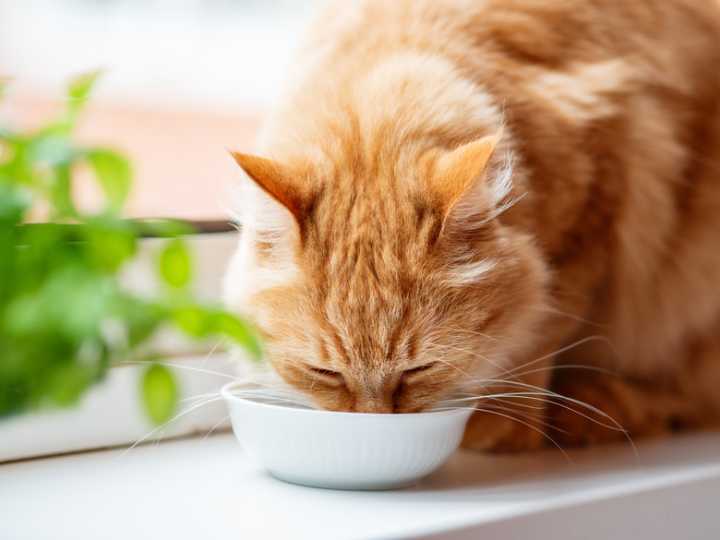
Why Does My Cat Put His Paws In The Water Bowl?
CatsCat BehaviorWhy Does My Cat Put His Paws In The Water Bowl?ByMariel LovelandUpdated Jul 1, 2021Konstantin Aksenov/iStock/GettyImages #pcb383c5d8815a9012947dbbb895e348e, #pcb383c5d8815a9012947dbbb895e348e img { aspect-ratio: 5184/3888; height: auto; }It doesn't take very long for any first-time cat owner to notice that their feline has some interesting — and unequivocally adorable — habits. This includes the zoomies (aka your pet's tendency to run around the house like a maniac for no apparent reason) or pawing under the bathroom door should you dare to ever shut him out. Among all, a cat's most renowned and bizarre habit may be his penchant to tap.Most internet users have seen viral videos of cats carefully tapping glasses of water to the ground in a fit of playful mischievousness, but their tendency to paw at water extends to just about any accessible water around the house. This includes open toilet bowls, dripping sinks, and even your cat's own water dish. Believe it or not, there is a method to the madness.Though cats can't really verbalize beyond a meow or a chirp, experts do have an idea about why your cat might put his paws in his water bowl (or your water cup should you have your head inadvertently turned away).It’s just a personal preferenceIt's just a personal preferenceIf you find that your cat is dipping its paws into a water dish or glass, and then licking off the moisture, it could just be the way your cat likes to drink. Consider it a personal preference. In the same way that you might use your hands to take a sip of water from the sink, your cat may just prefer using their paws rather than lapping it up directly from the source. This preference can form at an early age and doesn't necessarily have to do with anything else.He can't take the pressure (on his whiskers)He can't take the pressure (on his whiskers)Sometimes your cat's preference to drink from their paws extends beyond a childhood habit. They may be unhappy with the shape of their water bowl or the level of water within their bowl because of the way it feels on their whiskers. This is known as "whisker stress."Whisker stress is particularly prevalent if your cat is drinking from a bowl with a small diameter or a drinking glass made for humans. While some cats don't like feeling pressure on their whiskers, others don't mind. If you think your cat may have an aversion to drinking directly from their bowl, try replacing it with a flat, shallow dish or topping up the water so their whiskers don't brush the sides.The water isn’t fresh enoughLightspruch/iStock/GettyImages #pac9fb2c7250f40500ea481da1e884b63, #pac9fb2c7250f40500ea481da1e884b63 img { aspect-ratio: 6000/4000; height: auto; }The water isn't fresh enoughYou may notice that your cat enjoys drinking water directly from the sink — and this is no mistake. Cats are particularly sensitive to taste. Call them the divas of the pet world, but many can't stand the taste of stale water and actively prefer drinking moving water, even if they have to make the water move themselves.If your cat is dipping his paws into his water bowl, he may be trying to mimic running water. This actually compounds the problem because it helps bacteria and bits of litter build up in the bowl. You may find that your cat isn't drinking enough to stay hydrated. Instead, replace the water daily or use a fountain that keeps the water constantly moving.Your cat feels too vulnerableYour cat feels too vulnerableCats like to feel safe and secure, but they're particularly vulnerable when they're eating or drinking. For this reason, many cats feel uncomfortable when putting their heads down to drink or when drinking with their back to the room. This is particularly true for households with more than one pet, especially if there's been fights or tension between animals.To make your cat feel more secure, don't back the water dish into a corner or against a wall. Allow them to see the room while they drink. The water level also makes a difference. Make sure it's not so low that your cat can't see over the edge of the bowl. In a multi-animal household, you may also want to give each animal their own drinking station.Your cat is playing aroundNils Jacobi/iStock/GettyImages #p0559d57524a8179474fab8582a159e1a, #p0559d57524a8179474fab8582a159e1a img { aspect-ratio: 5600/3738; height: auto; }Your cat is playing aroundYour cat's water bowl may be in the perfect position with the perfect amount of fresh water but he's still pawing away and leaving little wet paw prints around your kitchen. In this case, your cat may simply like to play with his water.If you think your cat may be playing because he's bored, try offering it alternative toys that deter him from splashing around. It never hurts to spend a few extra minutes a day playing with your pet.ReferencesPam Johnson-Bennett: How Appealing Is Your Cat's Water?Cat Health: Why Do Some Cats Dip Their Paws in the Water Bowl?Pam Johnson-Bennett: Why Does My Cat Put Her Paw In the Water Bowl?
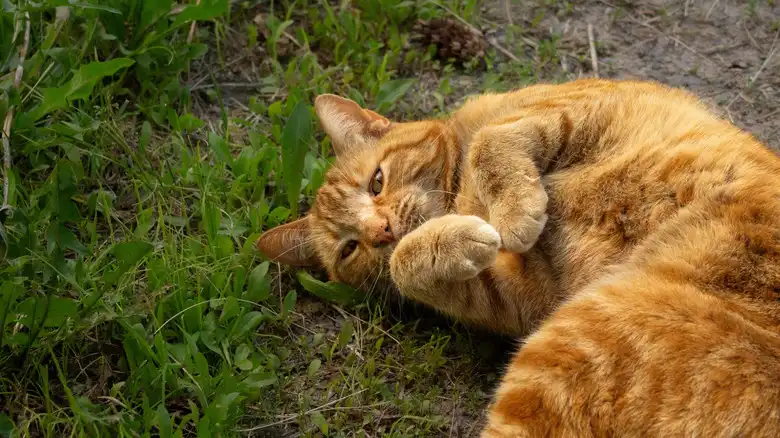
Why Do Female Cats Roll Around After Mating?
CatsCat BehaviorWhy Do Female Cats Roll Around After Mating?ByJo JacksonUpdated: Dec. 3, 2024 4:01 pm ESTPrism Acres Rebecca Young/ShutterstockCats are tactile creatures who love to be stroked and to rub their whiskers and butt their heads against objects, people, and other animals. When an unspayed female cat — also known as a queen — comes into heat, usually in the spring and summer months in the Northern Hemisphere, she becomes even more physical and persistently rubs against things and rolls on the floor. If stroked, she will raise her hindquarters and tread with her back feet. After mating, she will roll around frantically for several minutes in an instinctive reaction that may be related to ovulation.Cats getting ready to mateUnlike a queen, an unaltered male cat — also called a tomcat — doesn't have a heat cycle and can mate at any time. Successful mating depends on the readiness of a female, so a tom will go wherever he's receiving signals from a queen in heat. He will often do whatever is necessary to gain access to a female who's ready to mate.A queen will make a special yowling sound that she only makes when seeking a mate, and a tomcat vocalizes right back to her. She will also produce hormones and pheromones that are present in her urine, which is what attracts tomcats to her. Although she is indicating her readiness to mate, the tom will approach with caution and follow her around, keeping out of paws' reach until she adopts a crouching position with a raised rear end. This position is necessary for success.At this point, he will grab her by the scruff of the neck and mount her. He does this to keep her in position and prevent her from biting him while the event is taking place. He then thrusts his pelvis against her until he penetrates her with his penis for 1 to 2 minutes.Cats inducing ovulationAs the male ejaculates, the female will let out one or more loud screams. The male's barbed penis scratches her insides and induces ovulation. The scratching is painful, but pregnancy will not occur without this stimulation. Eggs aren't released from the ovaries until after the male has ejaculated, so the first mating will often not produce kittens.Robert Way/iStock/GettyImagesFemale cats usually need to mate three to four times in a 24-hour period to successfully achieve pregnancy, and she will often mate with more than one male. This increases the chances of pregnancy, and it may lead to kittens of the same litter having different sires. The female's heat cycle will end within a day or two of inducing ovulation.Female cats after matingAs the male releases his grip on her neck, the female often will swat and hiss at him. Immediately after mating, the queen may furiously roll around on the floor. She will change positions and lick at her genital area and at her back where the male cat touched her. She will be quite frenzied and move from one action to another for several minutes.Since triggering ovulation, her hormones are changing significantly, and are likely the cause of her behavior after mating. She may also be trying to clean the scent of the tom off her before she accepts another mating.Tomcats after matingChristopher Loh/Moment/GettyImagesAfter mating, the tom is normally eager to move away from the female to avoid getting scratched and swatted at. The female makes it clear that she wants him to keep away from her. The tom will often leave her sight but stay nearby, waiting for her to be receptive again. Once she is ready, he will return to mate again. If the mating results in kittens he will have no part in raising them.
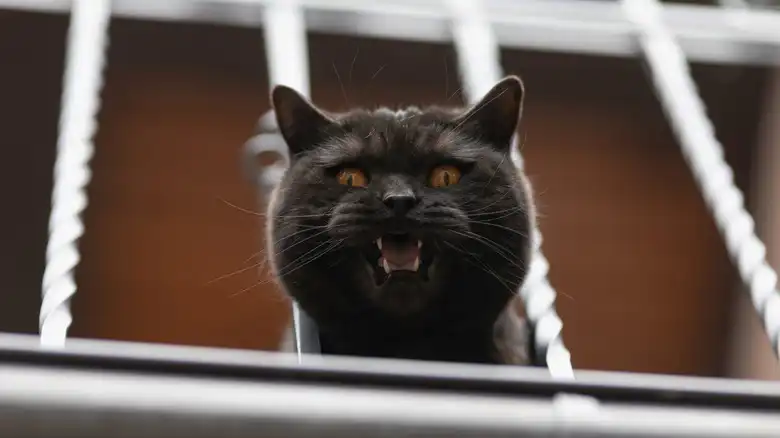
Is Your Cat's Loud Meowing Keeping You Up At Night? Here Are 5 Ways To Prevent The Behavior
CatsCat BehaviorIs Your Cat's Loud Meowing Keeping You Up At Night? Here Are 5 Ways To Prevent The BehaviorBySanaphay RattanavongFeb. 3, 2025 9:25 am ESTPawel Wewiorski/Getty ImagesIf you've ever found yourself staring at the ceiling at 2 a.m., wondering what your cat is trying to articulate with their loud meowing, you're not alone. Nighttime meowing, or "night vocalization," is a common issue many cat parents face. Understanding why cats meow is the first step to solving the problem.Cats may vocalize at night for several reasons: they're naturally more active during dawn and dusk, they might be bored or seeking attention, or they could be hungry or thirsty. Sometimes, the cause is more serious, such as health issues like thyroid or kidney disease, particularly in older cats.By identifying the root cause, you can tailor a strategy to address the behavior. Whether it's keeping your cat entertained during the day or checking for potential medical concerns, there are effective ways to prevent these nighttime disturbances. We'll explore five practical tips to help you and your furry friend enjoy peaceful nights once again.Tire the little hunters outAnita Kot/Getty ImagesAs with puppies and human toddlers, one of the most effective ways to prevent nighttime restlessness is to get your cat to expend their energy during the day, particularly in the evening. Cats are crepuscular creatures, meaning they are naturally most active at dawn and dusk. Without enough stimulation, this energy often manifests as vocalization during your sleeping hours.Evening play sessions can help mimic your cat's natural hunting instincts while tiring them out. Use interactive toys like feather wands, elusive laser pointers, or kicker toys to engage them in active play. Rotating toys regularly can also keep their interest piqued. For cats that enjoy solo play, provide toys designed for independent use, such as puzzle feeders or motion-activated balls. Even a small catnip toy can suffice.Playtime doesn't have to take hours: 15 to 20 minutes of vigorous activity before bedtime is often enough. As your cat winds down from their "hunt," they're more likely to settle into a restful sleep, leaving you undisturbed through the night.Keep it clean and comfyCreative Cat Studio/ShutterstockSometimes, a cat's meowing at night is simply their way of telling you that something isn't quite right. Hunger, thirst, or an unclean litter box can all trigger vocalizations, especially during the quiet hours of the night. Making sure your cat's basic needs are met before bedtime can go a long way in reducing disruptive after-hours complaints.Start by leaving out fresh water and a small portion of dry food before you head to bed. Cats are notoriously particular about their hygiene, and a dirty litter box can lead to restless behavior and vocal protestations. Not cleaning the litter box often enough could lead to excessive vocalization, or worse. Additionally, consider your cat's physical environment. Is your cat's sleeping area cozy and quiet? Providing a calming, comfortable spot, such as a soft cat bed, can encourage them to settle in for the night. If they're comfy, they're less likely to climb into your bed and meow, too.Don't reward nighttime meowingrai106/ShutterstockWhen your cat meows at night, it's tempting to respond — whether by offering food, cuddles, or even scolding. However, reacting to their meowing can inadvertently reinforce the behavior. Cats quickly learn that meowing in different ways gets them the attention they want, turning nighttime disruptions into a recurring issue.To break this cycle, it's essential to ignore your cat's meows, no matter how persistent they are. While this approach requires patience, it's an effective way to teach your cat that meowing won't yield rewards. Over time, they'll stop using vocalizations to demand attention. Breaking this habit might take a few days or even weeks, but the effort will pay off when you finally get the uninterrupted sleep you deserve.Of course, it's crucial to differentiate between attention-seeking meows and those signaling genuine distress. If your cat's vocalizations are accompanied by signs of pain, illness, or anxiety, consult a veterinarian. Otherwise, consistency in ignoring the behavior is key to long-term improvement.Rule out health issuesORION PRODUCTION/ShutterstockIf your cat's nighttime meowing persists despite your best efforts, it might be time to consult a veterinarian. Excessive vocalizations can sometimes be indicators of an underlying health problem, especially in older cats. Common conditions associated with increased meowing include hyperthyroidism, kidney disease, and cognitive dysfunction syndrome (CDS). Senior cats are particularly susceptible to these conditions, and changes in vocalization patterns may be one of the first noticeable symptoms. Remember that sudden changes in your cat's behavior should never be dismissed out-of-hand as mere attention-seeking, especially in adult cats with established routines.A thorough vet check-up can help rule out health-related pain or discomfort. Your veterinarian may recommend diagnostic tests or treatments to address any identified concerns. For instance, medication can help manage hyperthyroidism, while dietary changes might benefit a cat with kidney disease. Blood work and physical examinations are typically the first steps in identifying these conditions, and early detection often leads to better treatment outcomes. Some cats may require ongoing monitoring and treatment adjustments to maintain their quality of life.Create a peaceful sleep zonePaul Biris/Getty ImagesCreating a calming, cat-friendly environment can help your feline settle down for the night. Cats are sensitive creatures, and addressing distractions can make a significant difference in reducing nighttime meowing. Start by designating a quiet, cozy sleeping area for your cat. Consider using a soft, calming bed that provides comfort and security. If your cat is prone to anxiety, a pheromone diffuser or calming spray can promote relaxation. You may also want to move your cat's sleeping area out of your bedroom, to help keep them from waking you up at night with disturbances. A white noise machine may also mask outside noises, creating a consistent, soothing atmosphere. Finally, consistency in your cat's routine is equally important. Feed, play, and wind down with them before bedtime. Over time, this predictable schedule will signal to your cat that it's time to rest, not yowl and yap. After all, silence is golden, and quality rest is very much the cat's meow.
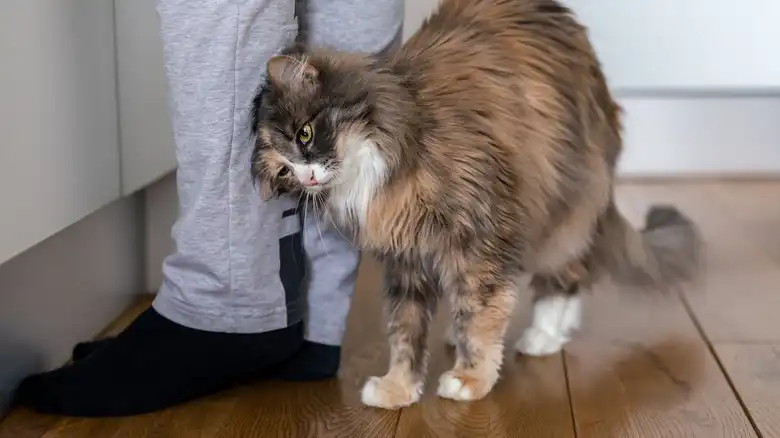
What Is Bunting And Why Does Your Cat Do It?
CatsCat BehaviorWhat Is Bunting And Why Does Your Cat Do It?ByCori ChapmanDec. 25, 2024 9:25 am ESTNataliya Derkach/ShutterstockIf your cat rubs his or her head on you repeatedly, congratulations! You adopted your cat, and now they have adopted you. This behavior is called "bunting," and it is a sign of affection that cats use to mark their territory because they are leaving their scent behind.Cat bunting is essentially a headbutt, and it is performed between cats as well as toward humans. According to Dr. Megan Petroff of Dutch, the motivation behind bunting can range from marking, self-soothing, attention seeking, and learning. "You may see your cat rubbing their face against objects or even people because their cheeks emit pheromones," Dr. Petroff explained. After mixing their scent with their beloved human, cats will bunt to soothe themselves because they are a bit egotistical and like their smell. In other words, it's a sign that your cat has bonded with you.The other common reason for bunting is more obvious: attention-seeking. Your cat may want you to provide more pets or play, so they may bunt you to signal this, as well as engage in other cat behavior, like licking, meowing, purring, and looking up at you. "You reinforce this behavior every time you talk to them, pet them, or give them toys and treats when they bunt you, so if you're trying to prevent your cat from bunting, be aware of how you react," Dr. Petroff included as a warning to cat parents.How bunting can differ in a multicat householdJacques Julien/Getty ImagesIn a multicat household, there are multiple smells mixing with other cats and their human(s). This can create a hierarchy among the cats as they vie for affection and domination. They bunt each other to establish a group scent that signals to other animals that they come as a package deal, including approaching tasks as a team and looking out for one another. The dominant cat will also often bunt to establish their place in the hierarchy. If the dominant cat does the majority of the bunting, other cats may prefer to show affection in other ways, like purring, kneading, or slow blinking (a strategy you can mimic to bond with a feline). Ultimately, it is normal for a cat to use bunting to establish a relationship with a human or another kitty. Responding to a bunt with affection is crucial to maintain that connection with your beloved fur-child.
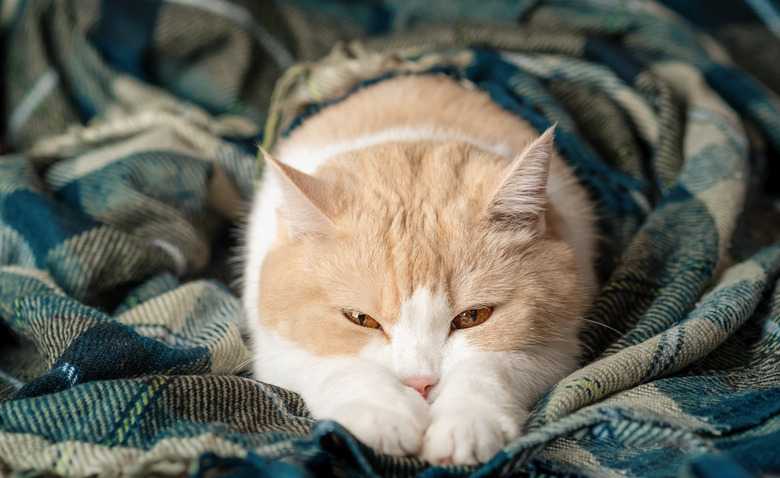
Why Does My Cat Suck On Blankets?
CatsCat BehaviorWhy Does My Cat Suck On Blankets?ByRachel HastingsUpdated Jun 28, 2021It's no secret that cats exhibit many strange behaviors. From rubbing their heads against anything and everything, to kneading, to sitting on you, numerous cat behaviors can cause a cat owner to wonder why their cat is doing what they're doing. A cat or kitten suckling on blanket, or wool sucking, is one such behavior.Osobystist/iStock/GettyImages #e325cd601d3d86419c402c2e9e57d478e, #e325cd601d3d86419c402c2e9e57d478e img { display: block; aspect-ratio: 1.5What is wool sucking?What is wool sucking?Wool sucking occurs when your cat sucks on a blanket or other fabric items, such as a sweater, bathmat, or carpet. Any cat can exhibit wool sucking, but it is most common in Burmese cats, Siamese cats, and Oriental mixed breeds. It is also more prevalent in young cats, specifically those under one year of age.More Like ThisCatsSuckling Behavior in a CatCatsWhy Do Cats Knead Blankets?CatsWhy Doesn't My Cat Like Blankets?Why cats suck on blanketsWhy cats suck on blanketsWhy do cats suck on blankets? One reason cats may suck on blankets is that they were weaned too early as kittens. When a kitten is separated from its mother too soon, you may see the cat nursing on a blanket later to replicate the feeling of nursing. This can be prevented by allowing kittens to stay with their mothers until they're at least 12 weeks old. Even though cats are able to eat solid food at around 6 weeks of age, they may not be physically or emotionally ready to be separated from their mothers or littermates just yet.Another potential cause of a cat suckling a blanket is stress. According to cat behavior expert Pam Johnson-Bennett, a sudden change in the cat's environment, such as a move to a new home or the arrival of a new baby, may cause stress that can lead to wool sucking. Separation anxiety is another stressor that might lead your cat to turn to wool sucking as a coping mechanism.Dietary deficiencies or other underlying medical conditions can also increase the likelihood that your cat will exhibit wool sucking.How to discourage wool suckingMariia Kokorina/iStock/GettyImages #p8133c38107db98617a095d201fefccad, #p8133c38107db98617a095d201fefccad img { aspect-ratio: 6240/3824; height: auto; }How to discourage wool suckingOne way to discourage your cat from sucking on blankets or other wool items is to make these items less accessible. Placing the objects out of reach will prevent your cat from being able to suck on them. Also, if the kitten blanket is in a specific room, such as the bedroom, you can limit your cat's access to the room in question.Another way to decrease your cat's urge to suck on blankets is to make sure they're getting enough playtime. Playing with your cat regularly can distract them from their urge to suck on wool objects while simultaneously relieving stress. You can even initiate playtime when you notice your cat is about to start sucking to divert their focus away from the behavior.You can also take measures to ensure that your cat is adequately stimulated when you're not at home. Consider getting your cat a food-dispensing toy, or rotating your cat's toys every 1 to 3 days to increase usage. Other ways to boost environmental stimulation include providing a cat tree or scratching post so that your cat can displace anxiety through climbing or scratching.When to call the vetWhen to call the vetIn some cats, wool sucking is just occasional. As long as it's only happening every once in a while and the cat isn't chewing or ingesting the material, it's okay to allow them to continue sucking.Linda Raymond/Moment/GettyImages #e614e55462d3ad3a402d5941f458c031a, #e614e55462d3ad3a402d5941f458c031a img { display: block; aspect-ratio: 1.4998615342011However, if the behavior is compulsive and the above measures aren't discouraging the behavior, it may be worth consulting with a veterinarian or cat behavior expert. It's also good to make sure the behavior isn't a symptom of an underlying medical cause.There may be adjustments you can make to your cat's diet as well. Increasing the amount of fiber in their diet can cause them to feel fuller and may help reduce their urge to suck on or ingest fabrics. Discuss these changes with your veterinarian.ReferencesWool Sucking Behavior in CatsCat Behavior Problems – Chewing and Sucking
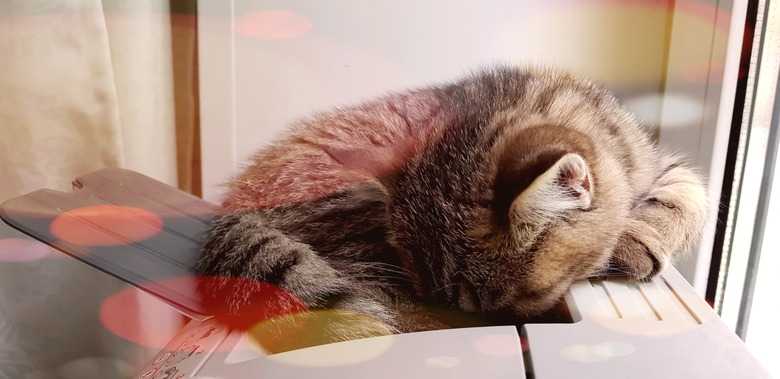
Why Do Cats Like Sleeping On Warm Things?
CatsCat BehaviorWhy Do Cats Like Sleeping On Warm Things?ByKayleigh RobertsJan 29, 2019 1:07 pm ESTMake a mental list of "things cats love." Got it? Is "curling up in a fluffy ball and napping on anything remotely warm" on the list? If it's not, you clearly don't know a ton about cats—but that's okay! We're all learning new things every day! Even if it made the list, however, there's a decent chance you don't actually knowwhycats are so prone to catching z's on any warm surface they can find. Here's a primer on this most common of cat behaviors.Blackzheep/iStock/GettyImages #e037fa349c8704c7aaebef7887a154cae, #e037fa349c8704c7aaebef7887a154cae img { display: block; aspect-ratio: 1.5What is a cat's normal body temperature?What is a cat's normal body temperature?Fun fact: The warm thing your cat is sleeping on might actually feel kind of cool to her.More Like ThisCatsWhat Does it Mean When Your Cat's Ears Are Cold?CatsWhy Do Cats Like to Sleep on Top of You?CatsDoes Your Cat Need a Sweater in Cold Weather?Cats' normal body temperature range is 100.5 to 102.5 degrees, with 101.5 degrees often cited as a definitive "normal" body temperature (the same way 98.6 degrees has become the official "normal" human temperature). With a higher natural body temperature comes a higher tolerance to heat, which is why Fluffy can nap, perfectly content, on your radiator when you've set the temperature to be in the 70s.Do cats seek out warm places more than dogs do?Batalina/iStock/GettyImages #p6a817a2d2ed2d2addf13dc30b7f78164, #p6a817a2d2ed2d2addf13dc30b7f78164 img { aspect-ratio: 4032/1960; height: auto; }Do cats seek out warm places more than dogs do?While many dogs love a good sunbathing session, cats do seek out warm places more than their canine cousins. Like cats, dogs have a higher natural body temperature than humans (theirs is typically in the 101-102 degree range), so they tend to prefer hotter temperatures than we relatively-hairless humans do. Dogs aren't as good at keeping themselves cool and regulating their own body temperature as cats are, however, which is probably why they're less prone to seeking out makeshift heating pads to doze on.Does a cat's fur keep them sufficiently warm?sdominick/iStock/GettyImages #pb12b82e126c2343684ff3b4d33e0498a, #pb12b82e126c2343684ff3b4d33e0498a img { aspect-ratio: 5616/3744; height: auto; }Does a cat's fur keep them sufficiently warm?You might assume that your cat's soft, luscious fur coat mostly functions as a built-in heating system, but that's not totally true. While a cat's fur does help keep them warm in the winter, it also helps keep them cool during times of extreme heat. The fluffiness of the fur creates a little bubble of air around the cat, which protects its skin from the elements, be they hot or cold.Should you ever worry about your cat sleeping on warm things?Should you ever worry about your cat sleeping on warm things?Even though your cat loves to nuzzle up to warm stuff, there can be too much of a good thing. And remember how your kitten's fur coat can help keep her cool in addition to keeping her warm? Well, that can be the source of some trouble when it comes to heat-based napping.Speaking to the Mother Nature Network, cat expert Pamela Merritt explained that "while [cats'] fur is insulating, this can work against them when they use our heat devices. They can cuddle up to something warm, not realize it is getting warmer, and their fur will keep them from noticing until it is quite hot."Anthony Bradshaw/Photographer's Choice/GettyImages #e7eee98b360cbedb5ba5d6f4b49316de2, #e7eee98b360cbedb5ba5d6f4b49316de2 img { display: block; aspect-ratio: 1.1875159887439Short answer: Youshouldkeep an eye on your cat and not let her sleep on something outrageously hot. But, like, duh, right?Are cats ever uncomfortable when they sleep?Are cats ever uncomfortable when they sleep?Based on the range of bizarre positions they sleep in, it probably seems like cats are incapable of discomfort, as long as they're unconscious. In a way, this is kind of true—catscansleep comfortably just about anywhere. This is probably due to their kind-of-sort-of liquid state (seriously—there's science to back up the idea that cats do, at times at least, qualify as liquids).MarynaVoronova/iStock/GettyImages #e03a7cb088bc1bbdeedb37a9f940a2318, #e03a7cb088bc1bbdeedb37a9f940a2318 img { display: block; aspect-ratio: 1.5057142857143So, you can at least take comfort in knowing that if your cat is snoozing somewhere, be it warm or cool, she's comfy and you don't need to worry (unless you need your laptop, of course).
Calming A Cat With Gravol
CatsCat BehaviorCalming A Cat With GravolByLaura PayneUpdated Jul 20, 2010Zonf/iStock/Getty Images #p2199d52f712ef6388ff415c1d212cc81, #p2199d52f712ef6388ff415c1d212cc81 img { aspect-ratio: 3264/2176; height: auto; }Gravol is a medication designed to help children and adults with motion sickness, and it has been effective for use with cats and dogs, too. It is not considered a veterinary medicine, though; let your vet explain whether it's suitable for your cat and how much to give.How Gravol WorksHirokazu Aoyama/a.collectionRF/amana images/Getty Images #pf0bb8867cacfa2466470c8ddb2e4962c, #pf0bb8867cacfa2466470c8ddb2e4962c img { aspect-ratio: 2001/1501; height: auto; }How Gravol WorksGravol is a brand name for an antihistamine called dimenhydrinate. Another brand name for dimenhydrinate that you may have heard of is Dramamine. Dimenhydrinate works by preventing the sensory system of the inner ears from being overstimulated. This is the part of the ears that is responsible for balance and motion — and preventing overstimulation can help prevent motion sickness. Antihistamines are also known for causing drowsiness in some people, and it has been found to calm some cats.How to Administer GravolHow to Administer GravolYou must let your vet make dosage decisions for Gravol; you can't be sure the package directions will apply to your cat. Administer Gravol at least a half-hour before traveling. Getting cats to take pills is not an easy task. One method is to hide the pill in a treat. Other methods are giving the pill by hand and using a pill popper. A pill popper looks like a syringe but is longer and larger. Using a pill popper makes it easy to get the pill to the back of your cat's throat, causing the cat to naturally swallow.Other Uses for GravolKumiko Campos/iStock/Getty Images #p54a8f3f9438ff91fdead5cb3c5e1a0a0, #p54a8f3f9438ff91fdead5cb3c5e1a0a0 img { aspect-ratio: 3600/2400; height: auto; }Other Uses for GravolIn addition to helping with motion sickness, antihistamines appear to have a calming affect that can help with anxiety, too, according to veterinarian Jason Nicholas. Ask your veterinarian about using Gravol to help your cat in other stressful situations, too. Things that are not part of a cat's normal routine often cause the cat to feel uncomfortable and anxious. Going to the groomer, having unfamiliar people over to your house, and adding a family member or another pet are examples of situations that may cause a cat discomfort. Consult your veterinarian before giving Gravol for any situation.Potential Side Effects of Gravoldeeepblue/iStock/Getty Images #pce18be2d08854f7ea34f70cf17a7a831, #pce18be2d08854f7ea34f70cf17a7a831 img { aspect-ratio: 2122/1415; height: auto; }Potential Side Effects of GravolWatch for some potential side effects. If your cat has an allergic reaction to the drug, you may notice weakness, lethargy, loss of appetite, vomiting or diarrhea. A severe allergic reaction can result in difficulty breathing or loss of consciousness. Contact your veterinarian immediately if you notice any such reaction.A Natural OptionStockbyte/Stockbyte/Getty Images #p112a68e5c0f63ee4dd5767a871de0220, #p112a68e5c0f63ee4dd5767a871de0220 img { aspect-ratio: 1818/1652; height: auto; }A Natural OptionGinger is known to be a natural remedy for motion sickness, and it also has other health benefits for both humans and cats. Karen Rosenfeld, the Ottowa Valley Dog Whisperer, says ginger can help cats and dogs with pain, arthritis, gas, coughing, bronchitis, loss of appetite and more. The Gravol brand stable includes a natural formula made with ginger; it does not contain dimenhydrinate. You should also consult your veterinarian before using ginger for your cat.ReferencesPetPlace.com: Dimenhydrinate (Dramamine)Life With Dogs: How to Prevent Travel Anxiety and Carsickness in DogsOttowa Valley Dog Whisperer: Ginger – Herbs for Dogs and CatsGravol: ProductsAll Feline Hospital: Pilling Your Cat
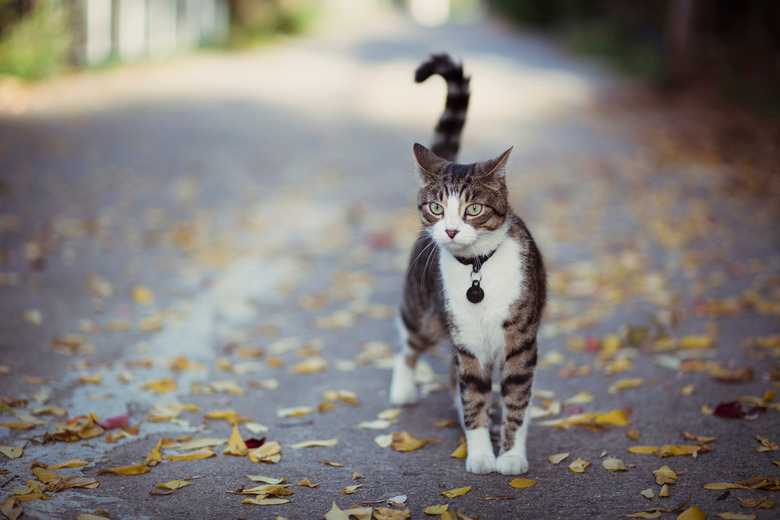
What Does It Mean When A Cat's Tail Vibrates?
CatsCat BehaviorWhat Does It Mean When A Cat's Tail Vibrates?BySusan ParettsUpdated Sep 18, 2018Linda Raymond/Moment/GettyImages #p58527710049c2a675d793ec805133ee3, #p58527710049c2a675d793ec805133ee3 img { aspect-ratio: 5760/3840; height: auto; }One minute your cat is lounging around dreaming of catnip and the next he's awake and his tail is vibrating. But what do those tail movements mean and what is your cat trying to tell you? In addition to their adorable meows and other vocalizations, cats do most of their communication with body language, which includes their posture, eyes, ears, and — most importantly — their tails. So keep an eye on your feline's tail, because it has quite the tale to tell.About to mark territoryAbout to mark territoryCats are territorial and will sometimes spray their turf with urine. If you notice that your cat's tail is vibrating and pointing straight up in the air, he may be about to mark his territory with a spray of urine, says the American Society for the Prevention of Cruelty to Animals. This behavior is most common in un-neutered cats who use their scent to attract a mate. The urine spray sends a clear message to potential rivals to buzz off.If your cat tends to spray urine around your home, you can try to redirect his behavior by putting him in the litter box when his tail is vibrating. Most importantly, get him neutered or get your female cat spayed. The majority of the time, this solves any unwanted marking behaviors, meaning you won't have to watch out for a vibrating tail.More Like ThisCatsWhat Is Your Cat's Body Language Telling You?CatsHow to Read Your Cat's Tail MovementsCats7 Fascinating Facts About Cats' TailsYou'll also want to visit the vet with your cat if he's suddenly started to spray and is already neutered. It could indicate that he's suffering from an illness. And, if he's just a bit stressed out, your vet can prescribe medication for him to calm him down.Giving you good vibrationsGiving you good vibrationsA playful cat will usually be moving her tail a bit, back and forth, twitching it to signify that she's interested in something. She may be paying attention to you or maybe she's watching something engaging outside the window that she wants to hunt such as a bird or a bug.Check out the rest of your cat's body language to determine if the movements are positive. If she's not hissing, her fur is not puffed up, and her vocalizations are her normal, everyday meows, then she's likely just excited or engaged with you or something else. You'll likely notice some good tail vibrations during playtime, when she twitches her tail just before attacking a toy, which shows you how happy she is, according to Vetstreet.Avoid the rapid swishAvoid the rapid swishIf you're spending time with your cat and he starts to swish his tail around rapidly, it's time to give him a little space. That's because he's likely agitated by something or someone and a rapidly moving tail is the telltale sign of his upset, warns The Humane Society of the United States. The more rapidly that tail moves, the more agitated and anxious your cat may be.You may also notice other signs that he's upset like flattened ears, puffed-up fur, and dilated pupils. He might also give you a warning hiss or growl, too, depending on how agitated or stimulated he is.Don't worry, though, once you give your cat a little time alone, he should calm down and so should his tail. He'll be back to his usual purring self in no time.Vibrating tail while snoozingVibrating tail while snoozingYou may notice that when your cat is napping, her body — including her whiskers, feet, and tail — vibrate. This may mean that your cat is dreaming of something interesting like chasing a favorite toy or rolling in a bed of catnip, according to National Geographic.A vibrating tail while snoozing could also mean that your cat isn't quite asleep and is simply relaxing but still aware of something that's caught her interest. You might notice this happens when your cat seems to be sleeping in the window but there's a bird chirping outside, or she hears some other interesting sound. She's using her tail to let you know that she's on the case of whatever is causing that sound and not quite off to dreamland just yet.ReferencesThe Humane Society of the United States: Cat Chat: Understanding Feline LanguageVetstreet: 5 Keys to Decoding Your Cat's Body LanguageAnimal College of Veterinary Behaviorists: Behavior Tips — Basic Feline Body LanguageAmerican Society for the Prevention of Cruelty to Animals: Urine Marking in CatsNational Geographic: Here's What Your Cat's Tail is Trying to Tell You
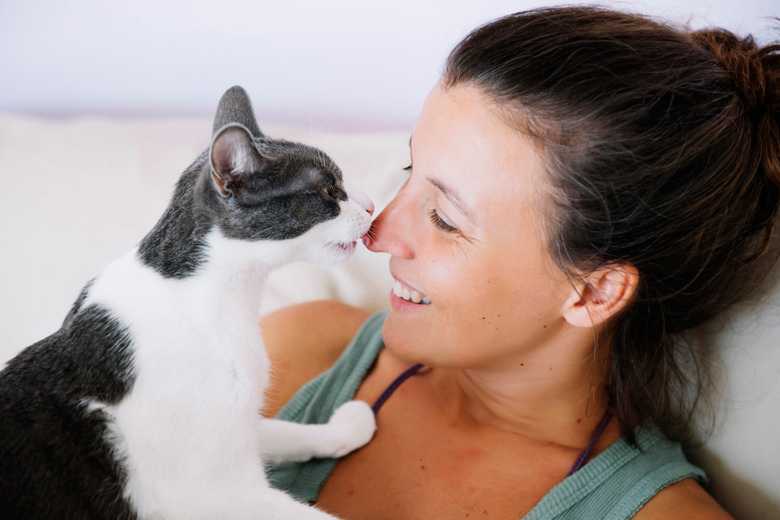
Why Does My Cat Lick Me When I Pet Her?
CatsCat BehaviorWhy Does My Cat Lick Me When I Pet Her?BySarah Jeanne TerryOct 31, 2019 4:07 pm ESTOn a lazy Saturday afternoon, you probably love nothing more than a good snuggle with your kitty. When your cat snuggles in your lap, there's no better sensation than stroking that soft fur and hearing your cat happily purr. However, purring isn't the only way that our cats respond to petting. Some cats lick us. It doesn't matter what position they're in or where they are being pet, without fail, our cats have to find a way to lick their humans in response to being pet. And why is that? We dug into the body language and science behind our cats' tendency to lick us when we pet them to understand a little of their behavior.What exactly does it mean when my cat licks me?Volanthevist/Moment/GettyImages #p38329d81b34e4b103c711d8e57ecc4fe, #p38329d81b34e4b103c711d8e57ecc4fe img { aspect-ratio: 6016/4016; height: auto; }What exactly does it mean when my cat licks me?More Like ThisCatsWhy Do Cats Like Being Pet on Their Heads?CatsWhy Do Cats Groom Themselves After You Pet Them?CatsWhy Do Some Cats Lick When You Scratch Their Backs?First of all, it's important to know that cats lick for more reasons than we humans might imagine. We tend to usually just classify licks as "kisses," and, while kitty licks are a sign of affection, they also represent much more than that. Cats don't just lick you to say, "I love you," but also to claim you as their own. Their saliva contains pheromones that leave a scent trail that suggests to other animals that you are taken. They also lick as an important part of social bonding and grooming habits. Cats often socialize by grooming one another, and they want to socialize with their humans too.What does petting mean to your cat?Konstantin Aksenov/iStock/GettyImages #p19734ddde8540e46d66fbef6e5230df9, #p19734ddde8540e46d66fbef6e5230df9 img { aspect-ratio: 5472/3648; height: auto; }What does petting mean to your cat?Because cats are our pets, we naturally assume that they love being pet. However, the truth, as everything with cats, is a little more complicated. A study in the Applied Animal Behavior Science journal analyzed where and how cats like to be pet, because there wasn't a lot of scientific evidence about cats and physical touch.For the study, scientists filmed cats' reactions to being petted in different areas, as well as their reactions to their own humans versus strangers. The study showed that cats prefer to be pet in the areas where they might practice social grooming – their cheeks, their ears, between their eyes and their chins. So for your kitty, it's safe to assume that when you pet them, they're experiencing similar social cues and bonding that they experience when they socially groom with other felines.Your cat may lick you when you pet her because she thinks you're socially grooming each other.Viola Tavazzani Photography/Moment/GettyImages #p6c6697fb08bedc748a882a47a8772703, #p6c6697fb08bedc748a882a47a8772703 img { aspect-ratio: 4256/2832; height: auto; }Your cat may lick you when you pet her because she thinks you're socially grooming each other.When your cat licks you while you pet her, one of the most common reasons is that she's trying to socially groom. As in the study above, cats love to be pet in certain areas, because those areas are likely associated with their instincts to create social bonds by grooming one another. Though you're not a cat, your cat may feel like you're improving and building on your social bonds when you pet her. And perhaps she wants to return the favor.But cats don't groom one another with their paws, they use their tongues. In fact, that's what a cat's tongue is made for. When you feel her reach out and graze you with her sandpaper-like tongue and wonder why it feels like that, the answer is for grooming. According to assistant curator of great cats at the National Zoo, Leigh Pitsko, "Their tongue is actually like sandpaper. They have tiny hooks called papillae. When they glide across the fur, it acts like a comb." She explains that these hooks help to detangle fur, so they work perfectly for cats' fur, even if they feel a bit rough on human skin.Unless your hands and arms are incredibly hairy, your kitty probably isn't doing much to keep you well groomed. However, she is doing you another service. She is attempting to reaffirm and strengthen your social bond as she would with one of her own kind. When another cat licks her as part of social grooming, she would lick back. She's trying to pay you back for the favor of petting her by offering you a little grooming in return.She wants your pets only for herself.vladans/iStock/GettyImages #ea0477fd40970f66c6b2044e86c3ca965, #ea0477fd40970f66c6b2044e86c3ca965 img { display: block; aspect-ratio: 1.5A cat's licks and affection may not only be a generous way to show their humans they care. They may also be marking their territory and signaling to other animals that you're their property. While we often think of a pet marking its territory through peeing, cats can also leave behind pheromones in their saliva. This scent marks you and shows how much your cat wants to connect with you.Cats are big on family, and they like to mingle their scents with the smells of their family members to create a unified, family scent. This helps them to build their family group and feel comfortable. When your kitty licks you, she's inviting you into her family and creating a family scent.So, to answer your question, the licking is perfectly normal.Faba-Photograhpy/Moment/GettyImages #e01e2b8b3b2119ebf8fed14c12de306d7, #e01e2b8b3b2119ebf8fed14c12de306d7 img { display: block; aspect-ratio: 1.3325109649123Overall, your cat's tendency to lick you whenever you pet her is a positive sign. She is most likely licking you to grow closer and form tighter bonds. So you can feel good each time you feel that rough little sandpaper tongue that you and your kitty are becoming closer and happier and snugglier together.
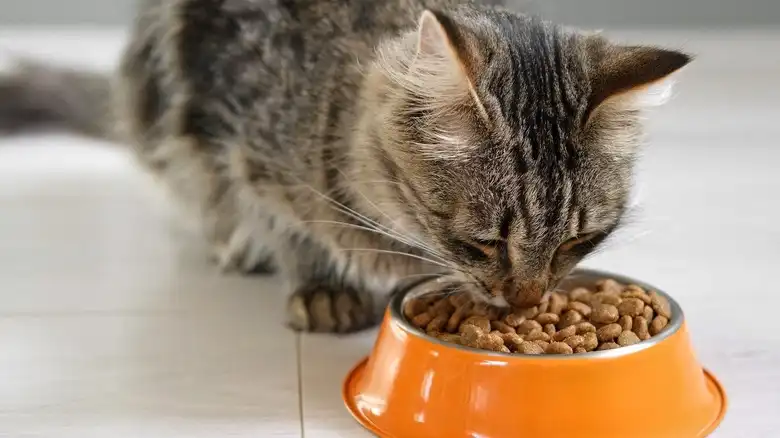
What Is Whisker Fatigue And Is It Real? Here's What We Know
CatsCat HealthWhat Is Whisker Fatigue And Is It Real? Here's What We KnowByJessica DesrosiersNov. 23, 2024 9:25 am ESTMarina Demidiuk/ShutterstockWe may receive a commission on purchases made from links.Has your cat shown less interest in their food lately or only been eating out of the center of the bowl? Whisker fatigue, also known as whisker stress, is one possible cause. However, there's some debate over whether or not whisker stress actually exists, spurring conversation between pet parents and their veterinarians. While a 2020 study in the Journal of Feline Medicine and Surgery found that there was no preference for whisker-friendly bowls over regular ones, other experts, such as cat behaviorist Jackson Galaxy, assure that it's a real problem.Whiskers are sensitive organs that help cats move around their environments. When those whiskers receive constant information, such as through brushing against the food bowl, it may cause overstimulation. This can show up in many ways, mainly as behavioral changes. Your cat may not want to eat, pace in front of the bowl, paw at it, or dump their food onto the floor. They could also seem stressed out or less interested in their typical activities. What to do if you suspect your cat has whisker fatigueIlionescu Corneliu / 500px/Getty ImagesIt's important to keep in mind that just because your cat is behaving differently around their food, it doesn't mean they're experiencing whisker fatigue. Speaking to Wag, veterinarian, Dr. Linda Simon explained, "Whisker stress is not something I have encountered in practice." This may suggest that something else is the cause behind a cat's disinterest in their food. For this reason, you'll want to rule out any health issues that may have led to their behavioral changes. This includes dental problems such as plaque or tartar buildup, gum disease, facial pain, and food allergies.Once your cat has checked out as healthy, try making a few changes at home to keep your feline happier at mealtimes. Oklahoma State University Veterinary Medical Hospital recommends buying a flat food bowl that your kitty's whiskers won't come into contact with. You can pick up a two-pack of CatGuru Whisker Stress Free Bowls on Amazon. Your feline friend may also benefit from some cat puzzle toys that provide extra enrichment and fun when eating. Look for a flat toy that doesn't brush their face, or one that allows them to interact with their paws. This can give their whiskers a rest while they eat. It's also important that you don't trim your cat's whiskers, as this can cause them pain and discomfort.
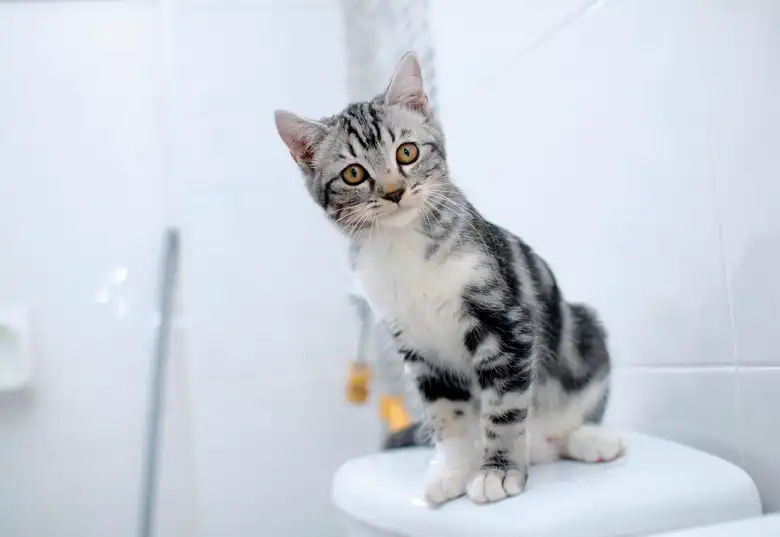
Why Does My Cat Follow Me To The Bathroom?
CatsCat BehaviorWhy Does My Cat Follow Me To The Bathroom?ByAllegra RingoUpdated Aug 19, 2023ronen/iStock/GettyImages #p310496527d02b7aa11923890001e5504, #p310496527d02b7aa11923890001e5504 img { aspect-ratio: 3600/2483; height: auto; } In This ArticleNew cat or new environmentVulnerabilityCuriosityHistory of reinforcementThey just like youPreventionThe bottom lineMost cat parents know that cats can be real creeps. One of their commonly-reported creepy behaviors is the habit of following their parents to the bathroom. Why do some cats do this?It turns out that some cats are big fans of following their owners everywhere. Their reasons for following you to the bathroom are probably similar to their reasons for following you in general. Though veterinarians and scientists haven't come to any definitive conclusion, there are several theories that might explain why your cat is so keen on following you to the bathroom.Okssi68/iStock/GettyImages #e8ac7a482c49f7b29dd881719633d44b9, #e8ac7a482c49f7b29dd881719633d44b9 img { display: block; aspect-ratio: 1.6243902439024New cat or new environmentNew cat or new environmentIf your cat is a new family member, they might be feeling scared because of the recent upheavals in their life, and look to you as a source of comfort. Similarly, if you recently moved or even just rearranged your furniture, your cat might feel scared or stressed, and might follow you around for the comfort you provide.If this is the case, it is likely temporary. Be patient with your cat and give them lots of comfort and mental stimulation to offset the stress!More Like ThisCats14 Photos That Will Cat-apult Your Laughter Levels to New HeightsOther AnimalsThese 19 Animal Pictures Will Touch Your Heart So HardDogs20 Dogs Who Would Like You To Wake Up NowSeregraff/iStock/GettyImages #e82ea8859283a22c2bb09ba7e20ed956c, #e82ea8859283a22c2bb09ba7e20ed956c img { display: block; aspect-ratio: 1.5VulnerabilityVulnerabilityCats may feel vulnerable without you. Cats are predators, but they are also prey, and they are aware of that. Since you are a source of safety and comfort, your cat might feel less safe when you're behind closed doors, and prefer to accompany you to the bathroom, where they can continue to take advantage of the safety you provide.CuriosityCuriosityCuriosity may also play a role in a cat's bathroom-following habits (like it does with many cat behaviors!). Cats are visual hunters, and as such, they like to use their vision to keep track of where things are. When you close the door to the bathroom, you are doing something mysterious behind it, and your cat may feel compelled to get to the bottom of this. What if you're doing something cool or pertinent to their lives?Nico De Pasquale Photography/Moment/GettyImages #eb0a59de04e4594a185f73b2b6b35fa6c, #eb0a59de04e4594a185f73b2b6b35fa6c img { display: block; aspect-ratio: 1.499245852187History of reinforcementHistory of reinforcementCats learn quickly that when a human is seated in the bathroom, they can't go anywhere! Plus, most bathrooms have a counter conveniently located at cat-petting level. This is a great setup for cats, as you have to pet them on their terms, and you cannot leave.You may have accidentally reinforced your cat's behavior of following you into the bathroom by petting them or giving them attention once they're in there. If your cat being in there with you doesn't bother you, this isn't a problem. However, if it does bother you (or if it bothers other people when they're in there), make an effort to stop giving your cat attention when they follow you into the bathroom. You can also give your cat something to do in a room far away from the bathroom, like a puzzle or just a scatter of treats on the floor. That way, they can stay occupied while you're in there.Melissa Ross/Moment/GettyImages #e0263c4f1430e4ef3b43a7d5cdc767343, #e0263c4f1430e4ef3b43a7d5cdc767343 img { display: block; aspect-ratio: 1.4980079681275They just like youThey just like youA lot of cat behaviors can be explained by the fact that they simply like you and want to be where you are. Domestic cats' lives are fairly uneventful, and you're probably the most entertaining thing in the room most of the time. Your cat may want to follow you to the bathroom to see what entertaining thing you do next. What if you do something really cool in there and they miss it?How to keep your cat from following you to the bathroomHow to keep your cat from following you to the bathroomIf you don't want your cat to continue following you into the bathroom, or if you have housemates who don't want this, make sure you don't pet your cat or give them attention when they come into the bathroom with you. Ask your housemates to do the same. Don't punish the cat, but don't provide attention when in the bathroom.You can ward off cat boredom by keeping your cat stimulated with lots of playtime and fun enrichment activities. Try setting up one of these activities, such as a puzzle toy, before you head to the bathroom, to give your cat something to do that's away from the bathroom area. In general, try to ignore your cat in the bathroom, and reward the cat when out of the bathroom.Melissa Ross/Moment/GettyImages #ef45eeaf9da08ad7b5a0c33a4e5e41edd, #ef45eeaf9da08ad7b5a0c33a4e5e41edd img { display: block; aspect-ratio: 1.3333333333333The bottom lineThe bottom lineCats may follow you to the bathroom because you're "trapped" when you're in there, because of a history of reinforcement, because they are new to your home or to this environment, or because they just like you and find you interesting. If this behavior doesn't bother you, you don't have to do anything about it! If it does bother you, try not to give your cat attention while you're in the bathroom, and give them something to do in another room when you're using the facilities.ReferencesAnimal Eye Group: How Does Your Cat See the World?
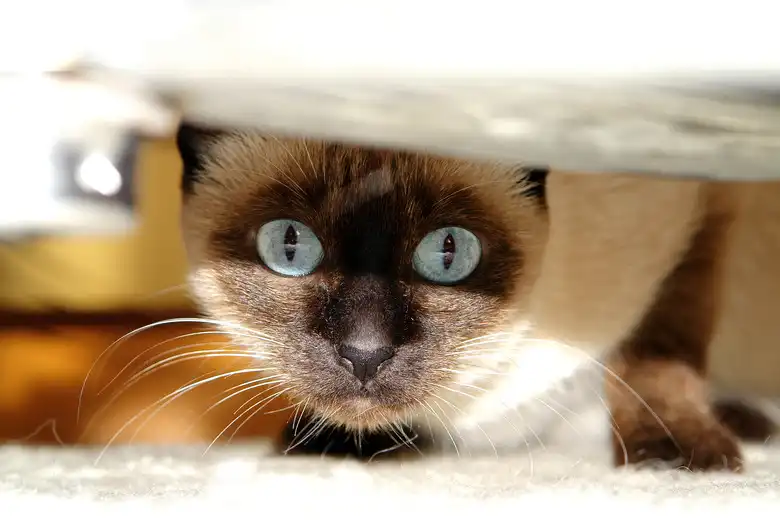
Cat Hiding Under Bed: Why Does My Cat Hide Under The Bed?
CatsCat BehaviorCat Hiding Under Bed: Why Does My Cat Hide Under The Bed?ByCatherine ArmstrongUpdated Apr 17, 2023Dejan Petkovski/iStock/Getty Images #p5f373f1628a0b1181d5e6895961c7c67, #p5f373f1628a0b1181d5e6895961c7c67 img { aspect-ratio: 3264/2176; height: auto; }If your cat is hiding under the bed, it may be a simple matter of preference, or because he's temporarily overwhelmed and needs a little break. If separating himself from the family is out of character, a cat hiding under the bed all day may be a sign of illness or injury and may require intervention.TipCats hide under beds for a variety of reasons, including fear, illness or just the need for some personal space.It just joined the familyIt just joined the familyWhen you first bring your new cat home, he may immediately retreat to the space under the bed, as far from your reach as he can get. For a cat, hiding under the bed (or other hidden spots) is natural; some cats hide for a few days because their new environment is unfamiliar and scary.An adult cat with past trauma may need more time to adjust than a new kitten who is simply shy and timid. Leave food, water, and a litter box in the bedroom for the first day or two while your cat adjusts to life with his new family.If you're bringing a new cat home, you might prepare for this type of behavior by checking under your beds to make sure the spaces are safe, or you might block them off or close the door to the room.Your cat likes alone timeYour cat likes alone timeEvery cat is an individual with his own personality traits. Some cats enjoy lots of physical contact and prefer to perch in spots where they can keep an eye on things. Others are more independent or aloof, and spend time away from the hustle and bustle of a busy household. Many cats feel secure in tight spaces, so a cozy spot under the bed works well for a little break. If your cat enjoys an occasional sabbatical under the bed, give him some space; he'll be back to hang out with the family when he's ready.Cats sleep about 15 hours a day, so if your cat is hanging out under the bed a lot, it could just mean that's their preferred spot for their cat naps. If your're not noticing any other troubling signs that might suggest he's injured, it could be that he's just enjoying the dark, cool, cave-like space.tihomir_todorov/iStock/GettyImages #ec425c7eeef9f2b22d7e02bcf8fa8bc3e, #ec425c7eeef9f2b22d7e02bcf8fa8bc3e img { display: block; aspect-ratio: 1.4980079681275The cat is frightenedThe cat is frightenedCats often retreat under beds when they are afraid. A loud noise, such as a dish shattering on the floor, results in varying behaviors depending on your cat's personality. He may react with nothing more than a feline look of disdain, or if he's a fraidy cat, he may bolt in terror to hide under the bed for the remainder of the evening.A naturally anxious cat might hide every time there's a loud noise or an unfamiliar visitor. It's fine to let your cat retreat to his under-the-bed spot, but don't punish his behavior. Instead, speak to him in a calm, quiet voice and allow him to emerge from hiding when he's ready.Your cat is sickLeePeers/iStock/GettyImages #p2f53584a4a3ab2613fe660b760ab01ac, #p2f53584a4a3ab2613fe660b760ab01ac img { aspect-ratio: 3888/2592; height: auto; }Your cat is sickIt's natural instinct for cats to hide illnesses and injuries from their owners. If they're unable to act normally, they may hide in the quiet, enclosed space under the bed. Pay attention to your cat's daily habits and watch for changes in his behavior.Signs of illness include eating or drinking less or more than normal, vomiting, coughing, diarrhea or constipation, and lethargy. An injured cat may have visible wounds or engage in other behaviors such as excessive purring or grooming. If your cat exhibits any of these signs, or you suspect he may be injured, take him immediately to the veterinarian.ReferencesFeliway: What Does It Mean If My Cat Hides Under the Bed?Feline Behavior Solutions: Hiding Behavior in CatsBrittanica: Why Do Cats Sleep So Much?
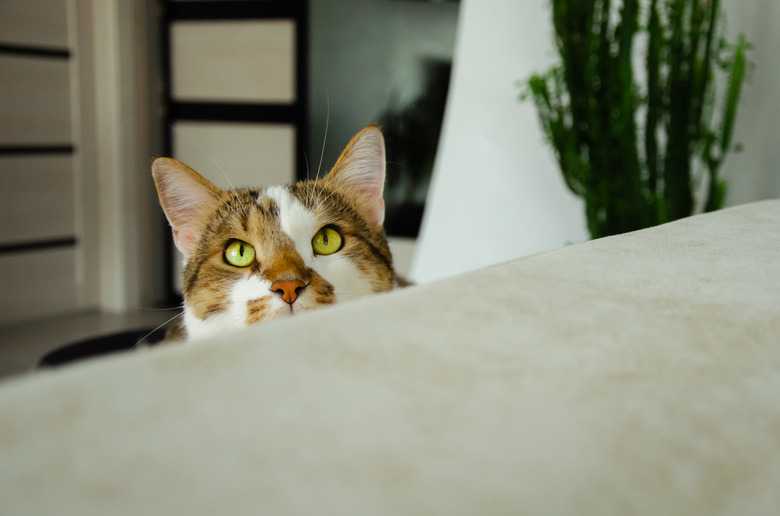
How To Get Your Cat To Sleep With You
CatsCat BehaviorHow To Get Your Cat To Sleep With YouByBarbara Bean-MellingerUpdated Aug 31, 2021Cats are not shy about playing favorites, and they tend to sleep with their favorite person. Since they're always interested in a meal or snack, their favorite person is usually the one who feeds them, cares for them, and makes time to play with them. If your cat isn't cuddling up next to you at bedtime, there are changes you can make to get your cat to sleep with you.netjens/iStock/Getty Images #e8d8a44d8dfd772f1a2a91cd3c08c1915, #e8d8a44d8dfd772f1a2a91cd3c08c1915 img { display: block; aspect-ratio: 1.4996466431095A cat's favorite personA cat's favorite personIf you are not your cat's favorite, step up your interaction with him. Make time to sit with him on your lap and pet him — not just for a few minutes but for prolonged periods of time every day. Talk to him and play with him if he likes to play. Buy or make new toys, like a large button attached to a string, a simple ball of yarn, or rolled-up paper, and roll or drag it past him or back and forth to get him to pounce on it and play. Give him healthy treats now and then; just be sure to account for the treats' calories in his diet.Cats like warmth when they sleep, so make a cozy spot on your bed into which she can burrow, like a pile of blankets or what looks like clean clothes. Avoid leading her to it; let her think she found it herself. If that works for a few nights but she then sleeps elsewhere, move the cozy pile and change out the blankets or pillows.Give them an escape routeValiantsina Halushka/iStock/GettyImages #pddf31c35cde79bc6a21d5aaff5e45f99, #pddf31c35cde79bc6a21d5aaff5e45f99 img { aspect-ratio: 4000/2649; height: auto; }Give them an escape routeCats like to sleep where they feel safe, which is one reason they choose their favorite person: They trust and feel safe with that person. If he does decide to cuddle up on your bed with you, keep yourself from snuggling him too tightly or wrapping your arm around him, which he may find stifling. Let him know he is free to go any time by leaving the door open enough for him to slink out.Don't expect company every nightDon't expect company every nightJust when you think you've become the favorite and your cat has slept with you not once but several times, you will find her spot cold the next night. Don't be alarmed. Even if your cat accepts your invitation and sleeps with you several nights in a row, be prepared to be without her some nights too. Cats like to change up their sleeping spots to remind you who calls the shots. They are also daytime nappers who get up and wander in the night, so it's rare that she will sleep with you the whole night through.Know the pros and consKnow the pros and consIf you are allergic to cats, sleeping with them is not a good idea. While allergists would prefer you not have a cat at all, if you do have one, they recommend closing your bedroom door so the cat doesn't come in. For nonallergic cat owners who like the idea of sleeping together, many end up finding it less than ideal. Some say cuddling up to their favorite purring machine helps them fall asleep quicker than when they sleep alone. Staying asleep, however, is another matter.Most cats do the majority of their sleeping during daytime naps, so by nighttime, they have a burst of energy. They may think it's playtime and want you to join in. If their gentle pats on your face don't rouse you from your slumber, their constant coming and going along with jumping on and off the bed can cause you to have disrupted, restless sleep.malyshkamju/iStock/GettyImages #eba02ee9ee5cd6859b860240749afc17d, #eba02ee9ee5cd6859b860240749afc17d img { display: block; aspect-ratio: 1.5Understand too that while sleeping with your cat, you're also sleeping with any fleas or intestinal parasites he may be carrying. While fleas don't infest humans, they can bite you and leave welts. Some viruses can be transferred from cats to humans and vice versa. On the other hand, petting and cuddling your cat after a stressful day releases hormones that reduce anxiety and lower your heart rate, so sleeping with your cat can be good for your health.ReferencesUnion Lake Veterinary Hospital & Pet Services: How Cats Choose Who to Sleep WithFeline Rescue: Should You Allow Your Cat to Sleep in Your BedReader's Digest: Is It OK to Let Your Cat Sleep in Your Bed?
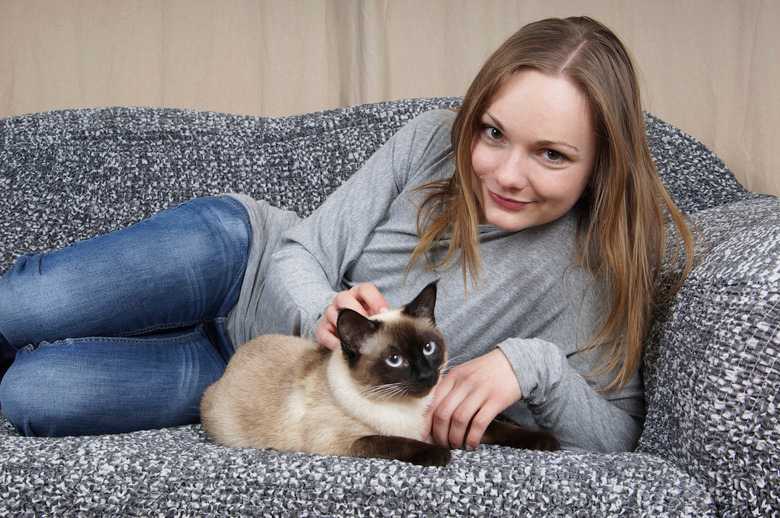
How To Tell If Your Cat Likes You
CatsCat BehaviorHow To Tell If Your Cat Likes YouByKay WikiApr 30, 2010 11:16 am ESTaxelbueckert/iStock/Getty Images #pe18653ba878ef154f2272ae068ea5f23, #pe18653ba878ef154f2272ae068ea5f23 img { aspect-ratio: 2126/1413; height: auto; }Cats are intelligent animals that are capable of feeling emotions toward their owners. Some cats love their owners while others may feel indifferent or even dislike the people in their home. Fortunately, there are ways you can determine how your cat truly feels about you.MORE: HOW TO GET A CAT TO LIKE YOUAccording to Fact Monster, cats are not spiteful animals. If your cat does something that is out of the ordinary such as not using its litter box, it doesn't necessarily mean that your cat is trying to seek revenge on you. There may be a health problem attached to this behavior. Growling, spitting, and hissing are indications that a cat is angry, aggressive, or annoyed. If your cat exhibits this behavior toward you, you may want to consult a vet or an animal behavior specialist.mercedes rancaño/iStock/Getty Images #pe7414d31d8a648721bdb0153b314d1ea, #pe7414d31d8a648721bdb0153b314d1ea img { aspect-ratio: 2122/1415; height: auto; }Step 1Observe the way your cat greets you. One telltale sign of a cat's affection is contingent on how they respond to you when you arrive home. A cat that likes you will greet you at the door. It isn't uncommon for a dog to greet his owner at the door, but a cat that loves his family may exhibit the same behavior. In general, cats are social creatures and enjoy being around people that they like.Step 2Julija/iStock/Getty Images #e5d1c9425232c7f89d749efe71f78ae9e, #e5d1c9425232c7f89d749efe71f78ae9e img { display: block; aspect-ratio: 1.4996466431095Use petting to gauge emotion. A cat open to friendship may also rub against you. In some cases, the cat may even raise his or her body toward your hand when you attempt to pet the cat. It may seem strange, but a cat may also lick you if he likes you. Cats lick each other and their owners as a way to groom and bond together.Step 3aimy27feb/iStock/Getty Images #e04bbca093f7276aac505bf969ea8dcba, #e04bbca093f7276aac505bf969ea8dcba img { display: block; aspect-ratio: 1.779830638953Listen for purring. Some cats purr to indicate their happiness. If a cat is happy living in your home, purring will be a way that the cat demonstrates affection. According to Drs. Foster and Smith, in some cases purring can also be a signal that the cat is sick or distressed. Some cats also purr to calm and reassure themselves.Step 4Michael Weirauch/iStock/Getty Images #eb88e683f2d6040ca16a83d5d3f090d62, #eb88e683f2d6040ca16a83d5d3f090d62 img { display: block; aspect-ratio: 1.5099290780142Understand the personality of your cat. If your cat is not particularly affectionate, it doesn't necessarily mean that your cat doesn't like you. Some cats are simply aloof and have a personality in which they don't seem to care about their owners. These types of cats usually want the owner around only when it's time to eat.ReferencesDrs. Foster and Smith: Why Do Cats Purr?Cat Chat: Understanding Feline LanguageFact Monster: You and Your Cat
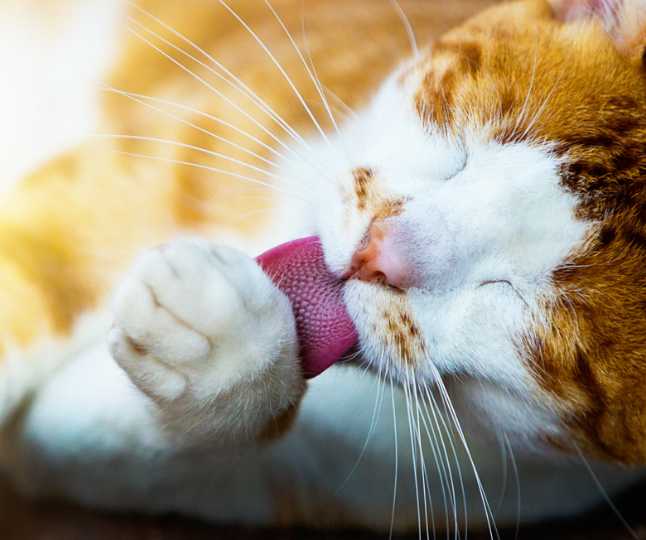
Why Do Cats Groom Themselves After You Pet Them?
CatsCat BehaviorWhy Do Cats Groom Themselves After You Pet Them?BySarah Jeanne TerryDec 27, 2020 12:02 pm ESTThough cat behavior will always be a bit of a mystery to humans, their many contradictions will always keep people on their toes. When you're having a cozy day petting your kitty, you might be confused when after you stop petting, your cat starts grooming themselves. Even though it seems like you were sort of doing something like grooming, cats lick and groom themselves afterwards. Cat grooming is something you've probably seen your cat do plenty of times, but why do they groom themselves after you've already been petting them? As usual with cats, there are many possible explanations.Your cat may be grooming just to groomRapidEye/iStock/GettyImages #pdf854a8834c670d941cadf57b3ca0f37, #pdf854a8834c670d941cadf57b3ca0f37 img { aspect-ratio: 2505/2096; height: auto; }Your cat may be grooming just to groomThe simplest answer to your cat grooming after you pet them is that they just want to. Cats clean and groom themselves a lot. According to VCA Hospitals, cats spend as much as 30% to 50% of their time doing some kind of grooming behavior.More Like ThisCatsWhy Does My Cat Bite Me When I Stop Petting Her?CatsWhy Does My Cat Lick Me When I Pet Her?CatsWhy Is Regular Cat Grooming Important?Whether it's licking their front paws, their back or the rest of their body, cats are actually designed for grooming. Their tongues are covered in thousands of tiny spines, called pappillae. These tiny spines are perfectly designed to comb through their fine hair. Grooming also helps cats to remove anything like parasites or other outside elements from their fur, and it distributes their natural oils throughout their coat and skin to keep their coat healthy. So even though your petting session may be really cozy, it may be interrupting your cat's regularly scheduled grooming.Your cat may be doing mutual grooming with youmegatronservizi/iStock/GettyImages #p0f021ae431102fa184bf305f1b08fd51, #p0f021ae431102fa184bf305f1b08fd51 img { aspect-ratio: 4605/6899; height: auto; }Your cat may be doing mutual grooming with youAnother possible explanation for your cat's behavior is that your kitty might be trying to join in on the grooming party. Cats learn to groom themselves from an early age, usually taught by their mother. Their mama cat grooms them and teaches her kittens to groom each other as well, which is known as mutual grooming. There's a lot of evidence that cats see humans as a big cat, like a mother or sibling figure. So when they start grooming themselves after you've been petting them, your cat may be trying to recreate that kind of bonding. They're showing you that they care and that they think of you as a part of their kitty family.Cats may not like petting as much as you thinkNatasa Ivancev/iStock/GettyImages #p905b9fbd647d87fbcd39b30415b8cddc, #p905b9fbd647d87fbcd39b30415b8cddc img { aspect-ratio: 4592/2584; height: auto; }Cats may not like petting as much as you thinkWhen you pet your cat, it usually feels good. It might even feel calming and sweet. It's a great time to bond with your beloved feline. However, sometimes cats don't like too much petting. According to the VCA Hospitals, the sensation of petting can cause some cats to feel overstimulated. Some cats might react by trying to bite or running away. Another way your cat might react is by grooming. If they're grooming, then you'll probably stop petting. So if you notice when you pet your cat, if they react as if they don't like someone touching that area and then start to groom it, you may want to give them a little break.There might be a health problemkrblokhin/iStock/GettyImages #p86b35b66e7a602e490591134acf0c493, #p86b35b66e7a602e490591134acf0c493 img { aspect-ratio: 5500/3667; height: auto; }There might be a health problemAlthough much of the time your cat's grooming behavior is perfectly normal, sometimes, it's a sign of a health problem that you may need to address. One of those problems is Psychogenic Alopecia. According to Cat Health, this condition is hair loss caused by emotional or psychological over grooming behavior. If you've noticed that not only does your cat groom themselves when you're petting them, but all the rest of the day. Or if you notice hair loss or other symptoms, it may be time to take your kitty to the vet.A related condition is Hypersthesia, where your cat might have increasingly sensitive skin caused by emotional or psychological trouble. If your cat starts to get twitchy, has rippling skin across their back or other strange behaviors, then your kitty may need attention from a vet or behaviorist. A professional can help decrease stress in your cat's life that is at the root of their strange behavior.sjallenphotography/iStock/GettyImages #eb5639513ed725a080efe2593faa7f1bc, #eb5639513ed725a080efe2593faa7f1bc img { display: block; aspect-ratio: 1.2502762430939In conclusionIn conclusionFor the most part, your cat grooming themselves right after you finish petting them is perfectly normal. They may just being performing their regular grooming rituals or bonding with you. But if their grooming comes with other strange or aggressive behaviors, then they might be stressed or overstimulated. So as with any unusual or changes in behavior, talk to a professional to make sure your cat is happy and healthy.ReferencesCat Behavior Problems – Compulsive Disorders in CatsHyperesthesia in CatsCat Behavior Problems – Aggression – Petting AggressionPsychogenic Alopecia in Cats
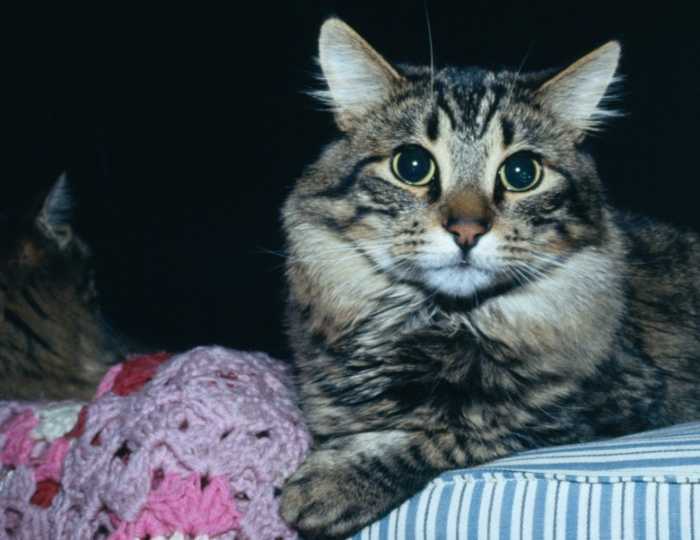
Why Does My Cat Lay On Me?
CatsCat BehaviorWhy Does My Cat Lay On Me?ByNaomi MillburnUpdated Jun 28, 2021Jupiterimages/Photos.com/Getty Images #p56d4d143e1b766907c07f1922c27a179, #p56d4d143e1b766907c07f1922c27a179 img { aspect-ratio: 3300/2550; height: auto; }When you're crazy about your cat, you often find yourself analyzing her every adorable feline action. If your furry buddy has a penchant for employing your body as a human couch and you wonder why your cat lays on you, don't get too offended or concerned. She's probably doing it because she loves your company, pure and simple.TipYou might notice your cat lying on your more when you're in a bathrobe or sweater. Take this into consideration when you're planning on spending a night on the couch watching TV with your pet.You're a cozy spotYou're a cozy spotCats are sweet, but they're also smart and savvy creatures. If your cat loves nothing more than being sprawled out on top of you, it's possibly because you feel cozy and more importantly, warm. Remember, cats love to sleep, especially as they get older and their metabolisms slow down from kitten-speed.Your cat adores youAleksandr Zubkov/Moment/GettyImages #p4e1fa9391b14b61db64f4bae59e82f99, #p4e1fa9391b14b61db64f4bae59e82f99 img { aspect-ratio: 5205/3341; height: auto; }Your cat adores youSome people erroneously think of all cats as being distant and detached creatures. Cat lovers, however, know this not to be reality. If your cat thinks that you're her bed, it could just mean that she loves being near you all of the time. You can see the proof in many other ways.If you live in a three-bedroom condo and your cat is usually in the same room you're presently occupying, she most likely simply adores you. This behavior is a common sign of bonding with you.Your cat trusts youYour cat trusts youBy feeling free enough to lounge on top of you, your cat also is expressing pure trust in you. Cats can be extremely anxious and jumpy creatures when they're not at ease, so by sleeping on you, your cat is showing you that she knows you're not going to do anything to harm her. She feels 100 percent relaxed when she's that close to you.The cat also regards you as a security blanket and knows you will protect her, increasing her desire to remain in physical contact with you in order to relax. Take that as the most genuine compliment in the animal kingdom.It's a display of powerIt's a display of powerYour cat reclining on you can also indicate a display of power. If your cat wants to make it known to you — and to the rest of the household — that she's got a lot of sway around these parts, she might just be inclined to show it physically. If the rest of your cats walk by and notice your kitty on you, they'll probably get the message. Don't take the power display the wrong way, however. Your pet wouldn't want to possess you if she didn't adore you first, after all.Other signs of loveStudio CJ/iStock/GettyImages #pb15ba5ad0911d71cebbac1f45164b1cf, #pb15ba5ad0911d71cebbac1f45164b1cf img { aspect-ratio: 7196/4803; height: auto; }Other signs of loveAs your cat is using your body as rental space, be attentive to any other signs that might point to a happy feline. If you hear the familiar rumble of purring, your cat's probably on cloud nine. Her eyes might even look partially open and partially closed. If she pushes her paws into your body, she's "kneading" and therefore likely in a serene and giddy mood. Blinking and yawning also both usually signify a pleased kitty cat.ReferencesThe Humane Society of the United States: Cat Chat – Understanding Feline LanguageGreat Pet Care: Why Does My Cat Sleep on Me?
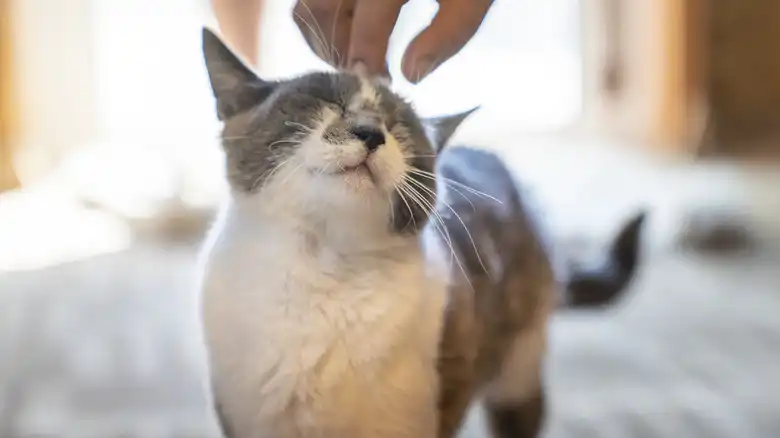
3 Reasons Your Cat Doesn't Purr (And When To Be Concerned)
CatsCat Behavior3 Reasons Your Cat Doesn't Purr (And When To Be Concerned)ByAdam SymchukApril 6, 2025 9:25 am ESTAnita Kot/Getty ImagesA cat's purr leading up to, or resulting from, a pet, scratch, or brush, is one of the most beloved sounds a kitty can make. Often, a cat's purr is a positive indicator of its mood: a greeting, a feeling of contentment, or a means to get attention from its favorite human. When a cat does not indicate its happiness through these little rumbles, it can be concerning for a cat parent.To understand why some cats don't purr or stop purring, Joey Lusvardi, Certified Cat Behavior Consultant and owner of Class Act Cats, spoke exclusively with Cuteness to shed some light on this issue. Lusvardi gave three main reasons why a cat may not purr, starting with mentioning how it may just be in its nature: "Some cats naturally purr more than others so in many cases, it's just a normal variation of the cat's behavior." He goes on to explain that secondly, traumatic events can sometimes require patience from the owner, while not being an immediate concern, noting, "We sometimes see this if a cat has a large, stressful event happen to them where they'll stop purring for a while until they have a chance to bounce back."Lusvardi stresses that, while not the first thing people should consider, medical or anatomical reasons could also be a third cause, saying, "If they had past trauma or injury to any of the structures involved in purring, they may be physically incapable of purring." While a non-purring cat is more likely to be caused by its personality or stressors, pet parents should be concerned if they have reason to believe that the cause is health-related.When to bring a cat to the vet when it is not purringlarisa Stefanjuk/ShutterstockThe careful cat owner may want to bring their pet to the vet at the earliest signs of trouble. Yet, Joey Lusvardi emphasizes that patience is often all that is needed. In talking from personal experience, he told Cuteness, "One of my cats didn't purr for the first few months after I brought him home because he was extremely anxious, but now he purrs (and drools) all the time." On the subject of it being an indicator of a pet's happiness, Lusvardi assures, "Every cat is different and most cat behaviors exist on a spectrum," adding, "Just because your cat doesn't purr constantly doesn't necessarily mean they're unhappy."Pet parents should try to address any potential stresses a cat faces if they believe the problem is related to mood. However, this can often be handled at home by providing an enriching environment, giving cats needed space, or avoiding overhandling them. While rare, some cats may be anatomically unable to purr because of problems with their larynx. In this case, a cat will find other ways to show affection.Lusvardi told Cuteness that you should take a cat to a vet when "...any sudden change in behavior [is] paired with other behavior changes [that] could be a cause for concern." A cat who becomes less vocal overall, begins to hide, and stops eating may have medical issues. Laryngeal disease, which can come with difficulties vocalizing, drinking, or eating due to larynx inflammation, will also be a reason to bring a cat to a vet. Awareness of common cat illnesses can also help a kitty caretaker determine when a pet's behavior points to signs that they need to be seen by a veterinarian. Considering medical issues is essential, but a cat's lack of purring behavior is not cause for concern most of the time.Is a cat's purr always positive?Blackcat/Getty ImagesWhile a cat's purr is almost always an indicator of happiness, there are a few cases where it can be used as a coping mechanism. Purring can be comforting for a kitty, so sometimes it uses it to cope with anxiety; some pet parents will notice rumbles after a vet visit as their cat tries to de-stress. This method of self-soothing may also apply to sickness as a means to help deal with pain or discomfort; it is not unheard of for a cat to purr before a medical procedure. Kittens are also unique in using their little rumbles and often purr constantly while eating. In this case, a pet parent should enjoy the chaotic adorableness on display.Cat language can be challenging for new and even seasoned pet parents to comprehend. To help unravel the complex cat language, check out the video above that Joey Lusvardi shared with Cuteness. A cat's purr is a happy thing in most cases, but knowing when to look for issues can help ensure its purrs stay positive.Always consult your veterinarian before making changes to your pet's diet, exercise, or care. To find an accredited veterinarian in your area, you can search theAmerican Animal Hospital Association's online database.
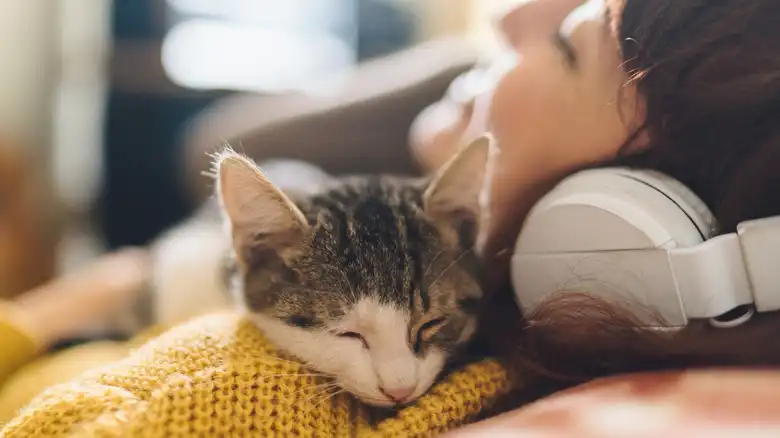
Why Do Cats Sleep On Your Neck And Face?
CatsCat BehaviorWhy Do Cats Sleep On Your Neck And Face?ByJo JacksonUpdated: Nov. 29, 2024 5:00 pm ESTMartin-dm/Getty ImagesFor many pet parents, a cat curling up on their face has become a standard part of their bedtime routine. Some felines may nestle under your chin and against your throat; others might lie half on the pillow and half on your head, twining their claws in your hair. The possible reasons for this behavior include seeking warmth, marking, and communicating unmet needs.Craving warmth and comfortCats love to sleep in a warm spot, to the point that they'll follow a sunbeam around the house throughout the day. At night, when your body is under the covers, your head and neck are exposed. While it's a myth that humans release most of their body heat through their heads, it's still your feline's best option for snuggling up against you directly in this scenario. Meanwhile, your pillow is a soft, comfortable place for your pet to lie while snoozing.Making their markCats like to constantly mark their territory, with head butting and whisker stroking spreading their scent from glands on their heads, cheeks, paws, and other areas. You can not smell a cat's scent — but when your feline rubs their face against you, they are marking you as part of their territory. While sleeping next to your face, they may be making sure you carry the mark of their ownership as much as their enjoying together time.Did you forget something?If snuggling on or around your neck and face isn't your cat's routine nighttime behavior, you might be neglecting some of their routine care. Review your cat's day to see whether they might be trying to tell you something.Perhaps you left their water bowl nearly empty or forget to leave out some midnight munchies. If you've put off cleaning the litter box, your feline might be letting you know conditions aren't acceptable for an impending potty stop.Your cat might be standing on your face because it's the only way to get your attention. They can't text you a low food alert, after all. Sometimes taking up residence on your face is the only way a cat can get your attention, and sometimes the bed is the only place the cat can catch up with you if you're particularly busy.
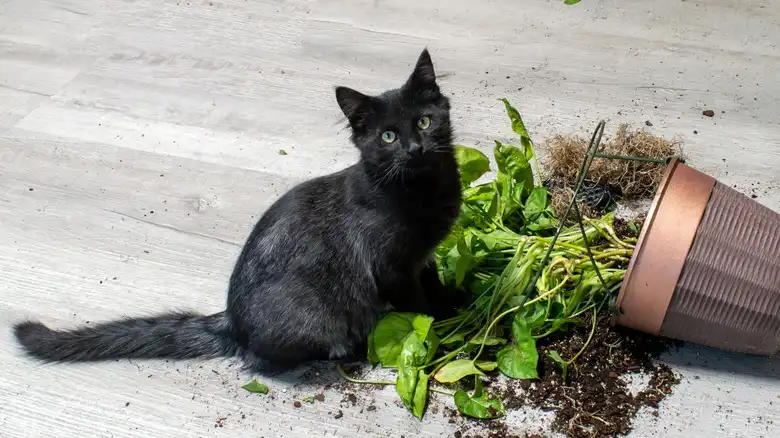
How To Nail The Aluminum Foil Houseplant Hack For Cats, According To Pet Parents
Pet ParentingHacksHow To Nail The Aluminum Foil Houseplant Hack For Cats, According To Pet ParentsBySanaphay RattanavongOct. 26, 2024 3:25 pm ESTPicunique/ShutterstockThough not natural enemies, cats and houseplants often spell disaster. One common challenge that caretakers face is the irresistible urge of their feline friends to rub against and explore houseplants, potentially leading to damage. Cats are drawn to soil for to perform various instinctual acts, such as digging, investigating, and marking their territory. While this behavior may be natural for kitties, it can be frustrating and disheartening for plant enthusiasts.Fortunately, there is a simple and effective hack that has gained popularity among experienced pet parents:using aluminum foil to deter cats from digging in houseplants and protect precious greenery. Typically, this involves placing the foil on the top layer of soil in a pot or on the floor in the area around the plant in question. To get the most out of this strategy, it helps to understand what attracts felines to soil in the first place. You can also hone your approach by incorporating the advice of seasoned pet parents.How to make the aluminum foil hack work for your situationAluminum foil deters cats because they dislike its texture and noise. The crinkling sound and reflective surface create an unpleasant sensory experience that discourages digging. If you decide to line the top of the soil with crinkled foil inside your plant pots, don't press it down too tightly to allow airflow and prevent mold. Alternatively, you can place foil around the plant base or on the shelf beneath, making the area unappealing for cats to approach or jump on.Several cat parents on Reddit have shared their creative solutions for using foil to protect houseplants. Redditor ChunkieKitten introduced the idea ofcreating "foil donuts" by loosely wrapping foil around the base of the plant, forming a flexible barrier that deters cats from digging without disrupting the plant's growth or watering routine. Other caretakers emphasize understanding their cat's behavior to find the right solution. Redditor so_cheapandjuicy points out that the effectiveness of tin foil can depend on the cat's personality—some may be too curious or agile for it to work. They suggest that calming pheromone diffusers may be better for more anxious pets. Similarly, NextLifeAChickadee combines foil with other strategies, such as offering alternative plants like spider plants and wheatgrass, to give cats safe options while protecting more vulnerable houseplants.Why cats dig in houseplant soilKilito Chan/Getty ImagesThe natural digging instinct of cats is rooted in their wild ancestry, when they would dig to create resting spots or hunt for prey.The soft texture of plant soil mimics this environment, making it an appealing redoubt. Felines are also naturally curious and explore with their paws, and the texture of soil provides stimulating sensory feedback. Boredom can also drive indoor cats to turn houseplants into a source of entertainment if they don't have enough toys or activities. Some cats may chew on plants to aid with digestion or help pass hairballs, which can lead them to paw at the soil. Lastly, if their litter box isn't clean or suitable, cats might use plant soil as a bathroom alternative.In additional to employing the aluminum foil hack, you can discourage your cat from digging in plant soil by making sure they have access to clean and multiple litter boxes. Offering alternatives like cat grass or scratching posts can also satisfy their natural digging and chewing instincts. Additionally, providing environmental enrichment with interactive toys and playing with your cat the right amount of time each day can help reduce boredom.
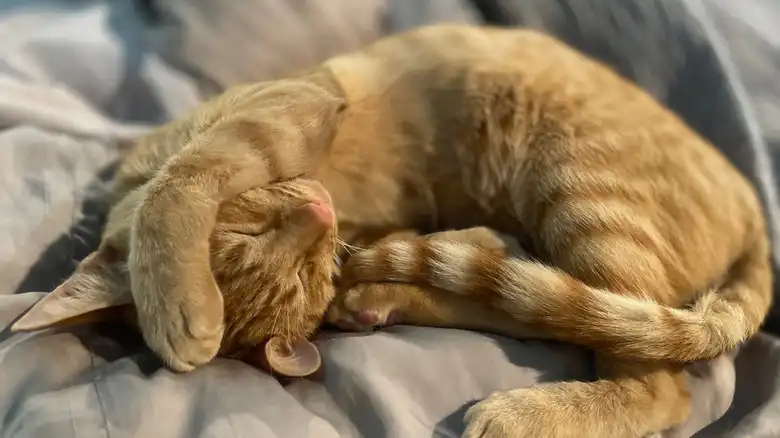
The Cat Sleeping Position That Means 'Do Not Disturb'
CatsCat BehaviorThe Cat Sleeping Position That Means 'Do Not Disturb'ByCori ChapmanFeb. 15, 2025 3:25 pm ESTBrett Mills/ShutterstockWhat does it mean when a cat sleeps in an unusual position? You may have noticed that your cat sleeps mostly during the day and has zoomies that can wake you up in the middle of the night. Since you're usually not sleeping during the day, you may witness the various sleeping positions of your cat, like having their paws over their eyes, before your own bedtime. While this could be for many different reasons, completely burying their face can mean something specific: Do not disturb.This cat sleeping position has a few loving names for it, including the "Hiding Face Henry." When a cat is in a deep sleep, they may cover their face subconsciously. This sign warns others not to disturb them while they are comfortable. In addition, a cat's paws may act as a "sleep mask" that shields their eyes, protecting them from harsh light or irritants in the air. While it may not seem like it, this position also helps the cat drown out noise for a better slumber.Comfortable cats are more likely to sleep in this positionReal_life_photo/ShutterstockCats sleep a lot, averaging about 12 to 20 hours of sleep a day. As they sleep, they will often swap into various positions, including the above "do not disturb" sleeping position. However, this position can also mean something else — that your cat is feeling safe and comfortable in the home with you. Your cat may be indicating that they're so comfy, they can easily drift into deeper sleep — something feral or stray cats may not be able to do. Sleeping carefree with a single paw over the face is a signal that your cat feels they're living the good life — especially if they're snoozing away indoors. Indoor cats receive regular meals and sleep on soft comfy surfaces to attain such a deep sleep. Indoor cats also typically have a lower incidence of injuries and have longer lifespans — giving them more time to blissfully snooze away. If you're looking for a way to make your cat feel even more pampered, consider adding a soft blanket or calming cat bed that can help them feel more at peace. The next time you see your cat in this position, think twice about poking or bothering your sleepy baby — but remember, it means they're feeling loved.
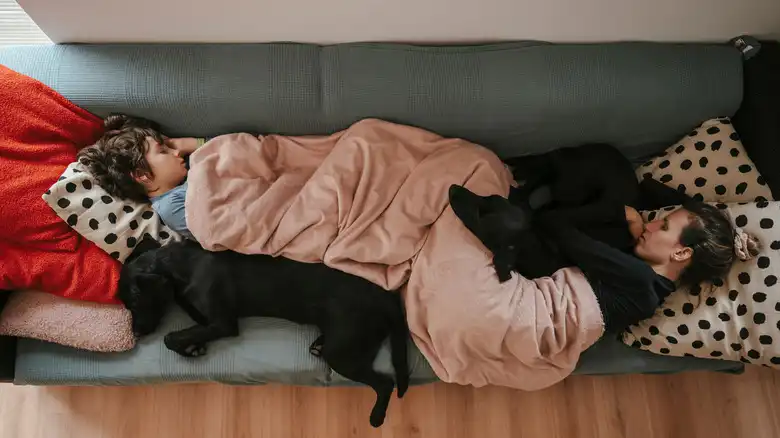
Dogs And Cats Know When You're Sick (But It's Not What You Think)
Pet ParentingDogs And Cats Know When You're Sick (But It's Not What You Think)BySanaphay RattanavongMarch 10, 2025 1:25 pm ESTGajus/ShutterstockHave you ever noticed your dog sticking to you like glue when you're under the weather, or your cat curling up on your chest when you have a fever? What do they know that you don't? It's easy to chalk this behavior up to unconditional love, but there's more to the story. Pets, especially dogs and cats, often seem to "know" when their humans aren't feeling well. Their responses might feel magical or intuitive, but they're rooted in a fascinating blend of heightened senses and a deep bond with their owners. Just like people, your dog or cat can have various attachment styles, including wanting to cuddle up with you when you're feeling unwell.From detecting changes in your scent to noticing subtle shifts in your mood or behavior, your furry friends are experts in reading you. While their methods may not involve supernatural powers, they're no less extraordinary. Let's explore the surprising ways dogs and cats recognize when you're unwell — and how they play a role in your recovery.Empathy and instinct in our pets1001slide/Getty ImagesYour pets' uncanny ability to sense when something is off with you boils down to their sharp observational skills and deep emotional connection with humans. While dogs can smell many things humans can't, much of their ability to detect when you're unwell comes from their keen observation skills. Dogs are masters of reading body language and changes in behavior. Even subtle changes, like how you're holding yourself or a shift in energy, can signal to them that something isn't right. Dogs also pick up on changes in routine — if you skip a walk, stay in bed longer, or forget a meal, they're quick to sense that something is out of the ordinary. This ability to recognize patterns and deviations is a survival skill they've adapted over thousands of years as human companions.Cats rely on their incredible awareness to detect when you're unwell. They're attuned to the rhythms of your daily life, so any change is a signal that grabs their attention. Cats are also drawn to warmth, which explains why they often snuggle up when you're feverish. The sensitive carpal whiskers on your cat's front legs react to vibrations, and may even allow them to detect physical changes, like shallow breathing or a quicker pulse.Beyond their observational skills, pets share a deep emotional connection with their owners. Dogs and cats also often mirror emotions. For instance, if you're stressed or anxious, your pet might show similar signs, such as pacing or vocalizing. Studies even suggest that dogs and their owners can synchronize heart rates during moments of emotional intensity, demonstrating just how closely they're tuned into you.The healing power of petsLucigerma/ShutterstockIt's not just that pets know when you're unwell, they actually actively help you feel better. Their comforting presence and intuitive behaviors provide emotional and physical benefits that aid recovery in ways science is just beginning to understand. Interacting with pets has been shown to lower cortisol levels (the stress hormone) and reduce blood pressure, creating a calming effect. Dogs often stay close to their owners during times of distress, offering gentle nudges or simply resting beside them. Cats, on the other hand, might knead, purr, or curl up in your lap, responding to your needs with quiet companionship.The benefits of pet interaction go beyond the emotional. Cats' purring, for example, occurs at frequencies believed to promote the healing of bones and tissues. Meanwhile, spending time with a loyal dog during recovery can encourage physical activity and help fight feelings of isolation, improving overall well-being.It's worth stating the obvious: The connection between humans and pets is a two-way street. Just as pets provide comfort, your attention and affection reassure them during times of uncertainty. Whether it's through a soothing purr or a warm, furry presence by your side, your pet's companionship isn't just comforting — it's healing when you're feeling sick.
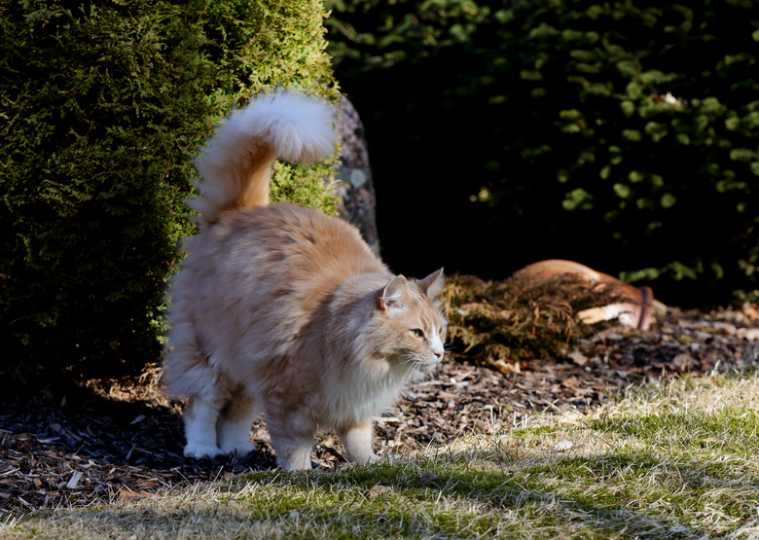
How To Get A Female Cat To Stop Spraying
CatsCat BehaviorHow To Get A Female Cat To Stop SprayingByKatherine MaloneUpdated Aug 30, 2021undefined undefined/iStock/GettyImages #p0b22360bdb8a12b102897b8331403604, #p0b22360bdb8a12b102897b8331403604 img { aspect-ratio: 4866/3468; height: auto; }Spraying is usually something that is associated with male cats as a way for them to mark their territory. Although it is less common, a female cat will also spray. Fortunately, their urine does not have the strong smell that a male cat's urine does, but this behavior is still destructive and undesirable. Evaluate your cat's behavior to determine the probable cause of spraying and take steps to stop the behavior.Never hit your cat or throw things at her if you catch her spraying. It's a natural behavior that she should not be punished for, and she won't understand the punishment. Don't rub her nose in the urine either. These methods are not effective and will likely increase her anxiety.Understanding why cats sprayUnderstanding why cats sprayWhen a cat sprays, she is depositing a small amount of urine on the surface to mark the area as hers. If you have multiple cats in the household, she may be spraying to claim ownership of the house.It is also a way for her to attract mates. Spraying is more likely in cats that haven't been spayed, although the behavior may continue in a small percentage of spayed cats.Stress is another trigger that may make your cat start spraying. Stress may be caused by a new pet or child in the household, moving to a new home, or unusual activity in the house such as when you have guests or go out of town.Get a veterinary examinationGet a veterinary examinationIf your cat has long been well behaved and suddenly starts spraying, the first thing to do is take her in to see a veterinarian. This can rule out a physical or medical cause for the behavior such as an infection.Vasyl Dolmatov/iStock/GettyImages #e6b30f560f88aead5f9bd6f1afac974c1, #e6b30f560f88aead5f9bd6f1afac974c1 img { display: block; aspect-ratio: 1.4983713355049If your cat has not already been spayed, make an appointment to have this done right away. Cats who have not been fixed may be spraying to attract male cats that may be roaming in the area. In many cases, spaying may resolve the behavior and it has additional health benefits including eliminating the risk of uterine and ovarian cancer and decreasing the risk of breast cancer. Once your cat is spayed and given a clean bill of health, you can address spraying as a behavioral issue.Check the litter boxCheck the litter boxMaking sure the litter boxes are clean and that there are enough of them can often help the problem, especially if you have multiple cats in your home. Make sure that for however many cats you have, you have the same number of litter boxes plus one. So a two-cat household could have at least three litter boxes. This can help reduce the risk of conflict and fighting between cats that can lead to spraying.Change out the litter at least once a week and scoop the box daily to keep it clean. Make sure to place the litter boxes in locations where your cat feels comfortable so that she doesn't deliberately avoid using them.Change the environmentChange the environmentIf the spraying is caused by a conflict with other cats, make additional modifications to your home. Make sure there are plenty of perches so that each cat has a safe place to rest. You can also have multiple areas where the cats can eat and drink water. If the problem is cats outdoors, consider closing the blinds so that your cat won't notice them.Clean up all of the areas where your cat has sprayed so that the scent of her urine doesn't draw her back. Use an enzymatic cleaner specifically designed for use on pet odors and urine to fully eliminate the scent.Catherine Falls Commercial/Moment/GettyImages #eb53a17f5625593d2e173b8ba1df80b42, #eb53a17f5625593d2e173b8ba1df80b42 img { display: block; aspect-ratio: 1.5947459918872Other products and medicationsOther products and medicationsIf these basic steps aren't working to stop your cat from marking, consider a product such as Feliway cat spray. This is a product that has the scent of the glands in a cat's cheek, which is different from the pheromone found in cat urine. Many cats may avoid urine spraying in areas that have the scent of the cheek pheromone.Cats that spray due to anxiety or depression may benefit from medications. Putting your cat on an anti-anxiety medication such as benzodiazepines or an antidepressant such as fluoxetine may an effective way to stop the negative behavior.ReferencesVCA Hospitals: Spaying in CatsVCA Hospitals: Cat Behavior Problems – Marking and Spraying BehaviorASPCA: Urine Marking in Cats
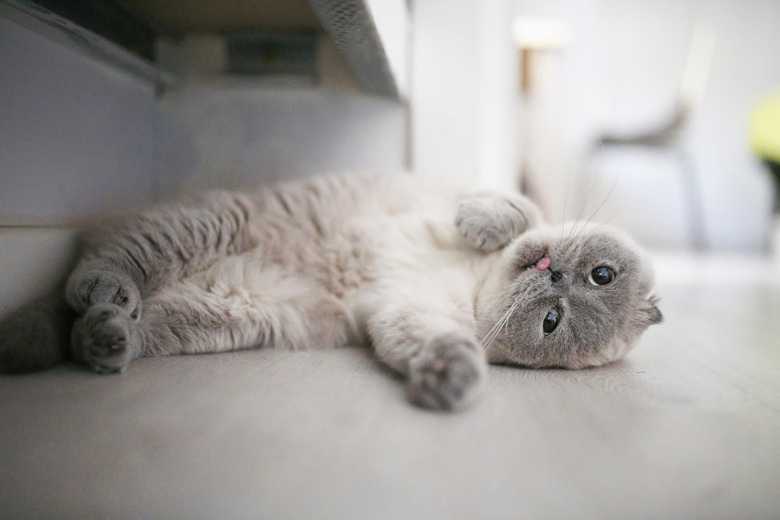
Why Does My Cat Run Around After Pooping?
CatsCat BehaviorWhy Does My Cat Run Around After Pooping?BySusan ParettsUpdated Jun 28, 2021Dogs notoriously have all sorts of weird rituals around pooping, but they're not alone in their weirdness. Cats, though they try to pretend they're the more dignified pet species, have their own set of pooping quirks. Chief among them is that some cats tend to go slightly nuts after pooping in their litter box.Many cat owners have probably noticed that their cat sprints out of the litter box after defecating. But why do cats run after pooping? As with so many animal behaviors, there's no concrete answer, but experts have several theories.NiseriN/iStock/GettyImages #e11cd039ab31ffa7c76d2dd798e34cb9c, #e11cd039ab31ffa7c76d2dd798e34cb9c img { display: block; aspect-ratio: 1.5Cat zoomies after poopingCat zoomies after poopingCat zoomies after pooping may occur because cats, like so many of us in the animal kingdom, simply feel good after pooping. Humans and cats both have a vagus nerve, which is stimulated by defecation. This can lead to a feeling of euphoria for your cat after pooping.More Like ThisCatsHow to Sleep With a Litter Box in Your BedroomCatsWhy Does My Cat Love My Dirty Clothes?CatsHow to Tell if a Cat is in PainCats may feel energized by the stimulation of this nerve, and may feel a desire to burn off that energy by taking part in one of their favorite activities: running around the house. It's their way of showing off how happy they feel.Cat runs after poopingCat runs after poopingBefore and after defecating, kittens typically get their rear ends licked clean by their mother. This is done to stimulate them to eliminate and to clean them up afterward. By running or jumping in the air after pooping, adult cats are celebrating or showing off their independence. Maybe they're proud that they can clean their bottoms on their own now!Why do cats run awayWhy do cats run awayCats may run away after pooping because they're trying to avoid predators. In the wild, cats generally bury their poop, most likely to mask their scent and throw predators off of their trail.Nils Jacobi/iStock/GettyImages #e1ca36ee7e809978a59d68622beeff321, #e1ca36ee7e809978a59d68622beeff321 img { display: block; aspect-ratio: 1.2500681013348By bolting away from the litter box after pooping, cats might be trying to increase their chances of survival by distancing themselves from their droppings as quickly as possible. This would make it harder for predators to find them.In multiple-cat households, less confident cats will bury their waste and then possibly sprint away to let other cats know that they aren't a threat. Monitor the cats in your household to ensure that one cat isn't bullying the other while she's in the litterbox and possibly chasing her off after she uses it. This could cause problems like inappropriate elimination if not dealt with by adding an additional litter box to the household.Cats run to stay cleanCats run to stay cleanAnother explanation for cat zoomies after pooping is that cats are clean creatures, and they simply want to rid themselves of excess litter or fecal matter. Jumping and running right after being in the litter box would help to shake off anything sticking to their feet or any other parts of them, so it may be that it just helps your cat feel extra clean.Sprinting away from the litter box quickly separates your cat from their smelly feces, which they want to get away from. After all, cats are fastidiously clean animals who never sleep or eat near their feces.Cat pooping painNico De Pasquale Photography/Moment/GettyImages #p40794133fdcaf1f0499cbcc5bffebcda, #p40794133fdcaf1f0499cbcc5bffebcda img { aspect-ratio: 7952/5304; height: auto; }Cat pooping painIf you notice that your cat runs away from the litter box and cries after eliminating, then they could be having a medical problem. This is especially true if you've never noticed this type of behavior before.For cats who experience pain during elimination, they may run away from the box and avoid it afterward due to associating the box with the discomfort. To solve these types of litter box issues, visit your veterinarian to rule out a medical cause of your cat's unusual behavior.ReferencesWoman's World: Why Do Cats Act Crazy After Going #2?The Mercury News: Why Does My Cat Race Around the House After Using the Litter Box?Napa Humane: Orphaned Kitten CarePAWS: Solving Litter Box ProblemsMSN: Why Do Cats Bury Their Poop?The Daily Telegraph: Crazy Cat Antics After Kitty Does a No. 2 is Called 'Poo-Phoria' and Here's Why
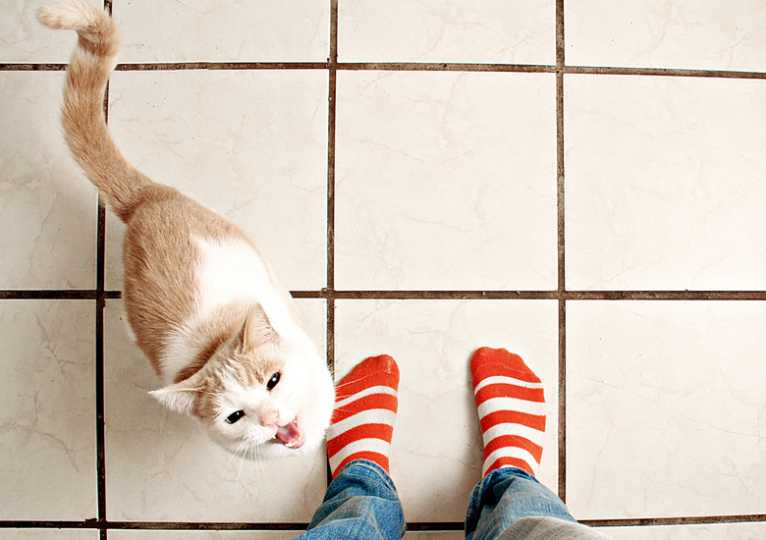
Why Are Cats Always Underfoot?
CatsCat BehaviorWhy Are Cats Always Underfoot?ByCarmen AngelicaFeb 12, 2019 1:07 pm ESTNatalieShuttleworth/Moment/GettyImages #p72774da04e0afd9a3aa9aab22ff0d8fa, #p72774da04e0afd9a3aa9aab22ff0d8fa img { aspect-ratio: 3847/2713; height: auto; }You're walking through the house when all of the sudden, a flash of fluff runs out in front of you, and you trip and fall. Yes, your cat decided to run underfoot. Again. Why? Are they trying to play with you? Do they want something? Or do they just like to see if they can trip you?It could be any of those things. There are a few different reasons why your cat might be running in front of you and impeding your journey to the opposite side of the room.ExcitementExcitementYour cat might know that when you get up and move, there is a solid chance that you might stop at their food bowl and give them some kibble. (Especially if it's around dinner time, and cats definitely know when it's dinner time!) Or that you might be making yourself a tuna sandwich and give them some leftover tuna juice? Or even just that you might play with them! This is all very exciting, and they want to let you know that they are here for it and will rub against your leg to mark you.More Like ThisCatsWhy Does My Cat Attack Me When I Get Into Bed?CatsWhy Do Cats Zig Zag Back and Forth in Front of You While Walking?CatsWhy Does My Cat Attack My Ankles When I'm Walking?Cat "herding"Cat "herding"Cats also know that the act of getting underfoot and rubbing up against your leg will make you inclined to get them to stop by giving them what they want. This form of dominance is to let you know they are in charge and will lead you to get them what they need. Although they are not actually "herding" you, this is a learned behavior to control you.Vivi Pineda Fotografía/Moment/GettyImages #ecbc43719e7bd915ac03afde4fd270778, #ecbc43719e7bd915ac03afde4fd270778 img { display: block; aspect-ratio: 1Similarly, cats will sit in the center of the room as "head of the house," and when you move, they plan on "re-centering" so you know who's in charge. These actions are usually found in bossy cats and nearly 86% of cats have been found to be "bossy cats," so if this happens to you, you are most likely dealing with a bossy cat.Cat hugsCat hugsWhen a cat walks underfoot and winds their tail around your calves, this could actually be your cat giving you a welcoming hug! Although cats have normally been presumed to be solitary creatures, research has shown that in nature cats are very pack-oriented. After hunting, wild cats will rub against one another and curl their tails around each other as a way of communing. That's why when you walk in a room you cat might run up underfoot and wrap their tail around you to say "Hi! Welcome back! I like you, pack member!".AttentionAttentionWhat's the best way to get someone to remember you are in the room? Have them trip over you. Your cat might simply be worried that you are not paying enough attention to them, and will let you know of their presence. This can become a problem quickly if you let it. If you reward this behavior with pets and snuggles this will quickly become something your cat can count on to get the notice they are demanding. A way to break this habit is to give them affection randomly so they don't feel the need to remind you they exist by tripping you.joeyful/Moment/GettyImages #e9846d09cc51526caab2ae95a29c8f41f, #e9846d09cc51526caab2ae95a29c8f41f img { display: block; aspect-ratio: 1.5656637168142Your cat can't speak. Or if she can, you have some sort of magic cat on your hands. That means when your cat is underfoot, she's trying to tell you something. Next time your cat almost topples you over, ask yourself: is it dinner time? Have I been out for a while? Have I paid much attention to her? Or is she just getting bossy right now? Pretty soon you'll understand exactly what is going on with your feline friend and figure out why they do what they do. It'll make your life easier, and will make them much happier to know that what they are communicating isn't going unheard.
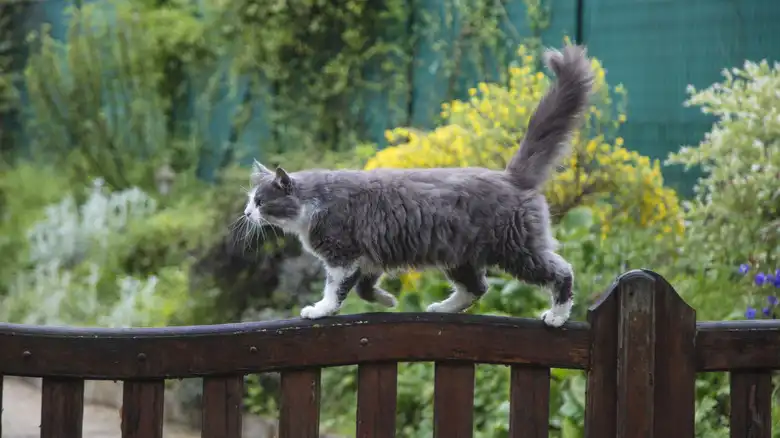
The Spice That Isn't As Effective At Keeping Cats Out Of The Garden As You Thought
Pet ParentingHacksThe Spice That Isn't As Effective At Keeping Cats Out Of The Garden As You ThoughtByJessica DesrosiersMarch 2, 2025 11:25 am ESTHolger Leue/Getty ImagesIf you've spotted stray cats digging up the plants in your garden, you may be looking for ways to stop them. There are many hacks and tricks to help deter feline, however, some are more effective than others. Cinnamon is often recommended as a deterrent due to a cat's heightened sense of smell. The theory is that the strong scent will smell offensive, keeping them out of the area. You can sprinkle cinnamon around your yard directly. It is also sometimes combined with other spices and water to create a deterrent spray.Unfortunately, this spice may not be very effective for keeping cats away. Some felines may not react to cinnamon at all. Weather changes, such as rain and snow, can also reduce the concentration of cinnamon and thus its potency. Additionally, while it is listed as non-toxic by the ASPCA, it can still harm cats and other animals. Inhaling dry cinnamon can cause respiratory issues such as coughing or breathing difficulties. Ingesting cinnamon can also irritate the throat and stomach. In large enough quantities, it can cause vomiting, diarrhea, and liver issues, per Pet Poison Hotline.Doctor Catherine Angle, DVM, of Pet Poison Helpline lists the potential dangers of some forms of cinnamon: "It takes a larger amount of ingested cinnamon powder to cause problems in our pets (greater than 1 teaspoon of powder for most pets) but only a small amount of the essential oil." Even if you try using cinnamon in the yard, it's important to avoid cinnamon essential oils.If you believe your pet has consumed a toxic substance and you can't reach your veterinarian or an emergency clinic, please contact theASPCA 24/7 Poison Control Hotlineat 888-426-4435 or thePet Poison Helplineat 855-764-7661.Alternative methods for keeping cats out of your gardenElizabeth Livermore/Getty ImagesFor other approaches you can use to help deter unwanted visitors from your garden, avoid chemicals, spices, or plants that could harm felines. For small garden spaces, a lemon-based spray may help keep cats away temporarily. Preventing felines from accessing enticing areas, such as filling in open dirt with additional plants, can also help. In addition, items such as pine cones, rocks, and other objects with hard surfaces can stop problem digging without looking unsightly.Feline deterrents for larger areas can include motion-activated ultrasonic sound devices and sprinklers. Improving fencing by adding netting or wrapping protective barriers around individual plants can also fend off curious cats. Be sure to secure any potentially intriguing areas such as open sheds, holes in fences, and other small spaces cats can squeeze into. It's also a good idea to place trash in a closed container to prevent scavenging for food.Creating an enticing space for cats away from your treasured plants can also help you coexist. Instead of trying to scare them away, consider putting together a feline-friendly corner of your garden. Planting cat-attracting plants like catnip can encourage felines to frequent that space and leave the rest of your garden alone. Whatever methods you choose to deter cats, ensure they're safe and not harmful to any pets or wildlife.
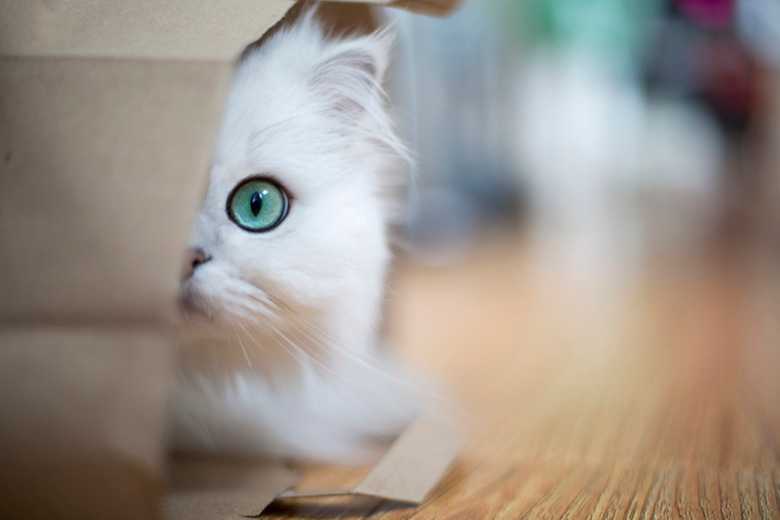
How To Lure A Cat Out Of Hiding
CatsCat BehaviorHow To Lure A Cat Out Of HidingByBarbara RubenUpdated Aug 17, 2020Selcuk1/iStock/GettyImages #p639e1bd9a8cc8815aeabdda45ba7f044, #p639e1bd9a8cc8815aeabdda45ba7f044 img { aspect-ratio: 5760/3840; height: auto; }Cats are masters of concealment, so you can expect them to hide themselves when they are frightened, stressed, or in pain. Drawing a cat from his hiding place can be as simple as placing some tantalizing food nearby, but it's not always that easy. If you are having trouble locating your kitty or if he refuses to budge from his shelter, you may have to resort to a more creative or long-term strategy.Finding cats outsideFinding cats outsideIf you think your inside cat has escaped to the great outdoors, act quickly. In the majority of cases, an escaped cat finds a hiding place very close to home. Check under the deck, in the bushes, and other areas that your cat has easy access to.Microwave a plate of canned tuna or wet food and leave it outside for a while. Your cat's hunger likely will overcome her fear of the outdoors when her stomach is empty. Familiar smells also can help your kitty find her way back if she's disoriented. Place her litter box, bed, or an article of your clothing outside to help her find home.You can set humane cat traps as a last resort, although you shouldn't leave them out overnight unattended. Consider leaving a little bit of dry food and water outside in case he comes back overnight.Common mistakes to avoidCommon mistakes to avoidShy cats are sensitive to loud noise and sudden movements, explains the Humane Society. Raising your arm too fast can send him cowering back under the furniture in a flash. When attempting to lure your cat out, move your body slowly and quietly. Kneel or sit on the floor as you call or reach out to him.Consider using a toy to catch her attention and encourage her to chase it out of her hiding spot instead of reaching in to pull her out. Shut the door and ask your family to avoid the room to keep the environment calm and controlled, says Catster Magazine.Drawing out shy catsDrawing out shy catsSome cats are more confident or sociable than others. Be patient and persistent to get good results. Use toys, catnip, and treats or wet food to encourage your cat to come out from under the couch, bed, or basement rafters. Place these lures near his hiding place, but make sure he has to come out a bit to reach them.Shake the bag of treats every time you give her some to condition your cat to respond to the sound. This can give you an easy way to "call" your cat when needed.Acclimating new catsAcclimating new catsNewly adopted cats are generally skittish and fearful as they adjust to new owners and a completely alien environment, says veterinarian Dr. Marty Becker. It's common for kitties to take a few days or weeks to adjust to their new home.Give new pets, especially those adopted as adults, some space and time. Place them in a private room where they are separated from other pets, and set up a convenient hiding place for them to use. Leave food, water, and litter in the immediate vicinity and allow the cat to use them at his leisure.Give him a chance to grow accustomed to your appearance and smell before introducing your other pets. Spend time with him every day, even if you just sit with him while he eats.ReferencesIs Your Cat Hiding? Here's Why — And What to DoHow to Help a Frightened CatWhat to Do if Your New Cat Won't Come Out of Hiding
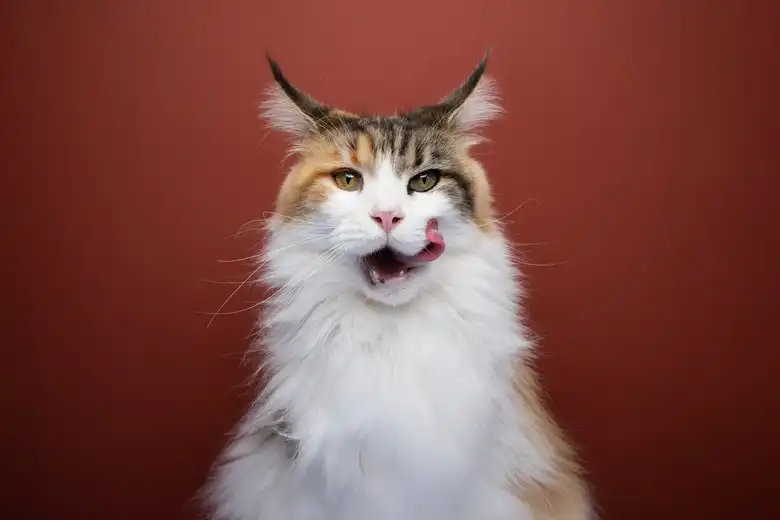
Why Does My Cat Stare At Me?
CatsCat BehaviorWhy Does My Cat Stare At Me?ByKrissy HowardSep 18, 2023 11:03 am ESTNils Jacobi/iStock/GettyImages #p03e831c2e5c8d6e43bf50b5513b312d4, #p03e831c2e5c8d6e43bf50b5513b312d4 img { aspect-ratio: 8640/5760; height: auto; } In This ArticleReasons why cats stareCats and body languageThe slow-blinkWhen to be concernedThe bottom lineOur feline friends do a number of things that may leave us puzzled, including staring us down for seemingly no reason at all. Why do cats stare at people? Well, that's a tough question to answer as it will depend on the cat and the situation at hand, but most of the time, a staring cat can likely be chalked up to curiosity, attention-seeking, or an attempt to have a need met (especially around dinner time.) Sometimes, a lingering look can even signify love feelings when accompanied by a perfectly-timed blink, and in others, a stare-down can be a warning to stay away.Reasons why cats stareReasons why cats stareCats stare at their pet parents and other humans for a number of reasons. One reason that a cat might look at you is to get your attention, especially if it's around their feeding time, or if they're stressed, uncomfortable, or otherwise seeking soothing from their most trusted friend. Cats are also curious creatures who use their sight to navigate the world around them and keep themselves safe within it, so if your cat is maintaining their glare for more than a few seconds, they could just be attempting to gather information they're unsure about. This is especially common for kittens, cats who are new to their current home, and cats seen exploring the outdoors.Some people guess that cats might be appearing to stare at people when really, they're just trying to get a better look at what they're fixated on. Cats tend to be more near-sighted than people, which can make it hard for them to get a clear, crisp view of what they're looking at. So, if you're standing more than 20 feet away from your cat, they may just be having a tough time seeing you, which can be alarming for a prey animal. Despite their near-sightedness, cats are believed to possess the capacity to see ultraviolet light, so it's possible that they're just examining something that we can't technically see.More Like ThisCatsShort on Space? Try Wall-Mounted Cat FurnitureCatsWhy Do Cats Like Sleeping on Warm Things?DogsWhy Are Dogs and Cats Scared of Vacuum Cleaners?Sanja Baljkas/Moment/GettyImages #e2ded5dc36e506438337fd45115002704, #e2ded5dc36e506438337fd45115002704 img { display: block; aspect-ratio: 1.5Kitty stares could also signify a confrontation, as cats will often maintain eye contact with other cats during territorial disputes or other altercations. In order to identify if a cat's stare indicates a happy cat or an angry feline, you'll want to familiarize yourself with common body posture cues displayed by cats.Cats and body languageCats and body languageOf course, the eyes would need to say a lot when the mouth really doesn't. Cats, like dogs, use body language to express themselves to those around them, including us, and the body doesn't stop at an arched back or a puffed-up tail. A cat's face, namely, their eyes, certainly expresses what a feline is thinking, feeling, and about to do next. Generally, sustained, direct eye contact among cats indicates that a dispute over territory or some other precious resource is going down, and you'll often notice additional body language cues that support this. Cues in a stare-down circumstance can include an arched or bowed back, a puffed-up tail, hissing, growling, and little to no blinking.Positive indicators through body language include head butting, rubbing their bodies against you, kneading, purring, and relaxing on their backs. Additionally, blinking is another way your feline friend express themselves by using nonverbal communication. A cat caught in a stare-down with another animal will hardly blink, signifying that they're on high alert. A relaxed and comfortable cat will not only blink as a sign of affection, they'll blink slowly, in an almost exaggerated way. Known as the "slow blink," this brand of cat behavior is done as a positive communication tool, both between cats, as well as between cats and humans.Gabrielle Therrien/iStock/GettyImages #ea916f78834e63b7b5464eceb15990a5a, #ea916f78834e63b7b5464eceb15990a5a img { display: block; aspect-ratio: 1The slow-blinkThe slow-blinkA 2014 study published in Scientific Reports examined 21 cats from 14 different households, along with 14 cat caretakers, and the study was done in a familiar room in the cat's home. The research showed that many slow-blinks from cats were followed by a series of half-blinks before the cats studied would narrow their eyes as if squinting. Some cats who participated in the study even closed their eyes completely. When the human counterparts in the experiment slow-blinked at the cats, either to initiate communication or in response to a cat's blinking, many of the cats would either slow-blink back or approach the person in a calm and friendly way, suggesting what researchers referred to as "positive emotional communication between cats and humans."Annetka/iStock/GettyImages #e5502e0f99c128560553a127c4e1a375e, #e5502e0f99c128560553a127c4e1a375e img { display: block; aspect-ratio: 1.3748786014892When to be concernedWhen to be concernedWhen examining whether your cat is staring at you or staring you down, one helpful detail to take note of, when possible, is the size of their pupils. Usually, pupils that are pin-point tiny, or wide and dilated, can be signs that your cat is distressed. Tiny pupils are usually indicators that a cat is angry, upset, or irritable, so it may be best to keep your distance if you notice it. Dilated pupils in cats usually occur when a feline is scared, nervous, or agitated. Of course, either of these can also occur when a cat is focused on something, so be sure to read your cat's other body language to determine if there's something you can do to make them feel more secure and soothed, or if you're both better off with a little space until things settle down.liebre/iStock/GettyImages #ec9d1dba3e8331495a30a5720a5974acd, #ec9d1dba3e8331495a30a5720a5974acd img { display: block; aspect-ratio: 1.4998321584424The bottom lineThe bottom lineCats stare at people for a number of different reasons, although most of them are harmless and not to be terribly concerned over. Most of the time, cats stare or maintain eye contact with people when the cat feels at ease, which is especially true when a cat's eyes become narrow or even closed when facing someone. A slow blink can indicate a happy cat, which can be confirmed by additional mannerisms that signify a comfortable feline friend, such as a relaxed body, a soft purr, kneading, and cuddling. If you find yourself in a staring contest you may have an angry cat on your hands, which can usually be confirmed by body language cues including a raised or arched back, a puffed-up tail, hissing, or growling.ReferencesScientific Reports: The Role of Cat Eye Narrowing Movements in Cat–Human CommunicationVCA Hospitals: Do Cats See Color?
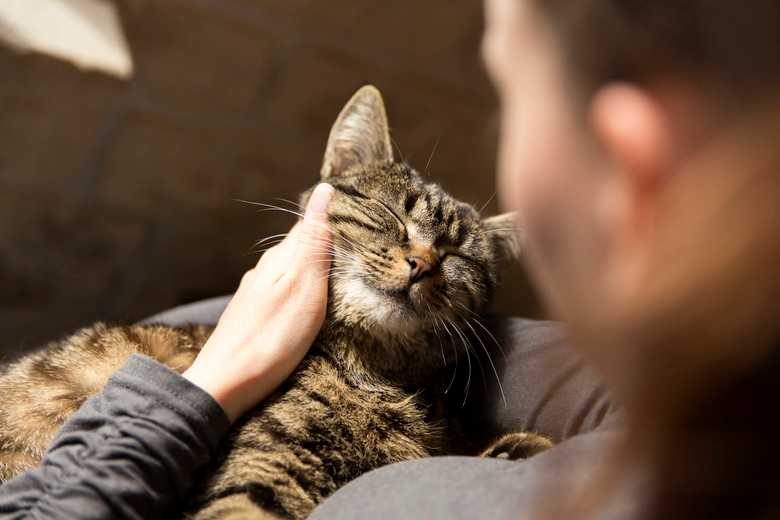
Why Does My Cat Bite Me When I Stop Petting Her?
CatsCat BehaviorWhy Does My Cat Bite Me When I Stop Petting Her?BySarah Jeanne TerryDec 28, 2020 12:02 pm ESTIt's a chilly winter day and your adorable kitty is cuddling in your lap. As you pet them, they purr. Then, you get a text on your phone and take a minute to look, interrupting the petting. Just as you're about to respond—ouch! Your kitty bites you. Why would your cat interrupt a perfect Caturday, teeth first?Bogdan Kurylo/iStock/GettyImages #eb2396f6713018fa35675f9caaf887647, #eb2396f6713018fa35675f9caaf887647 img { display: block; aspect-ratio: 1.4976958525346If your cat tends to bite you as soon as you stop petting, then you'll be happy to know that this is actually a common behavior in cats. Biting is one of the ways that cats communicate with their humans. They're smart and savvy, but cats can't speak human language, so they try to say things in their own. What exactly is your cat trying to say to you with their teeth? There are a few possibilities.Your cat might think that it's returning your affectionWestend61/Westend61/GettyImages #p48f7b41a3986d685143b25e8ff890c13, #p48f7b41a3986d685143b25e8ff890c13 img { aspect-ratio: 5472/3648; height: auto; }Your cat might think that it's returning your affectionMore Like ThisCatsWhy Do Cats Groom Themselves After You Pet Them?CatsWhat Does It Mean When a Cat Lies on Its Back?CatsDoes My Cat Know That I Love Them?Cat owners know that when you're petting your cat, you're showing them how much you love them. However, your cat can't pet back. Instead, they occasionally bite. Kittens learn about biting when they're young, according to Animal Planet. They bite one another as a part of play or affection. They see their humans as part of their family, basically just bigger cats. Thus, they're probably just trying to show you they love you the same way they would the rest of their family.Your cat might be telling you that it doesn't want you to stopLinda Raymond/iStock/GettyImages #pa3a29a97d2a687aafe99625affdb0c3c, #pa3a29a97d2a687aafe99625affdb0c3c img { aspect-ratio: 5573/3715; height: auto; }Your cat might be telling you that it doesn't want you to stopAnother possible reason your cat bites when the petting sessions stop is because they didn't want it to stop! They're trying to tell you to keep it going! Deborah S. Greco, DVM, a veterinarian and the senior research scientist for Nestle Purina Petcare, explained to Reader's Digest that your cat might also bite to tell you that they need something. If your cat was enjoying their cuddle time, then they might be annoyed when it stopped. A little love bite might be their most efficient way of telling you they want a good thing to continue.Your cat might be telling you that they're overstimulatedcyano66/iStock/GettyImages #p996c5c7add43262c39e132b5216d43dd, #p996c5c7add43262c39e132b5216d43dd img { aspect-ratio: 4600/3070; height: auto; }Your cat might be telling you that they're overstimulatedCats definitely enjoy petting and cuddle time, but the physical affection can quickly turn into something that feels overwhelming for your cat. It's possible that, while you were petting your cat, they had already become overstimulated. According to the Humane Society of Huron Valley in Ann Arbor, Michigan, cats can become overstimulated at a certain petting threshold, and they'll likely want you to stop right away. According to the VCA Animal Hospital, the bite tells you to stop—biting is one of the primary ways they know to tell us that.How to stop your cat from biting youNoelia González/Moment/GettyImages #pd2c113dffdae85b6c3f422a1a8cf73f6, #pd2c113dffdae85b6c3f422a1a8cf73f6 img { aspect-ratio: 5378/3589; height: auto; }How to stop your cat from biting youEven though your cat biting you is a normal kitty behavior, that doesn't always mean you want it to continue. Most cats, when they bite their humans, don't bite so hard that it hurts. However, if your cat never learned how much biting is too much, then you might want to find a way to adjust their behavior.The best way to stop your cat from biting you is to catch signs of your kitty's overstimulation before it results in biting. Usually, your cat will give off other body language that tells you they're about to bite. According to the Humane Society of Huron, some of the warning signs that biting is imminent include ears going back, tail flicking, a low growl, a stiffened body, or unsheathed claws. Make sure not to punish or physically correct your cat if they bite, because that might only make the problem worse.Pavlina Popovska/iStock/GettyImages #e1df39628fdfc202b2b0329c8cd752f03, #e1df39628fdfc202b2b0329c8cd752f03 img { display: block; aspect-ratio: 1.509911558402In conclusionIn conclusionWhen you're petting your cat and they bite you, they're trying to tell you something. They may want you to pet more, or they may want you to stop. They may even just be trying to "pet" you back. The key is to pay attention to the other elements of your cat's behavior to figure out what exactly they're trying to say. Since you don't speak the same language, you have to learn to read each other's signals. But the more humans and cats connect, the happier both are going to be.ReferencesHow to Stop a Cat From BitingWhy Does My Cat Bite Me?PETTING-INDUCED OR OVERSTIMULATION AGGRESSION IN CATSCat Behavior Problems – Aggression – Petting Aggression
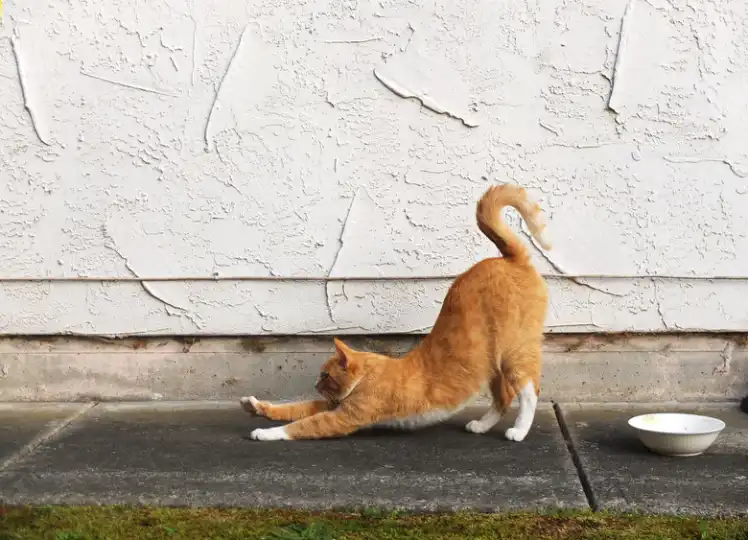
Orange Cat Personality: The Temperament Of Orange Tabby Cats
CatsCat BehaviorOrange Cat Personality: The Temperament Of Orange Tabby CatsBySusan ParettsUpdated Mar 30, 2023Orange tabby cats are the stunning beauties of the feline world with their bright ginger fur bedecked with a bevy of striped patterns. Although these orange felines are typically associated with feisty and outgoing personalities, coat color doesn't determine a cat's temperament at all. In fact, a variety of factors affect how friendly, shy, docile, and playful a cat will be, usually based on the environment in which the cat is raised.Yanine De Jonge / EyeEm/EyeEm/GettyImages #ed511c03f4d14daf56f6294f3b4478f0a, #ed511c03f4d14daf56f6294f3b4478f0a img { display: block; aspect-ratio: 1.4998641673458Orange cat breedsOrange cat breedsOrange tabby cats aren't a unique breed of feline; rather, their fur is a coat color and pattern that you'll find among many cat breeds. Several breeds of cats come with orange tabby markings, including Persians, American shorthair cats, British shorthair cats, ragdolls, American bobtail cats, LaPerms, Maine coon cats, Manx cats, and Scottish folds. The personalities and temperaments of these orange tabby cats may vary by their breed; there is no one type of orange cat character.Orange coat characteristicsOrange coat characteristicsEach orange tabby cat, no matter what breed, has an abundance of a pigment called pheomelanin, the same one that is responsible for red hair in humans. This leads to various shades of orange coat colors, from light coral to dark reddish-orange shades. All orange cats are tabbies. There are five types of orange tabbies: mackerel, spotted, ticked, classic, and patched tabby cats. Each tabby has a signature "M" on his forehead.Orange tabby cat personalityAll copyrights reserved by Harris Hui/Moment/GettyImages #p80dd3b79bdb9e3150edc468c51b2648f, #p80dd3b79bdb9e3150edc468c51b2648f img { aspect-ratio: 4154/3000; height: auto; }Orange tabby cat personalitySo, does the coat color and pattern affect a cat's temperament? Some claim that anecdotally, orange tabby cats of all breeds appear to be more gregarious than others. However, this could be because of the fact that the majority of orange tabby cats are male ― around 80 percent of them. This is simply due to the genetics of their coat color.There is some evidence that male cats tend to be more outgoing, friendly, and gregarious than their female counterparts. So, the fact that more orange tabbies are males could account for why people tend to view them as friendlier than cats of other colors.Every orange tabby is differentEvery orange tabby is differentAlthough there may be some anecdotal evidence that orange tabby cat personality tends to lean toward being friend and outgoing, every cat is different. No matter what the breed, one of the most important contributing factors to a cat's personality is the upbringing and socialization that the cat gets as a kitten.It's important that your cat had exposure to people and other pets, ideally before the age of four months. During this sensitive period, your kitten will learn how to interact with people and other pets based on her interactions with them. If these interactions are positive, the kitten will be more outgoing and friendly than kittens who have negative experiences or who aren't around people at all.Dealing with temperament issuesImage by Chris Winsor/Moment/GettyImages #pab5f83a8d08fa1d0310e3bd2804229d2, #pab5f83a8d08fa1d0310e3bd2804229d2 img { aspect-ratio: 5472/3648; height: auto; }Dealing with temperament issuesIf your orange tabby cat isn't an outgoing, friendly cat like the famous Morris, Heathcliff, or Garfield, you can work on that with positive reinforcement, even for older cats. Food is a good motivator for cats, and you can use tasty treats or small pieces of cooked chicken to reward your ginger kitty for the behavior that you want. For example, if you want a cuddlier cat, sit quietly with your cat in a small room and encourage him to come over and sit with you. When he does, give him a series of treats.For shy ginger cats, encourage them to be friendlier by inviting some friends to your home. Have each friend give your cat some treats so that your cat will soon associate strangers with good things (treats). Pretty soon, your formerly shy cat will be a social butterfly.ReferencesPsychology Today: Why Orange Cats Are So Special, According to ScienceFelineLiving.net: Orange Tabby Cats Facts, Personality And GeneticsNational Geographic: Surprising Things You Never Knew About Your CatCatster: The Orange Tabby Cat — 8 Fun FactsThe Cat Fanciers' Association: CFA BreedsAlley Cat Allies: How to Socialize a Kitten
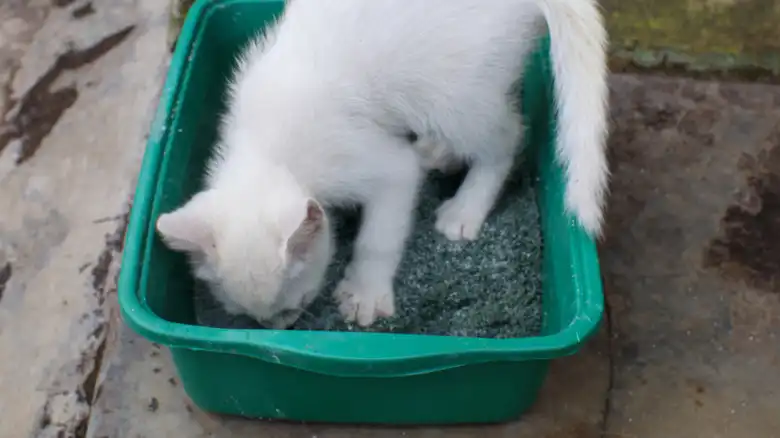
13 Reasons Cats Eat Poop That You Shouldn't Ignore (And What To Do About It)
CatsCat Health13 Reasons Cats Eat Poop That You Shouldn't Ignore (And What To Do About It)ByKeri-Beth ClurFeb. 22, 2025 9:05 am ESTAlpian Ahmad Nurdin/ShutterstockIt's no secret that cats can be weird (read: adorable). Some of the funniest things that cats do are bounce around the house, chatter, stare at nothing, and chew on grass, but when they start displaying unusual behaviors, such as eating poop, you shouldn't ignore it. This behavior is called coprophagia, and although it's disgusting to humans, cats don't associate eating poop with something negative; they're just acting in response to their body's cravings. There are several reasons your cat might be munching on poop, whether their own or another cat's, and sadly, it's usually not just out of curiosity. Instead, it could be reasons such as a dietary deficiency, intestinal parasites, the effects of certain medications, stress or anxiety, or boredom, among others.The good news is that most of these behaviors can be rectified with a diet change, deworming medication from the vet, calming sprays, extra attention or exercise, frequent litter box changes, or redirection. But, sometimes, all you can do is spot the symptoms and take your cat to the vet for a diagnosis and treatment. With that said, let's take a further look into these reasons and what you can do about them.1. Dietary deficiencies can lead cats to eat poopJaromir/Getty ImagesThere are so many cat diet options, with some widely accepted and others widely debated. Common types are dry food (like kibble), wet food (typically from a can), and a combination of the two. Less common types are homemade and raw diets. Dietary deficiencies tend to arise in cats when they're fed low-quality cat food without animal protein, and this is more likely in homemade and raw diets because owners can struggle to get in the right amount of nutrients. Only high-quality food that's nutritionally balanced and complete, compliant with the Association of American Feed Control Officials, and life-stage appropriate should be fed to your cat.A vitamin or mineral deficiency caused by an unbalanced diet may cause your cat to crave non-food items, including poop. A poor diet can also result in weight loss, skin problems, lethargy, diarrhea, vomiting, and a coat that's seemingly lost its luster. If you're adamant about cooking your cat a homemade meal or feeding it a raw diet, work with your vet to ensure it meets your cat's nutritional needs. 2. Intestinal parasites can make cats want to eat poop, tooWestend61/Getty ImagesSadly, various types of intestinal parasites can affect your cat's health. The most common types of worms found in cats are roundworms, whipworms, hookworms, and tapeworms, but there are other intestinal parasites to watch out for, too. Intestinal parasites are especially prevalent in kittens, who get them from their environment or their infected mothers' placentas. It's important to deworm kittens as early as 3 weeks old so that the worms don't stunt their growth. Adult cats can get worms by swallowing fleas or eating infected prey, as well as by eating infected poop.Intestinal parasites steal the nutrients that are intended to fuel your cat's body from its food , which can cause it to experience digestive problems, hunger, weakness, diarrhea, and poor coat quality. Due to hunger and a loss of nutrients, cats may turn to poop to try and get more nutrients. Prescription medication from your vet is crucial to treat a cat's worms, and it will need to be repeated every three months at minimum to keep your cat safe. It's important to give your cat the correct dosage and never use deworming medication prescribed for another type of pet on your cat.3. Eating poop can come as a side effect of some medicationsSelin Aleyna Gul/Getty ImagesSome medications can cause an increase in a cat's appetite, behavioral changes, and the disruption of good gut bacteria and nutrient absorption. Nutrient-deficient cats with an increase in hunger may crave and eat things they typically wouldn't, such as poop. For instance, cats' side effects when taking steroids commonly include increased hunger and thirst in cats, and antibiotics can disrupt your cat's healthy gut bacteria, which can lead to diarrhea.Some cats don't experience any side effects from their medication, while others can experience severe side effects, so it's important to communicate any concerns you have with your vet. They will likely put your cat on a different medication that may be more comfortable and better suited for it. Your vet may also opt to keep your cat on the same medication but introduce probiotics or another medication to strike a balance in its gut and ease negative side effects. Adjusting how you administer your cat's medication may also ease certain side effects.4. Certain diseases may make cats want to eat poopPeter M. Fisher/Getty ImagesSome diseases, such as hyperthyroidism, diabetes, and Cushing's disease (also known as Cushing's syndrome), can cause polyphagia, aka an intense desire to eat. Cats with these diseases may think they're hungry, even though they're not, and eat excessively, never feeling satisfied after a meal. This increased need to eat may result in them eating poop, but it will accompany other symptoms, too. Cats with hyperthyroidism tend to lose weight, even with excessive eating, and experience anxiety, vomiting, and diarrhea. The cat's appetite greatly increases because the disease creates too much of the metabolism-regulating hormone thyroxine. It's usually the result of a tumor in the thyroid gland. Diabetes also causes an increase in hunger because the body isn't able to turn glucose from food into energy. Other symptoms include weight loss, increased thirst, house soiling, lethargy, and poor coat quality. Meanwhile, Cushing's disease is when too much of the stress hormone cortisol is released into the cat's body. It can also cause weakness, hair loss, weak skin, and urinary tract infections, along with an increased appetite and thirst. If your cat's eating habits suddenly change, look out for other symptoms, and take your cat to the vet for a full examination. Although these diseases aren't all curable, your vet can give your cat medication to reduce its symptoms and feel more comfortable.5. Stress or anxiety can make cats eat poop out of fear and survivalRawpixel/Getty ImagesA stressed or anxious cat isn't a happy one, but many things can trigger this response, including changing environments, welcoming a new family member into the home, getting a new pet, or being alone while you're at work or school. Stress can cause behavioral issues in your cat, including urinating in areas it's never messed in before, becoming aggressive, hiding, digestive problems, grooming excessively, and pica, which includes coprophagia. Anxiety can also trigger obsessive-compulsive disorders, which can include symptoms such as tail chasing, self-mutilating, and ingesting non-food items.Anxiety can progressively worsen, so it's important to manage it while symptoms are still mild. You'll need to try and pinpoint what's causing your cat's anxiety, which can take time because there could be many triggers. Once you've determined what sets your cat off, make adjustments to your home. Adding a few more perches to your home may help your cat feel like it can get away from a new pet when it wants to be left alone. A cat bed in a quiet spot may ease your cat's nerves because it has somewhere to hide when visitors come over. You can also chat with your vet about calming pheromone sprays or diffusers, as well as anti-anxiety medications. A few small changes and trying out some cat-calming home remedies can make a big difference to your cat's mental health.6. Eating poop can come from boredom or attention-seeking behaviorsWirestock Creators/ShutterstockBored, unstimulated cats that don't get enough playtime can display behavioral issues like overeating, destructive behavior, aggression, and excessive meowing. It can also cause them to chew or eat plants, furniture, and poop. You can stimulate your cat mentally and physically with new, exciting toys to help them problem-solve and release pent-up energy. You don't have to spend a lot of money on toys, either, as you can make cat toys out of wine corks and other items around your home. You can even turn old boxes into an adorable cat house that your cat can hide, explore, sleep, and climb in. If that's not enough, you can get your cat a perch so it can watch the world outside, allow it to play outside, and groom it often.Other ways to stimulate your cat and give it attention include scheduling play times and training sessions. You can use string or feather wands to get your cat jumping, running, and catching. Playtime and training aren't just fun; they also get their bodies moving to keep their weight in check.7. Cats may eat poop out of submissionMarioguti/Getty ImagesCat poop smells generally stinky to humans, but cats can tell whose poop belongs to who by its smell. Each cat has anal glands that release a scent when it poops, and the scent is unique to each cat and tells other cats information about each other, which makes pooping a good option to mark territory. However, submissive cats would rather bury, hide, or eat their poop to avoid unwanted attention from the dominant pets in their houses. Leaving poop out could make a cat a threat because the dominant pet may think the cat is trying to challenge it.As much as having a multi-cat household sounds inviting, it can come with many challenges, and it's important to try and keep the peace between your cats. You can do this by placing several food and water bowls around the house so they don't have to fight for food. The same is true for toys, scratching posts, perches, litter boxes, and hiding spots. The fewer resources cats need to share, the less fighting there will be. If one cat is dominating the other cats in the home, get it neutered, as this can help reduce territorial behavior and frustration.8. A dirty litter box or overcrowding can lead to poop eatingVera Aksionava/ShutterstockCats feel most relaxed when their environments are clean — as such, dirty litter boxes may lead to stress, anxiety, and behavioral changes in your felines. Cats may poop outside of their litter boxes in an attempt to avoid them or eat their poop so they don't have to stand on it. Cats are so independent that you may forget they need you to keep their environments clean. Thankfully, it doesn't take much time to do. You can stop your cat from eating poop by removing feces from their litter boxes right after they've eliminated. You can help your cat love the litter box by placing it in a quiet area that's easily accessible, large enough to use comfortably, and filled with unscented litter.Overcrowding is another reason cats may develop anxiety and start acting strangely. Because they're independent creatures, they don't like sharing a single space, whether it's a food bowl, a bed, or a litter box. And just like they don't like using litter boxes filled with their own poop, cats don't like using litter boxes filled with other cats' poop. To prevent fighting and unwanted behaviors, make sure each cat has its own litter box, with one extra. To keep them clean, visit each litter box and scoop out any poop at least once a day.9. Cats sometimes eat poop as a response to punishmentDrazen_/Getty ImagesCats tend to stop using their litter boxes because they don't like the smell or feel of their litter, their boxes are too small, the boxes are too dirty, or because of health reasons such as diarrhea, arthritis, or cognitive dysfunction. It can be disheartening when you notice poop around the home when your cat knows to use the litter box, but don't let your emotions get the best of you. Punishing your cat for soiling the house by shouting at it or rubbing its nose in the mess does more harm than good and can cause it to become anxious. Cats may even eat their poop to avoid being punished, which causes more problems.Instead of punishing your cat, praise it when it poops inside of the litter box, as positive reinforcement is a healthier and more proactive approach that develops a bond instead of breaking one. It's also important to determine what's putting your cat off of its litter box. Trying different cat litter, getting a bigger box, cleaning it more frequently, and chatting with your vet about potential health issues may encourage your cat to use the litter box again and stop it from eating poop.10. Eating poop can be a learned behavior that needs to be nipped in the budOlezzo/ShutterstockBecause newborn kittens are so helpless, mother cats lick them to stimulate them to eliminate and clean them. Through this process, mother cats will eat their kittens' poop and lick up their urine. Although it sounds gross, this is a natural behavior and not a sign of concern. It's also normal for kittens to pick up on their mothers' actions and do the same. Most kittens outgrow this learned behavior, but some struggle to break the habit, even after learning to use the litter box. They may continue to eat poop because it's become a compulsive habit or because they've grown to like the taste of it. Cats may even mimic the behavior if they see a dog engaging in coprophagia.If you see your cat engaging in coprophagia, even if it's done it from a young age, behavioral training is necessary. Although it's normal for kittens to eat poop, the behavior should be worked out as they get older because poop contains bacteria and parasites that can make them sick. If you see your cat trying to eat its poop, redirect its attention with its favorite toys, reinforce better behavior with rewards like treats, and ask your vet for some food additive options that change the flavor of their poop, as this may put your cat off of it.11. Cognitive dysfunction can lead to cats eating poop as wellJohner Images/Getty ImagesSigns of cognitive dysfunction, like anxiety and memory loss, can become easily noted in affected cats from around 10 years old. Other signs include disorientation, no interest in things they once enjoyed, house soiling, wandering, and excessive sleeping. Some cats with cognitive dysfunction may eat their poop out of confusion because they've forgotten that they've already eaten or to self-soothe due to their heightened anxiety. They could also be drawn to the poop because of the undigested bits of cat food present in it and don't understand that poop isn't food.Vets will need to rule out other health conditions through blood tests before being able to diagnose a cat with cognitive dysfunction because other conditions can cause similar behavioral changes. If your cat does have cognitive dysfunction, your vet may start them on supplements or medication to slow down progression. You can also add enrichment to your cat's environment to keep it mentally stimulated. Feed your cat and do certain activities, such as playing with a specific toy, at the same time each day to maintain consistency and predictability. Although redirecting its focus to something else will prevent it from eating poop, removing poop from the litter box consistently is the most effective option.12. Brain tumors can increase appetite (and, therefore, the desire to eat poop)Abraham Gonzalez Fernandez/Getty ImagesAlthough uncommon, brain tumors can develop or move into a cat's brain. If the mass pushes against or affects certain parts of your cat's brain, it can cause it to become very hungry or experience unusual cravings to the point where it may seek out inedible items. Sometimes, cats also experience loss of learned behavior and may do things they've outgrown or been trained not to do, such as eating poop. However, these symptoms alone aren't signs of a brain tumor. In fact, some cats with brain tumors actually lose their appetites. Other symptoms could include weight loss, lethargy, loss of vision, weakness, muscle spasms, loss of balance, tremors, and seizures. If these symptoms arise, immediate attention from a vet is necessary. Your vet may want to surgically remove the brain tumor and administer chemotherapy. Once the brain tumor has been removed, unusual eating behaviors, such as eating poop and other non-food items, should diminish.13. Pyruvate kinase deficiency (PKD) can induce anemia in your cat, leading to poop eatingCenkertekin/Getty ImagesSome cat breeds are prone to pyruvate kinase deficiency (PKD), which is a genetic condition that can be life-threatening if not treated. Pyruvate kinase deficiency (PK) occurs when the enzyme pyruvate kinase is compromised or missing and can't perform its function of energizing a cat's red blood cells. This condition can cause anemia and nutrient deficiencies, causing cats to crave unusual items or seek out extra nutrients. Anemia is one of the main causes of pica, which often includes coprophagia.Unfortunately, there aren't many treatment options for PKD other than bone marrow transplantation. Vets can treat the symptoms of PKD with various supplements, as well as blood transfusions. Although there are several ways to deter cats from eating poop, the behavior will only be resolved once the symptoms of PKD are managed in this case.Always consult your veterinarian before making changes to your pet's diet, exercise, or care. To find an accredited veterinarian in your area, you can search theAmerican Animal Hospital Association's online database.
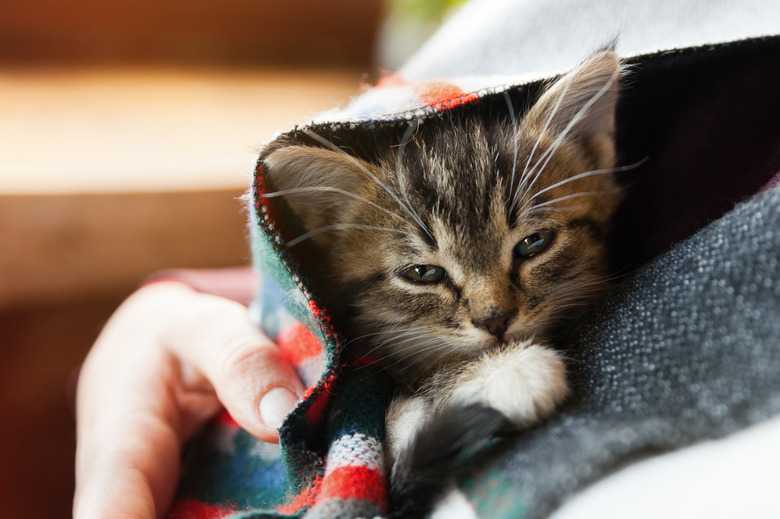
How To Know When A Kitten Needs To Pee
CatsCat BehaviorHow To Know When A Kitten Needs To PeeByLisa McQuerreyUpdated Aug 30, 2020Prystai/iStock/GettyImages #p1bcd79653dfaf623c5dbd0724f0739ca, #p1bcd79653dfaf623c5dbd0724f0739ca img { aspect-ratio: 4556/3037; height: auto; }Litter box training a kitten requires a different approach than housebreaking a dog, who can be taught to signal you when he needs to go outside. There are some overlaps, however, in terms of determining when the kitten needs to go. Getting your kitty accustomed to a litter box from the first day you bring her home will help ensure a clean, pee-free environment for everyone.Create a Kitty BathroomCreate a Kitty BathroomSet up a litter box in a low-traffic area of your home that's easy for your kitten to find and access. Ideally, a bathroom, laundry, or utility room is a good choice because accidents are relatively easy to clean up in these locations. You can also close your kitty into these small rooms with her litter box to get her accustomed to using her bathroom. Purchase a litter box that is easy for your kitten to climb into, and avoid covered boxes, at least initially, as some cats shy away from them.Post-eating potty timePost-eating potty timeAfter your kitten consumes food or water, she'll have to poop and pee within about 10 minutes. After feeding, take her directly to her litter box area and leave her alone. Cats like to go to the bathroom in private, and they naturally are attracted to areas where they can bury their leavings.When your kitten successfully goes potty, show her praise and attention. Keep the litter box clean, but initially, leave a little of the pee behind so she'll recognize her scent and remember where she has to go to the bathroom.Kneading to peeKneading to peeOutside cats will look for a private area to paw the soft ground, go to the bathroom, and cover it up. You may find your kitten exhibiting this pre-pee digging behavior before urinating outside the litter box. This might happen if your cat is marking territory or is turned off by a dirty litter box. Your kitten also might do this upon waking, before she is completely trained to the litter box.If you find your cat exhibiting this behavior, pick her up and take her to her litter box, but don't reprimand her for accidents. Instead, clean mistakes with an enzymatic cleaner designed to break down and eliminate all traces of the pee to prevent re-marking territory.Assuming the positionAssuming the positionKittens and cats squat when they're getting ready to urinate, so if you find your kitten squatting someplace she shouldn't, relocate her to her litter box immediately. If the kitten can't find a suitable place to go to the bathroom, she may choose a soft spot, like a towel on a bathroom floor or in a corner of carpeted flooring.Crying out loudCrying out loudWhile a kitten can't bark like a dog to be let outside to go to the bathroom, a kitten who is litter box trained may cry or paw at a closed door if she is accidentally blocked off from her litter box. Wherever you place kitty's bathroom, make sure it's an area she has continual access to. You might even install a cat pet door inside your home if you want to have the option of closing off the cat litter box area while still allowing your cat constant access to her potty area.ReferencesPet Education.com: Litter Box Training for Your KittenColorado State University Veterinary Teaching Hospital: Litter Box Training Your CatCummings Veterinary Medical Center: Litter Box Training and Issues With Cats
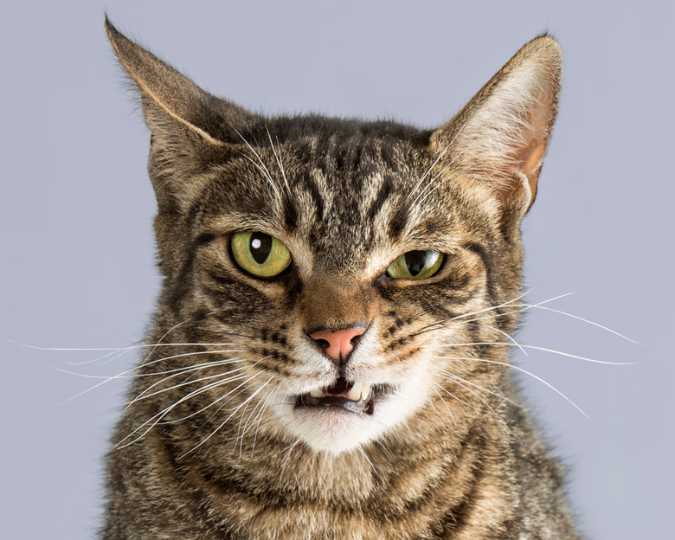
How Your Cat's Behavior Changes With Age
CatsCat BehaviorHow Your Cat's Behavior Changes With AgeByKayleigh RobertsAug 23, 2018 9:53 pm ESTLennette Newell/The Image Bank/GettyImages #p9349a7e7cda8d1ae1a2b933f06044598, #p9349a7e7cda8d1ae1a2b933f06044598 img { aspect-ratio: 4500/3600; height: auto; }Just like people, dogs and cats change as they get older. If you've noticed that your cat has started to act differently since she matured from a kitten to an adult cat, you're not imagining anything: This just a normal part of growing up. Cats' behavior continues to change throughout their life as they age. Here's how you can expect your cat's behavior to change over time.How your cat's behavior may change with age.How your cat's behavior may change with age.Just like humans, cats change as they get older. While kittens are often manic little balls of energy, rage and destruction, older cats are calmer and more content to lay in window sills and soak up the sun.As cat's mature from adulthood into senior status and beyond, they may exhibit some or all of these common behavioral indicators of aging.Unusual sleep-wake cycleMore vocalNeedy or demanding behaviorEasily confusedIncontinentLethargicIrritableAggressiveWithdrawnWith age, many cats will undergo a change in their sleep schedule. Kittens learn to mirror their humans' activity patterns, and this sleep-wake cycle continues on through cats' adult years. Older cats might start to stay up all night and sleep all day. If this happens, try coaxing your cat back toward a more tolerable schedule by wearing it out with play and attention just before bed.More Like ThisCatsAt What Age Are Cats Considered Full-Grown?CatsWhen Do Cats Stop Growing? Reliable Ways to Know When Cats Reach Their Full SizeCatsWhy Does My Cat Smack Me When I'm Sleeping?RELATED: Expect These Changes as Your Cat Becomes a SeniorSenior cats may also be more prone to aggression. This isn't because they're becoming meaner with age, necessarily. As cats enter their senior years, their eyesight and hearing deteriorate. Their senses simply do not perceive as much as they used to, and they're easily caught off guard and react accordingly. Don't take it personally, just try to make sure that you approach with caution and give your cat plenty of time to react to changes in its environment.Unfortunately, older cats might also have more accidents in the house. As they age, cats can lose some of their ability to control their bowels and bladder, which can lead to more out-of-the-box bathroom breaks. If this starts to happen, consider investing in extra litter boxes to make sure that your cat is always close to an appropriate place to go if the urge strikes.Andrea Picchi / EyeEm/EyeEm/GettyImages #eae1a8503b9364164a55c3d46ba810c6f, #eae1a8503b9364164a55c3d46ba810c6f img { display: block; aspect-ratio: 1.26341764343Older cats may suffer from feline cognitive dysfunction.Older cats may suffer from feline cognitive dysfunction.Feline cognitive dysfunction (FCD) is a condition that cat-owners should be aware of as their furry friends age. The condition affects more than 55 percent of cats 11-15 years old and more than 80 percent of cats who are 16-20 years old, according to the pets section of WebMD. Cats affected with FCD might experience a range of symptoms including memory loss, decreased cognitive abilities, and sight and hearing problems.THE BASICS: Caring for Senior CatsOther behavioral changes associated with FCD include confusion and disorientation, increased vocalization, and increased pacing. These side effects come along with the cognitive decline that cats experience during FCD. However, it's worth noting that there are other potential causes of all of these symptoms and it's important to talk to your vet to rule out other causes before your chalk changes up to old age or the onset or FCD.Cat behavior by ageCat behavior by ageAs your cat passes each stage of life, expect signs of aging to increase, and energy levels to decrease.Kitten (0-6 months):Your cat is full kitten, not sexually mature, and trying to process the massive amounts of information he's taking in about the world. It's a lot to deal with. All your kitten seems to want to do is play.Teen (6-12 months):The terrible "teens" of cat-hood. During this stage, your kitten is a full on nightmare, mouthing and grabbing at everything he can, challenging the humans in the house for dominance, and generally trying to show everyone he's the boss of everything (an attitude he will probably maintain throughout his life, regardless of how dominant he proves to be).Adult (1-2 years):By one, your cat is entering adulthood and developing all kinds of lifelong cat behaviors, like kneading, hissing, and hiding. He's calming down a little from his full-on kitten stage, but he's still got plenty of energy. He's learning a lot right now and settling into his cat life.Prime maturity (3-6 years):From ages 3-6, your cat is in his prime. He's learned the basics of catting and he's settled into the personality and energy level that feel right for him.Middle age (7-10 years):At this point, your cat has entered the kitty equivalent of middle age. He's still got energy, but not quite as much as he did in his prime. You may notice that your cat starts to becomeparticularlyset in his ways—he might be much more resistant to any changes and might experience anxiety more often than he did in the past.Senior (11-14 years):Now, your cat is officially a senior citizen. He will likely start to experience a decline in health, including deteriorating vision and hearing and possible cognitive decline. Like older humans, your cat might be prone to "grumpiness," and you might notice he gets irritated more easily than he used to.Geriatric (15+ years):After 15, cats are categorized as geriatric and need a lot more attention. Any behavioral changes will warrant a vet trip at this point and you can expect extreme lethargy and lots of naps.What is considered old age for cats?What is considered old age for cats?Around age 11, cats enter what is considered the senior stage of their lives. From 11-14, cats are comparable to humans in their 60s and 70s. Although cats become "old" at around 11 years old, they don't become officially geriatric until the ripe old age of 15. At this point, they're comparable to humans in their 80s. Many cats live to be geriatric and not all experience extreme health issues. It's important to keep an eye out for changes and discuss them with your vet, especially with geriatric cats.CAT AGE CHART: How to Convert Cat Years Into Human YearsHow old age affects your cat's behavior.How old age affects your cat's behavior.Old age impacts cat behavior in much the same way it impacts humans. Older cats are likely to have less energy (which translates to even more napping and lounging about than they did in their prime). They're also typically more irritable and easily startled, thanks to declines in their vision, hearing, and cognitive ability.Age changes us all. Ensure that your cat lives all nine of its lives by maintaining a regular routine of playtime, affection, healthy food and visits to the vet.
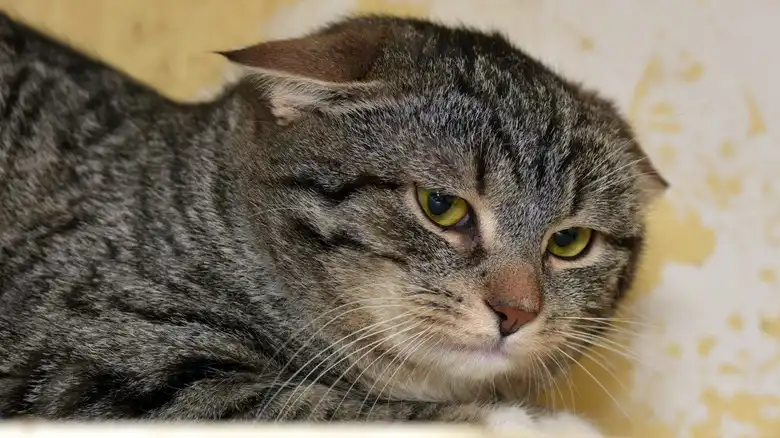
What It Means When Your Cat Has Flattened Ears (And Why You Shouldn't Ignore It)
CatsCat BehaviorWhat It Means When Your Cat Has Flattened Ears (And Why You Shouldn't Ignore It)BySanaphay RattanavongJan. 15, 2025 9:25 am ESTAnna Krivitskaya/ShutterstockHave you ever noticed your cat flatten its ears and wondered what it meant? Many cat parents miss this subtle sign of stress, but understanding flattened ears is the first step to better owner-pet communication — and a happier, safer cat. Though cats are subtle communicators, their ear positions are one of the most telling indicators of their mood. When a cat flattens its ears, it's sending a clear signal of distress, whether from fear or aggression. It's a deliberate and vital part of feline communication.Flattened ears are a direct sign of how a cat feels about its environment. This can occur during stressful situations or circumstances like loud noises, visits to the vet, or encounters with strangers. Recognizing and interpreting this behavior is essential for preventing misunderstandings, especially since these moments can escalate if ignored. To fully understand the complexities of your cat's emotions, you can explore how cats communicate with each other, combining ear movements with other cues like vocalizations and tail signals. Additionally, knowing what your cat's body language is telling you will give you a clearer picture of its emotional state.Flattened ears: fear, aggression, or something else?Azovsky/ShutterstockFlattened ears are a clear signal from your cat, reflecting fear or aggression, and the context in which this behavior occurs is key to understanding its meaning. For example, when cats feel scared, their ears become completely flat on their head, creating a defensive posture to protect themselves. Aggression, by contrast, involves ears flattening backward or swiveling to the side, signaling readiness to confront a threat. This stance is usually paired with other signs like an arched back, dilated pupils, or growling.Discomfort or unease is another possibility. Cats might flatten their ears in new environments or when meeting unfamiliar people. Unlike fear or aggression, this behavior doesn't indicate an immediate threat response, but rather a subtle expression of tension or unease.Interpreting these signals requires paying attention to the full picture of your cat's body language. A frightened cat may crouch with flattened ears and hiss, while an aggressive one might stand tall, growling and staring directly at the perceived threat. Recognizing these nuances helps you respond appropriately to your cat's needs. To deepen your understanding of feline communication, explore the role of cat facial expressions, and for a playful perspective, the "airplane ears" phenomenon, which has become a popular cat meme, offers a lighthearted take on this serious behavior.How to respond when your cat flattens its earsGabrielpevide/Getty ImagesHow you respond when your cat has flattened ears is crucial for preventing further stress and ensuring your feline's safety. Start by giving your cat space. Forced interaction can heighten its distress, so it's essential to allow your feline to retreat. Make sure it has access to safe hiding spots or elevated areas, as these can help it feel secure and regain confidence. Creating a calm, quiet environment free from loud noises or sudden movements can also reduce immediate stress.If your cat's flattened ears are a response to recurring triggers, gradual desensitization can be an effective solution. Begin by introducing the stimulus at a very low intensity, such as keeping a safe distance or reducing noise levels, and pair this exposure with positive experiences, like treats or playtime. Over time, you can slowly increase the intensity as your cat becomes more comfortable. This method helps build positive associations and reduces your cat's negative emotional reaction.Consistency and patience are key. By combining desensitization with counterconditioning techniques, where triggers are paired with rewards, you can help your cat overcome its fears. However, if the behavior persists or escalates, consider consulting a veterinarian or a certified behaviorist. Professionals can assess your cat for underlying medical issues or provide personalized strategies for behavior modification. After all, taking the "ears" out of "fears" — and vice versa — should be the ultimate goal, which starts by listening closely to your cat and all it has to say.
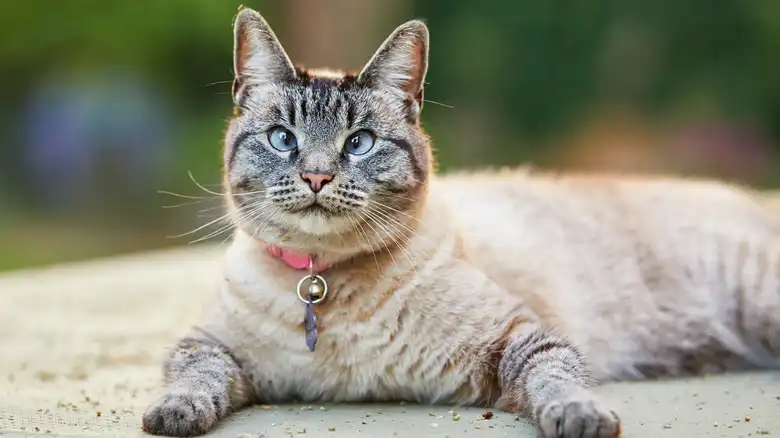
Why Are Some Cats Cross-Eyed?
CatsCat HealthWhy Are Some Cats Cross-Eyed?ByCynthia AnayaMarch 16, 2025 3:25 pm ESTSvetlana Popova/Getty ImagesAlthough there are many cat breeds in the world, many of their characteristics are similar to each other, like their size, pointy ears, and body structure. However, some cats have features that you might associate more with humans than animals, such as crossed eyes. You may not have ever seen a cross-eyed cat in person, but it's actually a common feline condition medically referred to as strabismus. Most cats with crossed eyes were born that way (congenital strabismus), but some develop it later in life (acquired strabismus) as the result of a health problem.Certain breeds are more likely to be born with crossed eyes than others, including Siamese cats, Persian cats, and Himalayan cats. Cats with congenital strabismus can still see everything around them and live normally, since they can start adapting to the condition as soon as their eyes open. Cats that become cross-eyed months or years after birth, on the other hand, may struggle with the vision change and require veterinary care. This latter group of cats and those born with the condition may also struggle with depth perception and focus.Inner ear infection or disease, eye injury, cancer, tumors, feline leukemia virus, and nerve damage are some of the causes of acquired strabismus. In some cases, strabismus as a result of an underlying condition can be reversed with treatment. This is why it's important for owners to schedule an appointment with a veterinarian as soon as they notice that their cat's eyes have crossed.Treatment options for a cross-eyed catRaquel Aparecida de Abreu/ShutterstockThere is no medical reason to treat congenital strabismus since no health condition caused the cat's eyes to cross. However, veterinarians typically recommend that cats with acquired strabismus receive treatment, especially since cancer can be a cause. Any other common cat illnesses that may have led to the crossed eyes will help determine the course of treatment.Surgery is one treatment option. If an injury caused the eyes to cross, the doctor may recommend corrective surgery. If a tumor is a culprit, treatment options could include tumor removal, radiation therapy, chemotherapy, or a combination of the three, depending on if it's benign or malignant. The veterinarian might even suggest complete eye removal if the tumor is found to be cancerous and aggressive.Medication and physical therapy are two other available treatments. A veterinarian would typically prescribe antibiotics if the strabismus is the result of an abscess, meningitis, or an ear infection that affects the brain. Physical therapy can be an alternative to corrective surgery, with the goal of strengthening the eye muscles with various activities that encourage eye movement in specific directions. While crossed eyes don't necessarily mean there is an issue — and may just be a quirk of your cat — if there are any changes, talking to your vet is best.Always consult your veterinarian before making changes to your pet's diet, exercise, or care. To find an accredited veterinarian in your area, you can search theAmerican Animal Hospital Association's online database.
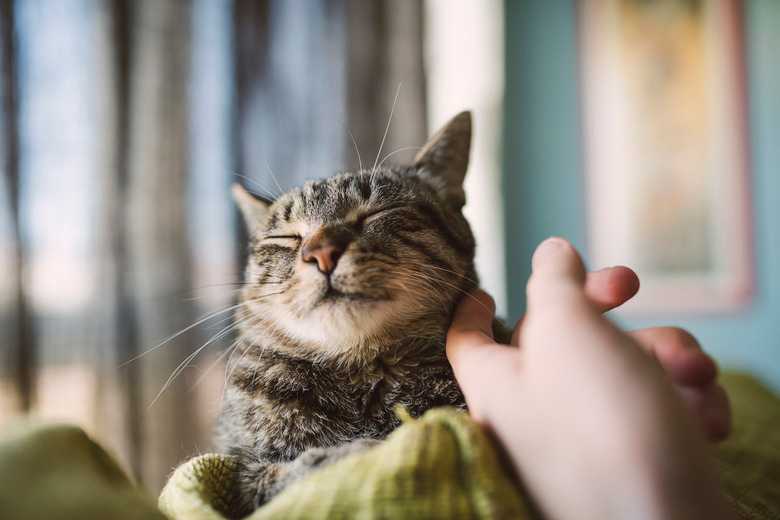
My Cat Is Gnawing On My Fingers
CatsCat BehaviorMy Cat Is Gnawing On My FingersByLisa McQuerreyUpdated Aug 25, 2021If you find your kitty gnawing on your fingers, it could be a playful gesture, a throwback to kittenhood, or an act of aggression. Identifying what's behind the kitten nibbling on hand can help you take appropriate action to curb the unwanted behavior. If gnawing progresses to biting, a trip to a vet or cat behavioralist may be in order.Linda Raymond/Moment/GettyImages #ec43e1d834a7b9146fc23472c01a2d315, #ec43e1d834a7b9146fc23472c01a2d315 img { display: block; aspect-ratio: 1.5Kitten nibbling on handKitten nibbling on handA young kitten's gnawing could be a way to soothe sore gums irritated by teething. Your kitty may view you as a mother substitute and chew in the same way she used to nurse from her mother, or play bite with her litter mates. Kitten biting fingers can be cute when the cat is very young, but can become a learned behavior that the cat may carry into adulthood. Curtail the behaviors when they start, no matter how cute they may be, or you'll have a tougher time down the line. When gnawing starts, give your kitty something more appropriate to chew, like a toy, and walk away and ignore her if she won't be deterred.Playful fun and gamesWestend61/Westend61/GettyImages #pba76b370420ad797098c62f8930dca57, #pba76b370420ad797098c62f8930dca57 img { aspect-ratio: 6016/4016; height: auto; }Playful fun and gamesYour cat may enjoy the play biting and finger gnawing because it means fun, interactive time with you. If you've encouraged the behavior in the past, or allowed it to go on and engaged in a positive way, you've reinforced the idea that it's a good thing. Transition to other forms of interactive play with your cat, such as with a feather dancer, laser pointer, or string.Keep your fingers away from her mouth when grooming or petting, and walk away when she starts to bite. Avoid toys that encourage playing with or biting at your fingers. Believe it or not, sometimes a kitting biting fingers means that the cat doesn't want you to stop petting her or giving her attention.Kitty may be stressed outKitty may be stressed outCats can become stressed or develop obsessive-compulsive disorders, such as incessant gnawing or chewing. This typically occurs with changes in the household or stressors in the environment. Try to maintain a regular schedule for your cat to reduce the potential for this problem through regular mealtimes, a balanced diet, and a clean litter box. Make sure kitty is comfortable around other pets, human household members, and guests. If she prefers to be alone, be certain she has a place she can call her own to escape from stressors.Your hands smell goodYour hands smell goodYour cat may be chewing your fingers because they smell or taste good. Always wash your hands thoroughly, particularly after preparing pungent-smelling foods — and especially cat food. Use unscented hand creams and lotions to deter unwanted gnawing as well. If your cat bites at your fingers when you offer treats by hand, stop feeding her by hand altogether, and feed only from her bowl.Go see a professionalChalabala/iStock/GettyImages #pb55e3d2303e2128cb6b092c08525ea55, #pb55e3d2303e2128cb6b092c08525ea55 img { aspect-ratio: 5081/3387; height: auto; }Go see a professionalPlayful gnawing and nips can turn to biting if left unchecked. While it's best to address early behaviors before they reach more aggressive levels, your cat can be retrained. Bring the gnawing activity to your vet's attention so they can rule out any underlying medical or health issues that could be promoting the action. Consider consulting a pet behaviorist to help you get to the underlying cause of the problem.ReferencesHumane Society of the United States: Teach your kitten how to play niceVCA Hospitals: Kitten Behavior and Training – Play and Investigative Behaviors
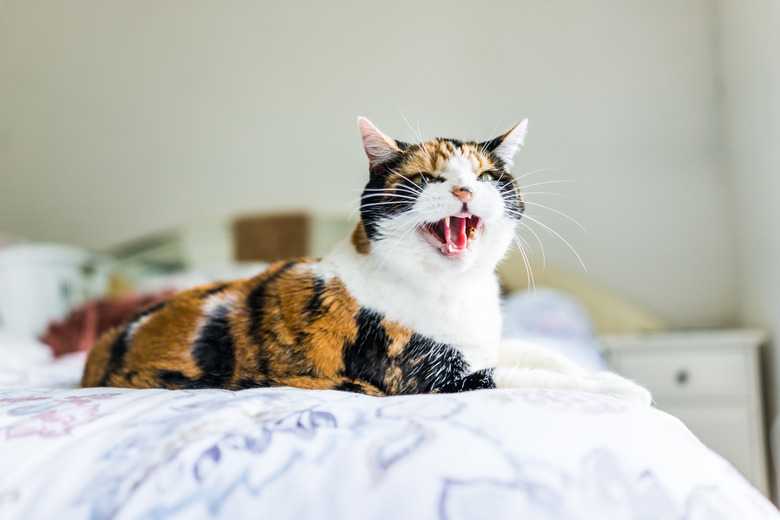
Why Is My Cat Hissing And Growling For No Reason?
CatsCat BehaviorWhy Is My Cat Hissing And Growling For No Reason?ByVanessa SalviaUpdated Aug 12, 2019krblokhin/iStock/GettyImages #pc8e81478d87aa3f2d8d7da71edd47588, #pc8e81478d87aa3f2d8d7da71edd47588 img { aspect-ratio: 6000/4000; height: auto; }Cats are creatures of mystery, which is part of their appeal. One moment they're kneading you or rubbing their face against you, and the next they're ignoring you. They might go from purring one second to suddenly sitting in a corner.Cats have different senses than humans do, so when you see your cat hissing at thin air, it might not mean that she's seen a ghost. She might be looking at something or hearing something that you can't see with your limited, mortal senses.Why do cats growl?Why do cats growl?Growling and hissing are both very common ways that cats communicate. A cat growling and hissing is usually a cat who's scared. The Humane Society says that cats have a wide variety of vocalizations that they use for communicating, both with other cats and with humans. A cat who is growling, hissing, or spitting is a clear sign that the cat is agitated, frightened, or angry about something.The problem is that when a cat is growling, it's not always obvious to us why they're growling. Even when a cat seems to be simply staring at a wall there are things that they can sense that humans cannot. Cats have keen eyesight since they evolved to be hunters. For example, your cat may notice the movement of a dust particle, or something else that is interesting to him that just happens to be on a very small scale.When your cat growls and hisses, he's effectively saying, "Back off now, or else." Usually, a growl is just a warning and he won't actually attack. Growling is often accompanied by hissing along with possibly arching his back. The point is to make himself sound and look fierce enough that whatever is bothering him backs off.Cat hissing at thin airCat hissing at thin airCats can hear much better than we can. Hartz says that on the low range of hearing, cats and humans are about the same in what we both can hear. The high end of the hearing range in humans, however, reaches its limit much sooner than cats' hearing reaches its limit. This means that cats can hear things of a much higher pitch than humans can.In fact, the range of what cats can hear is even higher than that of dogs! In another anatomical difference, cats can swivel their ears in all directions, which helps them pinpoint the source of sounds with much more accuracy than we can. Even if you can't tell where a sound is coming from, or even hear the sound, your cat will be able to pinpoint it precisely.A cat hissing at thin air could be hearing something in the house that you can't see or hear. There may be an animal outside that she can hear or smell. If there are loud children in the house, your cat growling may be a sign that she is agitated and scared. Visitors to your home can easily bring on a growl, a hiss, or both, particularly if they forget their manners and approach your cat suddenly.Why is my kitten growling?Why is my kitten growling?Sometimes a kitten growling is simply a biological impulse. Mother cats will hiss and growl to warn others away from their kittens. The kittens are learning from their mother, so they may hiss and growl just to emulate her. Older cats may growl to protect a toy or food.Bottom line, cat growling is a natural way that cats communicate. But, if your cat is consistently growling and hissing at something you can't see, it might be a good idea to get him checked out by a veterinarian. If there's some external factor that may be agitating your cat, such as a next-door dog that is barking, perhaps try to comfort your cat or allow him to control his environment by giving him safe, quiet places to hang out.ReferencesThe Humane Society: Understanding Feline LanguageHartz: How Your Feline Uses His Senses
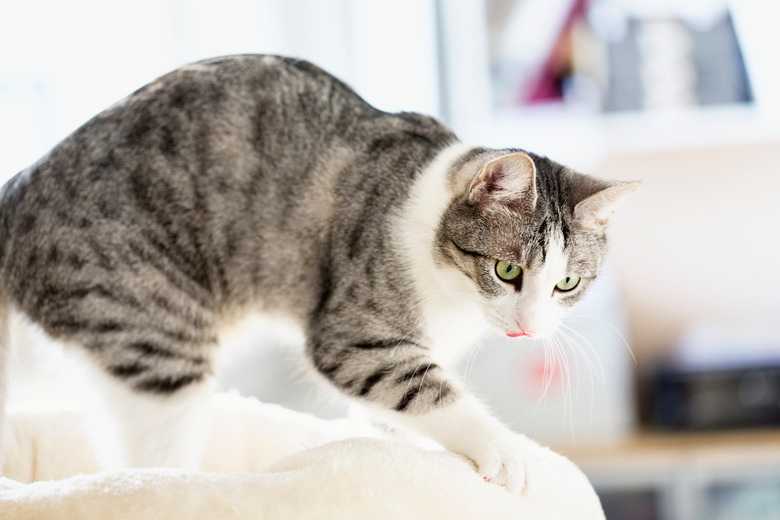
Why Do Cats Knead?
CatsCat BehaviorWhy Do Cats Knead?ByJennifer Kelly GeddesUpdated Apr 14, 2022Why cats knead may be a head-scratcher to some pet owners, but seasoned cat lovers know an age-old motion when they see one. This instinctive activity dates back to birth for this fluffy animal, and cat kneading continues to be important as your kitten becomes an adult.#e270683ba6e5315fffe1c0ac588b4f729, #e270683ba6e5315fffe1c0ac588b4f729 img { display: block; aspect-ratio: 1.5Cats making biscuits isn't really what's going on when a cat presses down on a soft surface (or your thigh!). As you learn about cat kneading and why it happens, it's also a good idea to pick up on a few ways to curb the habit too if only to protect your couch upholstery and your own skin. The best ways to ease the kneading at home is with consistent redirection along with praise, treats, and fun toys to distract.Why do cats knead?Why do cats knead?Why cats knead isn't known for sure, but there are several theories related to how a cat grows and develops and makes herself comfortable. If you spy a cat kneading, it could be due to the following:More Like ThisCatsWhy Do Cats Knead Blankets?Cats5 Interesting Things to Know About a Cat KneadingCatsSofas That Cats Can't RuinShe's remembering her nursing days: One kneading theory has to do with kittens pressing down on their mother while they suckled. If your cat kneads, she could be recalling her youth.She's showing love: Cats often knead to show their owners kindness and affection.She's trying to relax: Cats do feel stress sometimes, and kneading can be calming.She's creating a nest: Pawing and pressing on the ground or carpet could be a cat's way of making a cozy nest for her nap, much like dogs circle (and circle) before they settle down.She's marking her spot: Kneading could also be a way of claiming certain territory, as cat paws contain scent glands.What happens when cats knead?SilviaJansen/iStock/GettyImages #p48794c6b4c8693d237a8cc5c61d1a849, #p48794c6b4c8693d237a8cc5c61d1a849 img { aspect-ratio: 5760/3840; height: auto; }What happens when cats knead?When a cat is getting ready to knead, he may arch his back slightly as he bears down with both paws on a soft surface, such as the bedspread, sofa cushion, or his own bed. Your cat may even leap into your lap and knead your legs, which can be painful since his claws are out when he does it. Cat kneading is a happy action, but it's not a silent one; you can expect to hear some purring as he works his paws up and down. The kneading action is soothing and relaxing to cats, causing some to conk out for a short snooze during the process, which is super sweet to see.How to stop cat kneadingHow to stop cat kneadingCat kneading can be a bit destructive since your kitty's claws are pressing into fabric and other soft material, resulting in loose threads, holes, and tears. Kneading could also bother a pet dog in the house or the kids if they're trying to hold the cat. While you shouldn't scold your kitty when she's kneading, you can work to curb the activity and encourage it in other areas.One way to limit the destruction that a cat's kneading can do is to keep her nails trimmed short. You might also check out special sprays on the market to focus your kitty's efforts away from your settee and to her own blanket.SilviaJansen/iStock/GettyImages #e677410db772e56f6e68a9a497a19edb5, #e677410db772e56f6e68a9a497a19edb5 img { display: block; aspect-ratio: 1.4998574280011Consider a special pad made just for kneading that you can keep nearby when your cat is poised to begin. If she starts to knead in the wrong spot, gently remove her and offer a toy or treat by way of distraction. Whatever you do, don't punish your cat for kneading. This tendency is a natural feline habit that your pet can't help. Instead, keep redirecting her and rewarding her with tasty treats and toys.ReferencesThe Humane Society of the United States: The Cat's MeowNebraska Humane Society: Is My Cat Happy?
Cats Wag Their Tails Too. Here's Why
CatsCat BehaviorCats Wag Their Tails Too. Here's WhyBySanaphay RattanavongDec. 18, 2024 9:25 am ESTSamri/ShutterstockYour cat's tail is a built-in mood ring, and it's always sending signals. A softly swaying tail often indicates curiosity or contentment, while rapid movements can signal agitation. Certain gestures, like a high, quivering tail, can even signify excitement or affection, especially when greeting a trusted person. Studies, such as 2021 research published in the peer-reviewed journal Animals, suggest that this upright tail posture is a common way cats express friendliness toward humans, frequently followed by cute actions like rubbing on you.Beyond emotions, tail wagging in cats reflects an ability to adapt their communication strategies to suit their environment — for example, a shared home with humans. Behavioral research has shown that felines modify how they use tail signals to connect with their people. This adaptability allows cats to use their tails not only to convey their emotional states but also as a deliberate tool for interaction. Understanding these nuances will help cat parents better interpret their feline's behavior and foster deeper bonds. Moreover, researchers noted in a separate article published in Animals "that understanding behavioural plasticity and other recently evolved traits of domestic cats may lead to management strategies that maximise health and welfare of cats, wildlife, and humans."Just as it's important to pay attention to and "read" the shake and shape of a dog's rear extension, so too with cats. Now, move over, Rover, as we unpack the furl and flicker of wagging feline tails.Tell-tale tails and their role in feline communicationCarol Yepes/Getty ImagesYour cat's tail is an expressive tool, and each movement or gesture it makes can reveal a lot about their mood. One of the most common tail positions is a high, upright tail, often quivering slightly. This is a friendly signal, typically seen when cats greet their humans or anticipate something positive, like feeding time. Research focused on cat tails' social function, such as a 2009 study published in Behavioral Processes, highlight that this posture often precedes affiliative (read: positive) behaviors like rubbing against their owners' legs.When a cat's tail lashes back and forth rapidly, it's a clear sign of agitation or irritation. You might notice this if you're petting them, and they've had enough. As you likely know, ignoring it could lead to a swat or nip. On the other hand, subtle tail tip twitches often indicate focus, such as when your cat is stalking a toy or prey. Research on feline communication shows that these movements reflect your cat's heightened concentration and readiness to act.Some tail movements are deeply tied to affection and trust. For example, a cat wrapping their tail around you or another cat can signal a sense of safety and connection, akin to offering a hug. In contrast, a forcefully thumping tail or one held low and stiff may indicate discomfort, stress, or fear. Understanding these gestures in the context of their environment and other signals — like ear positions, posture, and vocalizations — is essential for decoding your cat's mood. Studies on multimodal communication in cats, including 2023 research published in Animals, emphasize the importance of integrating these cues to figure out your cat's emotions and respond appropriately.When tail wagging might signal that something's wrongFanpro/Getty ImagesWhile tail wagging is a normal part of feline communication, there are times when it can signal something more than just emotions, as it may be indicative of certain conditions. (Read here for cat tail injury symptoms and treatment.) Sudden changes in tail movement patterns or frequency may indicate discomfort or stress. For example, excessive tail wagging paired with signs like lethargy, loss of appetite, or avoiding contact could point to an underlying medical issue, including pain, tail injuries, or even neurological disorders. Cats with conditions like feline hyperesthesia syndrome — a sensitivity that causes tail twitching and other behaviors — may exhibit exaggerated tail movements that warrant attention.Physical injuries, such as sprains or fractures, are another potential cause of unusual tail behavior. If your cat's tail appears limp or they react negatively to touch in that area, it could indicate trauma or nerve damage. Skin irritations from fleas, allergies, or infections can also lead to excessive tail movement or biting. Observing such signs in tandem with tail movements can provide vital clues to your cat's health. In such cases, pet parents may want to err on the side of safety and consult a veterinarian for prompt diagnosis and treatment.Even if your cat's tail wagging seems normal, paying attention to the context and frequency is key to understanding your pet. Behavioral plasticity allows cats to adapt their communication styles, including tail movements, to fit their environments. However, monitoring sudden changes in behavior can help you identify stressors or potential health concerns before they escalate. After all, if a picture is worth a thousand words, a wagging tail may be worth a thousand meows.For more interesting details about feline behavior, check out these seven facts about cats' tails.
Science Says Cats Are One Of The World's Most Invasive Species. Here's Why
CatsCat BehaviorScience Says Cats Are One Of The World's Most Invasive Species. Here's WhyByCori ChapmanDec. 20, 2024 9:25 am ESTHeidi Bollich/ShutterstockIt can be easy to forget that the adorable bundle of fur curled up in your lap is actually a prolific hunter. There's a scientific reason that even domesticated cats bring home dead animals when let outside — it's in their nature. It is this natural disposition towards stalking and pursuit, coupled with the feline ability to reproduce quickly, that has made domestic cats one of the most invasive species in the world.The U.S. Geological Survey (USGS) defines an invasive species as a "nonnative organism (disease, parasite, plant, or animal) that begins to spread or expand its range from the site of its original introduction and that has the potential to cause harm to the environment, the economy, or to human health." The descendants of wild cats, the domestic and feral felines we know today arrived in North America alongside colonists from Europe. Cats kill billions of birds and mammals each year in the United States alone, per Forbes. In fact, a 2016 study conducted by Proceedings of the National Academy of Sciences (PNAS) revealed that felines are responsible for the extinction of approximately 63 species.Cats have a diet made up of approximately over 2,000 different species, providing a fairly definitive answer in the debate over whether felines are omnivores or carnivores. In 2023, Nature Communications published a study that determined that 347 of these species are endangered or extinct, with the list including birds, reptiles, and small mammals. Though they don't view them as prey, felines can even cause harm to humans.Feral and outdoor cats are the main problemWirestock/Getty ImagesCats, especially those of the feral variety, can be detrimental to human health through the transmission of rabies or toxoplasmosis, a parasitic infection that result from exposure to cat feces (though this is primarily only a concern if the feline in question has eaten infected raw meat). While you likely don't have to worry about getting toxoplasmosis from scooping the litter box of your strictly indoor cat, indoor-outdoor felines could be carriers. Meanwhile, feral cats may choose to poop just about anywhere.To add to this, unaltered outdoor cats reproduce at seemingly lightning speed. Shelters are often overwhelmed because of the constant influx of stray or unwanted felines, hence the term "kitten season," which ramps up as the weather turns warm (or remains consistent all year in more temperate climates). Feral cats typically aren't spayed or neutered, and therefore contribute to the rapid increase in number. In fact, one female cat can account for up to 180 kittens if not spayed (per Forbes). While the realization that felines are an invasive species might be distressing, kitty lovers can take key steps to help minimize the impact of cats on their local ecosystem. For instance, programs such as trap-neuter-return (TNR), a potentially life-saving alternative to kill shelters, seek to control the feral cat population by preventing more litters. While this approach may assist in addressing the population aspect, felines still contribute to the extinction of other species. The best way to combat their invasive nature it get your own cats spayed or neutered and keep them indoors. This will also give you the strongest chance of getting to spend as much time with your beloved pet as possible, as indoor cats tend to live for a decade or more longer than their outdoor counterparts, according to University of California-Davis (via PetMD).
13 Things You Do That Break Your Cat's Heart
Pet ParentingPet Compatibility13 Things You Do That Break Your Cat's HeartByLisa MaloneyFeb. 10, 2025 9:05 am ESTPhoto By Joel Sharpe/Getty ImagesWe may receive a commission on purchases made from links.Cats have a reputation for being aloof, but a lot of feelings go on inside those furry little bodies. If seeing a cat launch into delighted play, cuddle contentedly into a safe place, raucously demand food, or pine for a lost loved one isn't proof enough of their emotional range, consider that a growing body of science is telling us that cats not only have emotion and more nuanced facial expressions than many of us ever imagined, but they also crave time with the humans in their lives — to the point that many would choose us over food or toys.Of course, there are always a few exceptions, including non-feral cats that, although they deign to live with us, don't actually want to interact with humans beyond meal times. But the more we learn about cats, the clearer it becomes that, independent though they may be, it's unfair to treat them like the cold creatures they're often portrayed to be. And that begs the question: What choices might you be making that actually break your cat's heart? 1. Not prioritizing your cat's litter boxCasarsaguru/Getty ImagesIf we don't scoop waste out of the litter box frequently enough, offer our cats enough litter boxes, or put litter boxes in places that are convenient for our cats — which often aren't the same places that are convenient for humans — they may act out. Behaviors like inappropriate urination may be the only option they have to express that something is fundamentally wrong in their world. The good news is that you can redeem yourself by following the basic rules of litter-box maintenance. Scooping litter boxes every day gets you a gold star, as does following the general rule that you should have one litter box per cat, plus an extra. For example, if you live with two cats, you need three litter boxes. That might seem like a lot, but it's critical for your cats to feel safe in their potty territory — and if one of your cats has the unfortunate habit of ambushing the other as it leaves the litter box, this gives the cat being ambushed more options to avoid getting caught in that trap. Lastly, you can't really negotiate with your cat about where the litter box goes. Either you put it where it'll use it, or you suffer the consequences. But there is a trick you can use: Start with the litter boxes where your cat needs them, and very gradually shift them toward where you want them to be. Over time, you might be able to convince your cat to use the place that's most convenient for you. 2. Using a squirt bottle to discipline your catPickless/ShutterstockYes, the sight, sounds, and feel of water from a squirt bottle will scare most cats into stopping whatever they're doing at the moment — and that momentary victory might even make the squirt bottle seem like an effective deterrent. But as renowned cat expert Jackson Galaxy warns, "All you're doing is making them scared. They're scared of you. And as a training tool, [the water bottle] just doesn't work. What happens when you're not in the room and your cat scratches the carpet? They'll do it again."Unless you want to depend on yourself or another household member being constantly available to act as the squirt-bottle police, you need a behavior-changing agent that works even when you're not in the room. Motion-activated deterrents, like the PetSafe SSSCAT Motion Activated Pet Deterrent, work for some by using a pulse of air or water to teach your cat that going into forbidden places, like the kitchen counter or a potted plant, creates a negative consequence regardless of whether you're around to see what's going on or not.But don't forget the simple behavior modifier of redirecting your cat to more favorable options, such as a cat tree perched near the kitchen counter that's decorated with catnip, so they can see what's going on without actually being on the counter. Pair this with making the "forbidden" action less desirable, and you might not need another deterrent. For example, some experts recommend putting aluminum or tin foil on your kitchen counter or furniture because cats don't like the feel of it, although real-life reviews of how well aluminum foil keeps pet off of furniture are mixed. Double-sided tape, like Sticky Paws, and plastic spike mats, like the Mammoth Pet Products X-Mat, are other popular options.3. Cats don't like yelling and other punishments, eitherKrakenimages.com/ShutterstockThe struggle is real: Whether they're playing trampoline zoomies on your bed at 3 a.m. or casually knocking your favorite fragile, irreplaceable things onto the floor, even the most loved cat can occasionally get our goat. But the one thing that never works is yelling at your cat. Again, Jackson Galaxy shares words of wisdom: "If you think that yelling at your cat because they did something works, it doesn't. And all you're doing is damaging your relationship." But wait, there's more: The "excitement" — even if it's negative excitement — of being yelled at can act as a reward for an attention-seeking cat. If you make whatever your cat did interesting enough by yelling about it, the cat might keep doing that thing just to see you yell. Finally, the worst part of yelling at your cat is that, eventually, it'll end up afraid of you, which breaks everyone's hearts and can potentially lead to more troublesome behaviors, such as urine marking, as your cat tries desperately to create something that feels (and smells) like a safe place. If you find yourself teeing up to yell at your cat, it's time to take a big step back and make a two-part plan. The first part is finding a healthier way to vent your frustration, which is natural to have when your feline ninjas cause a little chaos. The second is finding ways to use positive reinforcement training to change your cat's behavior, which ends up being easier on everyone involved.4. Not playing with your cat can make it sadJenae Escobar/Getty ImagesEven though your cat doesn't have to hunt for survival, it craves physical and mental activity — or, to put it another way, it really wants to play. Exactly what that looks like varies a lot from cat to cat. Kittens will literally bounce off the walls if you let them (really, they're going to do that whether you like it or not). Some senior cats content themselves with birdwatching through a window or batting at a piece of string, while others want to play full-contact tackle with whatever toys you provide.But ultimately, the end result is the same: Getting adequate play is critical for your cat's physical mental health. If you have a cat who seems bored, depressed, or frustrated or is otherwise acting out, play can be the key to discharging all that energy in a positive direction while also fostering a stronger relationship between the two of you. And hey, if you do it right, playing with your cat can be lots of fun for you, too. (Read here to learn how to use games and training to bond with your cat.)5. Not providing other enrichment for your catKilito Chan/Getty ImagesA bored cat is a mischievous cat because its agile body and mind are going to burn off excess energy somehow — even if we're not ready for it. You should play with your cat regularly, but the happiest cats also have plenty of other opportunities for enrichment in their lives. Good ways to enrich your cat's environment include adding cat trees and other "cat furniture," like shelves, that give your cat places to climb, run, and scratch; placing a bird feeder outside the window to provide free entertainment; giving them food puzzles; and so on. Providing enrichment can make your cat not just happier but also healthier, and it doesn't have to cost you a pretty penny. Budget-friendly enrichment options include sprouting your own wheat grass or catnip for your cat to nibble on, tucking a few treats or pieces of kibble into an empty paper towel roll and watching your cat figure out how to extract them, and creating a vertical jungle gym by picking up shelves at a thrift store, gluing scraps of fabric onto them for traction, and then hanging them on the wall.6. Taking away your cat's bonded friendsPhoto By Rafa Elias/Getty ImagesNobody's sure exactly how long a cat's long-term memories last, but some experts think they may retain memories for their entire lives — and any owner who's lost one cat from a bonded pair can tell you that the surviving cat will mourn the absence of the one that doesn't return home. If that isn't the mark of a broken heart, what is?While nobody can stop the wheels of time entirely, keeping bonded cats together is one of the kindest things you can do. Not only does it spare them the heartache of being separated, but it also means that they'll help entertain each other. In effect, they become each other's enrichment — just one of the things you can do to help lengthen your cat's life and, just as importantly, ensure good quality of life while it's with you.7. Changing your cat's routine is a no-noSvetlana Rey/ShutterstockAs any cat owner can tell you, cat's aren't just territorial about whatever parts of your home they've claimed as theirs — they're also territorial about your schedule. Or, perhaps it'd be more accurate to say that they're territorial about your place in their schedule. If you've ever had a cat wake you for its breakfast or try to herd you into bed, you've already lived the proof of just how much cats are creatures of habit.On the flip side, your cat's routine is like a security blanket — it helps it feel safe and comfortable. If you suddenly break those habits, it may need some serious time to adjust. If you do have to change your cat's routine — say, you're moving or have changed jobs — you can help your cat by preserving as many familiar aspects of life as you can. That might mean keeping some of its beloved things (like cat trees, toys, or favorite beds and blankets) readily available during your move or keeping the same daily routine even if your work schedule changes — just starting earlier or later in accord to your new work times. Meanwhile, with your support, your cat will adjust eventually — it just may need a bit of time. 8. Introducing new pets abruptly will upset your catCatherine Falls Commercial/Getty ImagesYour cat loves you. You love your cat. You also love another cat (or maybe a dog) you'd like to adopt and really want them to love each other, too. Isn't that the magical formula for everyone to get along?Nope, not when there's a cat in the mix — and especially not when most cats are incredibly territorial animals. Every once in a while, you'll find a cat who, just like some dogs, simply can't tolerate the presence of another pet in the home. But most cats can reach that place of acceptance eventually — and in spite of their territoriality. They just need time and opportunity to get there, and you can help them out by introducing new pets gradually. This goes doubly if the new pet is another cat. Taking this patient approach gives all animals involved the best possible opportunity to adapt to each other's presence and can also help you dodge a number of behavior problems that may crop up if your cat feels like its territory has become unsettled or threatened, such as spraying. 9. Teasing your cat or not respecting its boundariesEyeem Mobile Gmbh/Getty ImagesYou see them all over social media: people annoying their cats on video and then posting it in hopes of cashing in on innumerable views, whether from outrage or people who think it's funny. But there's such a built-in power imbalance between you and your cat that even the pranks that might be funny when aimed at a human friend just aren't funny when directed at your feline. It's safe to say that tricks like the "cucumber prank" — a viral gag in which cat owners place a cucumber behind their unsuspecting cat, causing it to either jump or flee in fear once it notices the "intruder" — aren't fun for your cat. Other ways you should never tease or prank your cat include blowing in its face, grabbing it roughly, picking it up when it's trying to get away from you, and just generally disrespecting its boundaries. Doing those things can scare it, alienate it, and even induce "bad" behaviors like biting and scratching that are, to your cat, simple attempts to protect itself.In a world of social media influencers who bother their pets for views, be more like Paquito the Cat and his human, Andrea, who've garnered more than 50 million views on some of their sweet and simple videos. 10. Declawing your cat is a surefire way to upset itRJ22/ShutterstockDeclawing cats is actually a partial amputation of the digits in their paws, and this process is not only heartbreaking but also cruel. In fact, declawing is illegal in many countries, and it routinely causes more problems than it fixes. A declawed cat may be left with pain and gait problems for the rest of its life and may struggle to use litter boxes normally, as standing in the litter on the now-shortened ends of its toes is too painful.There are better, more effective, and much more humane ways of dealing with unwanted scratching. These include keeping your cat's claws trimmed, giving it lots of appropriate places to scratch, and giving it lots of play and enrichment throughout the day so it doesn't end up bored or frustrated — the perfect combination for creating its own "fun" with a little scratching. For example, the Smouatou Xin Three Layer Cat Tree includes plenty of spots to scratch, as well as places to hide and sleep. 11. Leaving your cat in an unsafe environmentC.aranega/Getty ImagesTrue heartbreak ensues when we accidentally leave our pets in situations that seem completely innocuous to us but are dangerous for them. Because of this, it's important to be vigilant about what items and environments cats should steer clear of. Consider the incredibly toxic (to cats) lily, which can, if you're unlucky, kill your cat with just a bit of pollen or even water from the vase. Essential oils are another hidden hazard, causing dangerous symptoms like stumbling, drooling, respiratory distress, and lethargy, which can progress to death. Another hidden menace is hair ties, which cats tend to love playing with and, unfortunately, swallowing. Once that happens, your cat could choke or get a belly full of hair bands, which can be so harmful — and even fatal — that many veterinarians warn about the hazard on social media.While it may be tempting to let your cat outdoors, this is another way in which we unwittingly expose cats to a dangerous environment. So many cats go missing forever because they're hit by cars, killed or chased off by local wildlife, get too scared and disoriented to come home, or run across something too poisonous or toxic to recover from. The good news is that your cat can be very happy indoors with the right kind of enrichment.12. Not taking your cat to the vet is harmfulLee Charlie/ShutterstockSure, cats don't generally love going to the vet, but they're also so famously stoic that you might not know they're sick until the illness has progressed, so it's worth the investment of time, money, and effort to take your cats to yearly preventative exams. This is also an opportunity to practice desensitizing your cat to travel in its carrier and to love on it while in the vet's office. This way, your fur baby will learn that going into the carrier doesn't always mean something "bad." You should also take your cat to the vet if you notice serious changes in its behavior but can't identify the cause. Sometimes, classic "problem behaviors," such as urinating outside of the litter box or displaying unexpected fear or aggression, are caused by underlying medical conditions that your vet can identify and treat. Either way, it's worth going to vet to avoid the enduring heartache of a preventable loss.13. You should refrain from ignoring your catBoyloso/ShutterstockLet's face it: Despite all rumors to the contrary, cats are anything but aloof. In fact, they crave our companionship so much that they may even pass up time with favorite toys or their favorite foods in favor of us. This finding comes from a 2017 study published in the journal Behavioural Processes in which researchers used a multi-step process to first determine which stimuli cats preferred in four categories (food, toys, scents, and human contact) and then offered cats their favorite from each category. Human interaction won in the end.And yet it's true that cats are less needy than dogs. Unlike dogs, you don't have to take cats outside every day (unless you have a cat who loves walking in a harness or you've stroller trained your cat) and even the most human-involved cat will still spend much of the day doing its own thing or simply snoozing. So, how much attention does your cat need, really?Expert recommendations vary and are usually built around topics that satisfy your cat's most basic needs — for example, a total of 20 to 30 minutes (or more) of play time broken into chunks throughout the day. But the one thing pretty much everybody agrees on is that ignoring your cat breaks its heart. Happily, the remedy is simple: Just spend a little time with it every day. That could mean playing, training your cat how to shake hands, or chilling out together in front of the TV or while reading a good book. The key here is to remember that you're everything to your cat — and it'll wait patiently for you to remember that each and every day.

How To Keep Your Pets Safe During The Holidays: Tips For Pet-Proofing Your Home
Pet ParentingHow To Keep Your Pets Safe During The Holidays: Tips For Pet-Proofing Your HomeByAdam SymchukNov. 25, 2024 1:24 pm ESTSolstock/Getty ImagesWe may receive a commission on purchases made from links.The holidays are hectic, and you may find yourself dealing with decorations, baking, cooking, and hosting, all compacted into a short period. It's undoubtedly a time to celebrate with friends and family, make merry memories, and manage a chaotic schedule backed by the need to keep things moving smoothly. For many pet parents, playful pups or cute cats are the center of their world, and their schedules and needs often work around ensuring their companions stay healthy and happy. However, the holidays can bring challenges, and you can't always put them at the forefront when you have many commitments and plans.The rush of the holidays can expose our companions to unexpected accidents, whether getting into something they shouldn't, becoming tempted by seasonal scents, or just trying to navigate the sudden influx of people around them. However, with proper preparation, you can easily avoid unwanted accidents and broken Christmas ornaments by considering your pet's needs in advance. The holidays will always be work, but here are some ways to ensure your pets have a safe and happy household so they can enjoy the season with you.Tether your Christmas treeDanielle Donders/Getty ImagesFor many, the holiday season starts as soon as the Christmas tree goes up, acting as a centerpiece as you deck the halls and begin your holiday preparations. But this tall-standing holiday monolith poses a potential problem for pets, with that shiny star or angel on the top potentially turning the evening into a horror story of your cat vs. the Christmas tree. Or, your inquisitive pooch sniffing around the base can lead to a tumbling tree if they get startled. For the sake of your hard work and the safety of your pets, consider securing and tethering your tree to ensure it stays upright.You will want your Christmas tree to be as straight and tight as possible. That means buying a solid base. If you have an existing one, examine it for any wear and tear, such as loose screws or joints. You can also use wooden shims or cardboard to help stabilize the base by wedging them in. While you may be hesitant to put holes in your wall, putting two hook screws behind the tree and running fishing wire through the hooks and around the tree is ideal to keep it secure. If you're worried about a potential eyesore, you can always place pet-friendly decorations on the hook, like a large bow, and use the same spot for your tree next year.Use a baby gate or obstacle to ensure your pet stays indoorsWirestock/Getty ImagesEvery pet parent has a different view of their companion's boundaries. Some may already have gates to keep their dog in or out of an area; others let them have full command of their kingdom. While your dog's wandering may be more manageable outside of the holidays, you may consider creating a barrier with many people going in and out. If your dog is prone to distractions, running outside could be dangerous with traffic coming in and out, cold temperatures embracing them, or salt from the streets hurting their paws.You can get a top-rated pet-specific gate, but an approved and tested baby gate will also work. For example, the Cumbor 29.7-46" Baby Gate for Stairs comes in multiple sizes to fit your needs. If you need a quick fix, you can use sturdy cardboard to make a barrier or other big household items (like a step ladder on its side) to block off a path. Just be mindful of tripping hazards for yourself, and avoid using something with sharp edges for your pet's safety. For the curious kitty, you can purchase a cute sign that reminds visitors to be mindful not to let the cat out or make a festive-themed one yourself. The sign won't stop your feline from seeking freedom, but visitors will be more aware of a potential escape artist at their feet.Get to know your holiday plants and keep them secure or out of reachPixel-Shot/ShutterstockPart of decorating homes during the holidays includes bringing in seasonal plants. Whether you want to kiss someone under the mistletoe or have a large poinsettia as a highlight of your festive decor, an influx of greenery can come into the home during Christmas. Unfortunately, much of the seasonal flora, including amaryllis, snowdrops, holly, mistletoe, poinsettias, and yew, is poisonous to pets. Your Christmas tree can also be problematic if a pet ingests its needles. You may want to consider alternatives like a synthetic or artistic tree in a lively household.The potential danger doesn't mean you must give up on these plants entirely; there's a way to dissuade your pets from chewing on them. For dogs, you want to find places where these will be out of reach, or you can create a barrier around a larger plant, like a poinsettia, with a wooden gate. Furthermore, you can buy pet-deterrent sprays online, like the Nature's Miracle Advanced Platinum Cat Pet Block Repellent Spray, but you can also use homemade solutions. And, of course, keep in mind that the same spray may not work equally for all pets. Cats are known to turn their nose away from citrus, so putting lemon or orange peels at the base of the plant can act as a natural deterrent, or dilute lemon juice and spray your plant; don't use essential oils, as they can be toxic to your pets. Even with these suggestions, monitoring your furry friend to ensure these measures work is necessary, or you can simply decorate with flowers that won't harm your pets.Keep food stored awayBogdan Sonjachnyj/ShutterstockMuch like festive flora, the holidays are a time of preparing meals and baking that you only indulge in during the season. Any pet parent can attest to the allure of cooking chicken or turkey and how involved in the process a kitty or pooch becomes. To be safe, you may want to avoid letting anyone give your pet Christmas treats unless you approve. We've even previously gathered the Christmas dinner foods that are safe for cats and dogs to eat. Still, popular festive snacks like chocolate, grapes, coffee, alcohol, and baking that includes xylitol can all be highly toxic. Fatty and salty foods aren't healthy for your pet, and onions, chives, leeks, or garlic won't be deadly in minute doses but are still toxic if consumed in large quantities.Keep food out of reach of pets, and if you're putting out baked goods, consider having them in a sealed container instead of laying out in the open. While your pooch should stay grounded, a cat can bravely leap to investigate potential meals. When decorating, make sure you don't take away your cat's high places so they still have a place to observe everything going on and will be less tempted to jump onto your counter. You can create deterrents to jumping by using towels on the edge so if they jump up, they slide off; placing baking tins in front of the baked goods to create a noisy deterrent; or attaching double-sided pet tape to the edge of any counters or tables.Secure your garbage canKonstantin Aksenov/Getty ImagesOne person's trash is potentially a treasure trove for a pet. This temptation is particularly strong during the holidays when food flows and garbage fills with wondrous scents to a nosey cat or dog. While the best way to avoid temptation is to take out any food waste or use a separate compost for food, this won't be the case in every household as the merriment commences. If you thought ahead or had issues with pets sniffing around the garbage, you may have already gone out and got a pet-proof touch-sensor garbage can, like the iTouchless 13 Gallon Dog Proof Trash Can. Still, there are other ways to keep those busy-bodies out of the trash.The easiest solution to keep pets from rummaging through a trash can is to store it out of reach, like behind a gate or in an enclosed space. If this is not an option, you can also secure most garbage lids with a child safety lock (on both sides to ensure no spillage if they knock it over). You can also try homemade sprays, like diluted lemon juice or vinegar, to dissuade them from getting too close. While some homemade sprays include cayenne pepper, only use this hot spice in very small quantities, as it can cause irritation.Bundle your wires and keep them out of reachLacaosa/Getty ImagesWhether you're running more lights or moving stuff around so you can swap between tunes and TV, you'll likely have many more wires running through the house come the holidays. Wires can present a hazard for any pet, whether they're chewing or getting tangled in them. With so many new obstacles and shiny lights brought into the house for our furry friends, it can get messy.Going wireless is certainly an option with modern decorating options, and you can also minimize any risk by turning off lights when not in use. If your setup is wire-heavy, there are ways to deter pets from getting tangled or chewing. Hiding and covering hazards is an excellent preventive measure, but with exposed wires, you can use wraps to keep them together and apply two-sided tape to deter a pet from picking at them. You can also place wires beside a training mat, with the mat's texture acting as a deterrent from a prolonged investigation of the spot. Another option employed by rabbit parents, seeing as rabbits are active nibblers, is to run the wires through PVC piping.Pick or make pet-friendly decorationsKerkez/Getty ImagesTinsel has been going out of fashion for a good reason; it's not environmentally friendly, it makes a mess, and it can be a hazard to your pet. Yet, old traditions die hard, and come winter, some families still use it to decorate. At the same time, a tree full of shiny ornaments can catch the eye of a kitty who wants to investigate closer, or a hanging candy cane could be a potential steal for a confident doggo. Ingested tinsel can cause blockage, a broken ornament is a hazard for everyone, and treats on a tree can be poisonous. So, as you deck the halls, you'll want to consider options that will be less dangerous to an inquisitive kitty or pooch.Ribbons have become the go-to for decorating, and you can find plenty of online inspiration to make them unique to your tastes. Bows are a better alternative, but you still want to ensure they won't be a choking hazard (stick to larger bows). Avoid ornaments that break easily; if you have one that's a family heirloom or tradition, consider hanging it up elsewhere and out of reach of any paws or snoots. You can also use the holiday to celebrate your little companion by making themed, safe ornaments for the tree. If you're only worrying about a canine, you can still use traditional decorations on a tree, but consider having a smaller one up high on a table that's out of reach.Set up a safe space for your pet where they can unwindsophiecat/ShutterstockEven the most extroverted person needs some downtime to reconnect with themselves and find a moment of peace to reflect. The same goes for our furry companions, and while they may always seem to want to be involved in everything we do, a full household can offer too much stimulation. A dog needs downtime to destress and avoid anxiety, while a kitty needs its own space to feel secure. Having these taken away during the holidays may not be unsafe, but it adds unnecessary stress that can see them acting out in ways that could lead to an accident.For the holidays, you can create a pet zone in your home. Offer them all their favorite things — check out our list of the best dog beds for every budget and preference —and have some relaxing noises or scents to help drown out everything happening around the home. You can even discuss with guests that the space is off-limits, particularly to kids who don't always understand boundaries. If you're hosting for the first time and your furry companions aren't used to others, you can also prepare in advance by having planned guests over for short bursts (10 minutes) and build up to longer stays. This is their home, too, and you'll want to ensure they don't lose that with an influx of people and noise during the holidays.Ditch the traditional candles and lightingSvetikd/Getty ImagesCandles and Christmas lights bring a certain ambiance to the holidays that's hard to quantify. There's a warmness and calmness when surrounded by the holiday glow. Yet, open flames can burn a cat that's weaving its way across a space, or a dog might find comfort in the warm lights only to find their skin getting burned. Candles can be dangerous to use around pets, and your moment of solitude can turn into chaos when you realize one of your little ones has hurt themselves.Luckily, you can still immerse yourself in a holiday glow while keeping your furry friend's skin and fur safe. Candle warmers are a great alternative, as they allow you to melt wax and get those comforting scents without an open flame; you can even get a festive one, like the Loowoko Christmas Candle Warmer Lamp. If you're thinking of updating your Christmas lights, LED is a better option to keep the voltage and heat low for any puppy that might find itself snoozing by the Christmas tree. You can also get crafty and make holiday-themed mason jar lights; just ensure any breakable decorations are kept in a safe spot.Keep your pets mentally stimulatedPixel-Shot/ShutterstockWhile entertaining your guests, you may pay less attention to a beloved pooch or cat. An ignored dog can lead to boredom — and to problematic behavior. You may not be able to play with them as much, and they may feel a bit anxious if the cold keeps them from their regular walks. While cats are often considered solitary creatures, stimulation is just as essential to their mental well-being. You don't want your furry friends to feel left out, but there are ways you can keep them occupied and involve them in the festivities.Pet-themed holiday gifts aren't just for people; you can give your pets early gifts to help keep them content. Cats can be relatively easy to please; hold onto some of those holiday boxes and build a fort to play in, or use corks to make a DIY toy. For your naturally inquisitive pooch, you can look at mental stimulation toys and pick a treat puzzle toy, like the Interactive Dog Treat Puzzle Toys, to keep your pup's mind busy. There are DIY options for your pooch as well. Consider playing a game of "find the treat" by placing something special inside one of a few small boxes, and let them sniff it out. Chews are a great time sink and distraction. You can make an affordable and healthy snack by cutting up thin lengths of sweet potato and dehydrating it in the oven or air fryer. You can even sprinkle it with a bit of cinnamon to give it a festive scent.Wait until Christmas to place your presents under the treeLiudmila Chernetska/Getty ImagesPart of the holiday anticipation for those with kids (and adults who are young at heart) is seeing presents under the tree and counting down to the moment you finally open them up. Yet, with their pretty bows and potential treasures, these bright boxes can be just as intriguing to a dog or cat. The last thing you want is to wake up and find a present that's already been opened and destroyed, or, even worse, that a dog that can't eat chocolates got into a box of them meant for a loved one.For displaying presents, consider having them stored away and bringing them out just before the little ones wake up so you can keep an eye on them. If you want the boxes to brighten your holiday decor, consider putting them on a table beside the tree to keep out of reach of dogs. And you can still display presents this way in a multi-pet household; just ensure there are no choking hazards and that the presents won't get knocked over by a cat. Another option for those with a more petite pooch is to place a gate around the tree and presents. You can even get Christmas-themed ones, like the Blulu Christmas Tree Gate.Your yard also needs some pet-proofingRossHelen/ShutterstockYou'll also want to consider your yard when pet-proofing for the holidays, as outdoor activities have potential risks. Decorations must be secured, and lights placed to avoid tangling. The cold can do a number on an unprepared pooch, and winter can bring unsafe temperatures for pets. When temperatures get below freezing, many dog breeds can only be out for short bursts.You'll want to ensure inflatables are safely secured. Stakes, additional tethers, and weights will all help ensure one doesn't take off into the path of a (now) terrified doggo. Then, lighting should be out of reach or secured tightly to prevent tangling. Any consideration for inside decorations should be the same for outside decorations.If you're playing the role of a gracious host, ask people not to let your dog out without asking you so that you're aware of where they are at all times. A quick pee could turn into a freezing and potentially dangerous outside stay in a backyard. Drinking responsibly to holiday music with friends or trying to entertain excited kids can cause one to forget about their pet's bathroom break, so set a one-minute timer on your phone to help you remember to check on your furry friend.
Excessive Yawning In Cats
CatsCat HealthExcessive Yawning In CatsByNaomi MillburnUpdated: Dec. 11, 2024 11:03 am ESTAleksandr Zubkov/Moment/GettyImagesIf your precious kitty seems to sleep much of her day away, yet still manages to yawn all the time, don't assume her yawning is related to her level of liveliness and energy. Yawning in cats can point to a variety of conditions, notably serious oral discomfort and, on the opposite end of the spectrum, sweet serenity. If your cat keeps yawning and licking their lips, it could be a cause for concern. Keep an eye on your cat and check out the following suggestions to determine the reasons behind your cat's yawning.Look for mouth ailmentsExcessive yawning sometimes signifies mouth ailments in cats — think feline stomatitis, for instance. This condition involves inflammation of the oral region, from the mouth to the throat. When cats experience excessive mouth pain, they sometimes try to deal with it by yawning — a lot. With these types of oral conditions, moving the mouth can be frustrating and uncomfortable. A cat with a mouth disorder may cry out and leap into the air every time she attempts to open up wide and yawn — ouch!Excessively yawning catssdominick/iStock/GettyImagesIf your cat yawns a little too much for your comfort, be on the lookout for other telltale hints regarding the state of her mouth. Cats suffering from mouth problems, apart from yawning a lot, often pound their teeth together, drool too much, and exhibit markedly unpleasant breath. It also may not be easy for them to swallow their food during meals. If your cat seems to react unusually to eating, take note, as it is definitely time to call the veterinarian for an appointment.Is kitty comfortable?Yawning in cats often denotes comfort and peace. If your cat is totally at ease with her surroundings, she may express that by stretching out her full body and giving off a long, luxurious yawn. Cats who do this are happy and don't feel any risks in their vicinity — in other words, everything is wonderful and nothing is scary. If your cat yawns excessively, however, it may not be a sign of serenity but rather a symptom of a health problem, so take her to the vet to be sure.Cats love their people, and the feeling is mutual. One way cats show their love and affection is by yawning when she sees you. Your cat trusts you and is happy to have your companionship. When you get home from a long day, your cat gets up and greets you with a big, long yawn. It's as if she is trying to wake up so she can enjoy your togetherness with alertness and high energy.The bottom lineMamiGibbs/Moment/GettyImagesIf a cat keeps yawning and licking their lips, this may indicate something serious if the feline is also not eating or experiencing any obvious signs of discomfort that could make eating unappealing. The best course of action for a cat yawning a lot is to take careful note of everything else that is happening in her surroundings, and take her to the vet before any perceived medical conditions escalate.
Spices That Deter Cats
CatsCat TrainingSpices That Deter CatsByCynthia AnayaUpdated: Nov. 13, 2024 2:47 pm ESTJakubD/ShutterstockBeing a cat parent can cause a range of emotions: comfort when the cat sits on your lap and purrs, and frustration when they scratch the furniture or jump on the kitchen counter while you're preparing lunch, for example. Cats can wreak havoc in other areas of your home, too, including clawing at your couch and textured ottoman, knocking over your potted plants, and even tearing down your curtains. It can be challenging to redirect a feline's natural or destructive behaviors, but by using a few spices, you can deter their unwanted exploits. Here, citrus, lemon thyme, asafetida, or a mix of spices can all do the trick.A cat's sense of smell is about 14 times stronger than a human's thanks to the little cuties having over 200 million odor sensors. Humans have only 5 million, but that's still enough for us to detect the potency of certain spices, so imagine a cat's experience when inhaling those same pungent aromas. To mark certain spots as "off limits" in your home, all you need are the aforementioned spices and a few sachets or a small spray bottle and a funnel.Citrus spices and asafoetida can deter catsBin Cai/Getty ImagesCats have a strong aversion to the smell of citrus fruits like lemons and oranges because the pungent aroma is too powerful and overwhelming for their heightened sense of smell. This is why dry citrus spices work well to deter cats from your off-limits areas. You can try lemon or orange zest or even lemon pepper seasoning. Sprinkle about a tablespoon of the citrus spice of your choice in small sachets and leave them lying near the areas that you want to repel your cat from.You can do the same with asafoetida, also known as the devil's dung. Used as a fragrance in some cosmetic products, this plant has a bitter taste and a strong smell. It's native to Iran, Turkistan, and Afghanistan and is commonly used in Middle Eastern and Indian cooking, as it provides a lovely allium flavor (think onion, leek, and garlic). While this flavor and taste may be pleasing to humans, several animal species don't share this sentiment. For your feline friend (as well as dogs and certain wildlife), the spice can act as a repellent. You can follow the same rule with sachets for asafoetida as you would citrus spices.Spice mixtures that can deter cats from plantsI.Luna/ShutterstockIf your target "cat deterrent area" is your potted plants, you can create a liquid mixture and pour it in a spray bottle or a dry concoction to be sprinkled. For example, The New Zealand Cat Foundation recommends mixing together 1 teaspoon of dry mustard with 1 teaspoon of cinnamon, 1 teaspoon of black pepper, 1 crushed garlic clove, and a few drops of citrus essential oil. Use a funnel to pour the ingredients in a spray bottle, and shake the bottle to mix them together. Then, spray the mixture in your plants and on the soil. You can also make a dry mixture of 3 parts dry mustard, 2 parts cayenne pepper, and 5 parts flour, according to Spokane County Regional Animal Protection Services. Mix the ingredients together, and sprinkle them on your plants to make your cat think twice about urinating in your houseplants again. After your cat gets used to the foul stench in those off-limits spots, they may eventually lose interest, and you may no longer need the deterrent spices.Now that you know the spices you can use, read up on the herbs and other smells that can repel cats.
Why Is My Cat Suddenly Sitting In Corners?
CatsCat BehaviorWhy Is My Cat Suddenly Sitting In Corners?ByAlexis KunsakUpdated Oct 27, 2021#pa7f1306223fb04c60722626bb55ca3f4, #pa7f1306223fb04c60722626bb55ca3f4 img { aspect-ratio: 400/300; height: auto; }Any sudden change in cat behavior shows that something has disrupted its routine. The cat may be upset about a change in the household, a different kind of food, or a new pet, for example. The cat might also be interested in the corner for a reason that seems mysterious.Some cats like to hear the sound of their own voice echoing off the walls or in the bathtub. Other cats like to revisit places in the house where they once caught something, like a spider or insect. By observing your cat's behavior closely, you may be able to understand why she is hiding in the corner.Outside the litter boxOutside the litter boxIt is important to watch your cat to make sure she is not using the corner as a litter box. Cats will commonly use corners to urinate if they are upset about a change in their life. This is one way they can show how upset they are with the new situation.The litter box should be accessible and regularly cleaned, and if the household has a new cat, the others may refuse to share the same litter box. Urine is used as a calling card to other cats, and is a more distinct marker in the corner than in the open center, which is another reason you may find your cat in the corner.Feline health concerns#paa051c656203769621e0ba9f98d8decc, #paa051c656203769621e0ba9f98d8decc img { aspect-ratio: 400/300; height: auto; }Feline health concernsIf the cat is suddenly using the house as a litter box, or is unable to control its bladder, then it is likely a health issue and should go to the veterinarian. The same may be true if your cat is in the corner facing a wall and seems bored and uninterested in its normal activities.It is a good idea to find out the date of the cat's last check-up and make sure the exam covered any problems relative to its age such as diabetes, kidney, and heart problems. Older cats do become somewhat inactive, but a sudden change could point to an internal health issue.Cat is listening to soundCat is listening to soundThe cat may be actively interested in the corner as well. If the cat is meowing or making noise in the corner, you may see if it is trying to get your attention, or simply sensing something else there. Cats sometimes like the sound of their own meow. Elderly cats with poor hearing sometimes meow into corners to amplify the sound. It is possible that the cat is simulating feline company or simply entertaining herself.Cat is stalking pestsCat is stalking pestsIf your cat is in corner of a room with her eyes open wide and ears upright in an alert position, she may be listening to another creature's movements. There may be spiders, ants, or even moths crawling on the walls or floor in the corner.She could also be listening to creatures inside the walls, such as mice, bats, or even squirrels, but this is much less likely because you would also be able to hear rodents yourself. Even if there are not any insects your cat may even remember finding an insect there before, and continue looking in the same spot later.Cat hiding in the cornerCat hiding in the cornerCats and all other animals sense the world differently than humans. The corner may hold the cat's interest for another reason. Some cats are interested in the shadows in the corners, cast by the molding on the ceiling or the furniture. Others often stare into space or at the wall for some time, only to look away abruptly after 15 minutes.Kirill Busargin/iStock/GettyImages #eea2d1c7840844c13676f065aa305383d, #eea2d1c7840844c13676f065aa305383d img { display: block; aspect-ratio: 1.5Cats also use their body scent to communicate, so if the cat is rubbing the corners of its mouth or the base of its tail in the corner, it is leaving its scent. In the wild, this behavior is a marker to show other animals it lives nearby. Domestic cats still follow their instincts from the past.ReferencesAnimal Corner: Cat BehaviorRSPCA: Why Is My Cat Urinating Inappropriately?
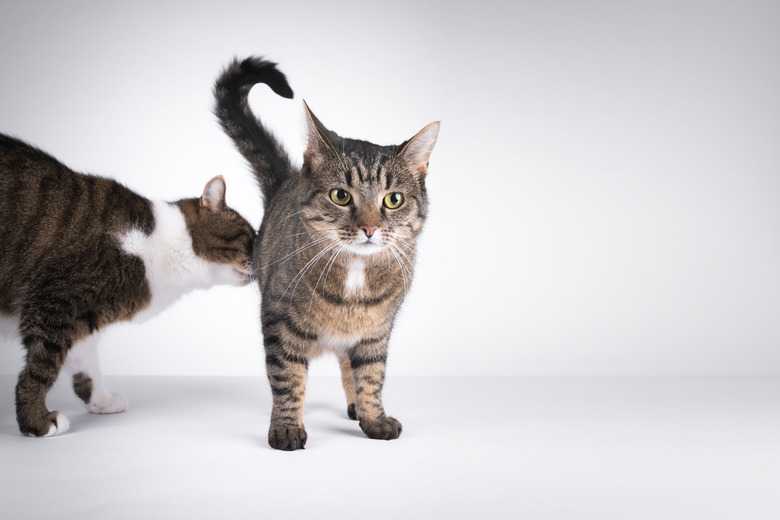
Why Do Cats Sniff Each Other's Butts?
CatsCat BehaviorWhy Do Cats Sniff Each Other's Butts?ByKrissy HowardJan 26, 2019 5:07 pm ESTNils Jacobi/iStock/GettyImages #p9b73bbf000b39f7a4673c5ad243590f6, #p9b73bbf000b39f7a4673c5ad243590f6 img { aspect-ratio: 6016/4016; height: auto; }We see dogs do it all the time: two canines meet, perhaps touch noses or size each other up for a second before immediately rushing around to the back end of their new acquaintance to get a good sniff. Dogs sniff each other's butts for a good reason: to gather information about the other dog in front of them. Unlike people, who can use language to ask questions, dogs rely on their keen sense of smell to get a feel for the world around them. Cat owners may have noticed similar behaviors among their felines as well, but do they sniff each other's butts for the same reasons that dogs do?Sense of smellSense of smellAnimals like dogs and cats rely on their senses of smell to understand their immediate environment by gathering information. For felines, many scents containing valuable info about another cat can be found directly in and on that cat, in areas like the forehead and the anus, explains VCA Hospitals. If you've ever seen two cats sniff each other's faces or bump heads, this is to release pheromones contained within their faces, which become released to emit animes and acids needed to communicate on a chemical level. This form of communication is unspoken, of course, but contains a wealth of information about the other cat, like the type of mood she may be in, or whether she is healthy or sick.On the other end of your feline friend, the butt also provides a valuable resource for decoding particular traits of a cat when sniffed out by a cat's nose. Anal glands stored within a cat's rectum contains the same information, only more detailed and easily recognized, and can even be used to tell if two cats have met before. For this reason, cats will often make a beeline straight to the behind, almost as if to bypass any unnecessary small talk to get right to the pertinent information.More Like ThisCatsWhy Do Cats Touch Noses?CatsWhy Do Cats Like Stinky Things?Cats7 Fascinating Facts About Cats' TailsSilke Klewitz-Seemann/imageBROKER/GettyImages #efe522c4da8d1ed1c56d1ef45ff348886, #efe522c4da8d1ed1c56d1ef45ff348886 img { display: block; aspect-ratio: 1.3847452856741Other ways cats communicate with smellOther ways cats communicate with smellCats are able to mark areas with their scent without requiring a nose in their nether regions to get the point across. This is done mostly by rubbing their bodies up against an object, like their human companions legs, or a fence post in their front yard, which transfers their pheromones and sends a message to other cats that this particular thing "belongs" to them. Additionally, felines use their bathroom functions to emit odors, according to the ASPCA. When a cat defecates, the same anal glands that a cat sniffs when they get a whiff of a fellow cat's butt releases a scented secretion each time they poop.Urine is also used to send important messages to other cats outdoors. Cats use urine to mark territories outdoors, which can keep them safe from harm as they are solitary creatures and hunters. Using urine to communicate through scent can tell another cat when a feline has recently been in the area (which serves as a nice way of saying "keep out") and can also signify which cats are looking to mate.adomer/iStock/GettyImages #e03587b3a34afc9a93bc0e8dfd9323f83, #e03587b3a34afc9a93bc0e8dfd9323f83 img { display: block; aspect-ratio: 1.5Other feline communicationOther feline communicationWhile a sense of smell is an invaluable resource for a cat, they use other senses to communicate as well. In order to read each other's body language, cats will also use their sense of sight. Generally, the position of a cat's ears, tails, eyes, and overall bodily posture will serve as either a warning or an invite for other cats and people. Flattened ears can indicate fear, while a flat coat usually means that all is well and that your cat is relaxed. When cats attempt to appear larger than they are — by arching up their bodies, allowing their hair to stand on end, and meowing loudly — they are sending a signal to keep away, or else.ReferencesVCA Hospitals: Why Cats Sniff ButtsThe Humane Society: Cat Chat: Understanding Feline LanguageASPCA: Urine Marking in Cats
The Cutest Pet Friendships Of All Time That Are Making Us Cry From Joy
Other Cute AnimalsThe Cutest Pet Friendships Of All Time That Are Making Us Cry From JoyByAdam SymchukJan. 4, 2025 9:05 am ESTRuslandashinsky/Getty ImagesPet parents and admirers love seeing unique friendships between animals; two cute critters are better than one, especially when it involves a cat who likes to cuddle or a playful pooch looking to wrestle. While many believe that cats and dogs are natural enemies, this could not be further from the truth. Though a difference in personality can put them at odds, early socialization and supervised interactions with other species at a young age can lead to remarkable friendships.While a connection between a cat and dog is not unheard of, many other heartwarming relationships are possible. At the same time, any pet parent aiming to forge such remarkable bonds should always exercise caution, as many of these pet friendships took time and patience to develop. Celebrating the differences between pets is just as key as trying to make them find common ground and become companions. Still, these best buddies have us crying with joy.Dalmatian takes a foster kitten under her wingTenderhearted and high energy, Dalmatians have remained a popular choice for homes and work, thanks in no small part to their Disney-famous counterparts and the Dalmatian's history of working in firehouses. Still, the doggos don't always make for the best companions for other animals, considered only moderately compatible with multi-pet households. Yet owner Taylor Meadows found herself pleasantly surprised by what happened when she took in a batch of shelter kittens to care for until they found homes. Not only did her Dalmatian, River, love the little fluffy babies, but one of them took a particularly strong liking to the large dog.The aptly-named Summit, who loves climbing his bigger sibling, soon started following the spotted dog wherever she went, and the two became quite close. This strong bond resulted in Meadows inviting the kitty into her own home permanently. "They are inseparable best friends and adventure buddies," she shared with Newsweek. "They do everything together, from hiking and camping to paddleboarding. They're the perfect duo for exploring the outdoors and I feel so lucky to have them."Beagle says goodbye to a beloved bunny and befriends a catOriginally bred to hunt rabbits, beagles have become beloved family pets thanks to their carefree attitudes and overall charisma. With its history, the charming breed still holds onto that high prey drive, so when Chloe the beagle befriended a bunny named Rue, it took the internet by storm. Yet Rue and Chloe's time together was short-lived, with the adorable brown rabbit dying after two years of unforgettable friendship. While owner Megan Cottone felt devastated as a result of her beagle losing a good friend, the dog still had a lot of love to give.Following Rue's passing, Chloe met Chlea, a gray-and-white tabby, and the two fostered a friendship that has been well-documented on social media. As the playful kitty grew up with her big sis, she followed in her pawsteps and began to copy her actions. Going on walks, sitting obediently for treats, and going on playdates with other dogs — Chlea exhibits some of the best attributes of both species.Chloe also started picking up on her little sister's traits, including staring out the window and jumping on countertops. In the caption of a TikTok, Cottone said, "I think this is why I say I am a—cats who act like dogs—and—dogs who act like cats—person whenever I get asked if I am a dog or cat person."A trio of adorable palsWhat is more adorable than a cuddle puddle of fluffy friends? How about a trio that includes two bunnies and a kitty? A testament to the power of proper socialization at a young age, little Mojo grew up alongside his two leporidae friends, Milky and Gaia. While the three pets love to play together, one of their favorite things to do is cuddle up for naps, with their TikTok full of videos of the three catching a snooze together.Now the best of buddies, the trio's owner, Lisa, spoke about the challenges of getting to the perfect harmony of cuteness in an interview with the French blog Le Blog Le Meillure Pour Mon Lapin. When asked how long it took, Lisa said, "With Milky, it was a great relationship right away. With Gaia, it took several months before we saw any progress. Mojo has been with us for 2 years, and she hasn't been coming to sleep next to him for long. As you can see, with patience, you can do a lot of things!"Nova the dog has to greet her horse friend every morningA pup excited to take part in its favorite morning outdoor activity may be quick to get its pet parent out of bed with a playful lick or a hefty bark. One dog, Nova, has adopted a unique routine where the German shorthaired pointer's day does not begin until she says hello to her favorite friend on the farm. Every morning, Nova rushes out to give Athena, her horse companion, some licks and snuggles. Their bond has become a daily ritual, with Nova and Athena's owner stating in a video for Cuddle Buddies, "No matter the weather, Nova will be there, with her whole body shaking with glee."Nova has lot of love to give. Not only does she have her favorite horse, but she enjoys spending time with her sibling Riley and exploring the farm where she lives. On the trios' TikTok and Instagram, the chocolate Lab makes friends with any frog, lizard, or other animal she crosses paths with. Still, Nova and Athena's bond remains one of the most adorable pet friendships you will find anywhere online.Skateboarding turtle needs to stay close to his cat friendThe Teenage Mutant Ninja Turtles may have been the most tubular turtles of the 1980s, but one modern-day shelled cutie may have them beat. Using a skateboard to travel with speed, Gunso loves shredding around his home, always in search of his favorite feline, a cat named Koyuki. Gunso is always close by, a little "shell on wheels" that constantly shadows his best friend.Koyuki's owner met the little turtle by chance. "I was walking home one day when I saw something that looked like a seashell. And then I got closer and realized it was a tiny turtle," they shared with Cuddle Buddies. The pet parent helped nurse the reptile, which was in desperate need of water, back to health, buying him a tank and all the necessities. The turtle quickly took a shine to Koyuki, making them inseparable and an adorable addition to their owner's home.German shepherd-Husky loves cuddling with his owlsWith around 250 owl species worldwide, there are many different ways in which the majestic birds of prey live. Yet most owl breeds choose to roost solo, getting together with others only when mating and rearing owlets. In contrast, Huskies are energetic, intelligent dogs who can certainly thrive within a pack. However, the Husky's high prey drive can prove challenging when it comes to socializing with other species. The characteristics of both Huskies and owls may cause many to think that a friendship between the two is impossible.Falconer Amy Jo Lawrance found Blue, her 11-year-old Husky-German shepherd mix, forming an unlikely bond with three of her owls, Juneau, Xena, and Frankie. When they were younger, the trio would play with and even nap with Blue, with Juneau taking a particular liking to their big fluffy friend. Yet transitioning from youth into their teens and moving out of Lawrance's home into their aviary has changed the dynamic. These independent owls still enjoy walking with Blue and Joanne but have grown out of their cuddly phase.Not all friendships last forever for people, and the same can be true for pets. However, the short time the four spent together and the adorable footage from it marked a pretty miraculous friendship. Opposites certainly can get along, even if it is just until it is time for the little ones to leave the nest.A cat and golden retriever raise kittens togetherThe saying "It takes a village to raise a child" certainly applies to pet parents welcoming new little ones, whether it's working with the mother to help keep them safe or the community to find all the adorable babies' forever homes. Yet one doggo stepped up in a big way when he decided to help his cat friend raise a batch of kittens. Golden retrievers are known to be good in homes with kids, but Dasher is certainly one remarkable pup for caring for other pet babies.There isn't much information about Dasher and his friends, as their TikTok sheds little light on the daily lives of the many pets, with most videos only bearing tags and no descriptions. The page is full of interactions with Dasher and the wee ones, as well as litters of other golden retrievers and dogs visiting the family. Still, the language of cuteness needs little explanation, with the most popular videos on TikTok of Dasher and the kittens garnering millions of views.Cat loves going on adventures with his horseThere are plenty of reasons why cats perch, and it is not just to act as an ornament for the unique cat tree a pet parent just purchased. Height allows a kitty to survey its kingdom for prey while also making it feel safe from those who might be hunting it. For the domestic kitty, it also puts it at the perfect height for pets and scratches from their favorite person. Yet Morris, a cat from NSW Australia, has upped his perching game by befriending a horse named Champy and riding him around the farm."Champy really initiated the friendship," their owner shared (via Daily Mail). "Sometime in that first week Morris realised Champy was being really gentle with him and just wanted to be friends and Morris just jumped from the verandah onto his back." The two are most active on Facebook, where their owner updates fans about the dynamic traveling duo and the other farm animals. Still, the affectionate feline and majestic equestrian are the focal point. Whether they are dressing up for Halloween together, enjoying a ride around the farm, nose boops, or Morris cleaning Champy's mane, the two seem inseparable.Dog and bunny were inseparableThe intelligence and kindness of a golden retriever are special attributes that can make them very compassionate pets. The adorably named duo Bear and Mighty Smols is a testament to the breed's adaptability, as a dog and a bunny make for an unlikely pairing, with retrievers originally bred to hunt small game. Yet the two became inseparable, with Bear always wanting his little friend involved in household events, like dressing up as a bee and a flower.Beyond countless adorable videos on TikToK, the duo's owner was inspired by their friendship to make a better change in the world. Embracing the Japanese term "omoiyari," which roughly translates to "acting towards others with kindness and a warm heart," Bear and Mighty Smols starred in their own book, "Bear Hugs." With a message of compassion and empathy using real stories of the two, the book supplied more than just positive vibes. The unique pair helped raise money for No Kid Hungry and gifted reading material to Hasbro Children's Hospital.Sadly, the friendship came to an end, as bunnies only have a lifespan of 5 to 10 years. The happy golden retriever outlived his little buddy, who died in July 2023. Still, through the book and many social media moments, the unlikely pairing left many great memories for their owner and the countless who logged on to have their days brightened by the duo.Lovebird keeps falling for catsWith the sheer attentiveness on the faces of most kitties when they see a bird flying or an insect buzzing, it would be challenging to picture a feline suppressing that instinct to hunt in favor of friendship. Yet, one little lovebird named Chicken managed to befriend a cat as a play buddy and snuggle companion. Wherever Frank went, Chicken followed. Frank's owner, Rachell, was so taken aback by the relationship that she tried her luck with another kitty, Pugsley, and the three became an unlikely trio.Frank died from illness just before the one-year mark after Pugsley joined the household. With the loss of their friend, Pugsley and Chicken found comfort in each other, taking on a loving relationship much like the one Frank had with the little lovebird. "I don't think they understand that one is a bird and one is a cat," Rachell shared with The Dodo. The orange tabby spends time in Chicken's cage, and the two eat and play together. The lovebird's family always seems to be growing, with Rachell also adopting hamsters and a dog.Huge dog watches his favorite piglet growWhile an adorable piglet can be tempting to bring into your home, a pig can be the most expensive pet you can own. While seeing plenty of cute little piggies online may make you want to own one for yourself, these pets need the right home to accommodate them when the little 2 to 3 pounders grow up to be as big as 200 pounds. The quick growth of a pig is highlighted in one unique companionship between the 135-pound French Mastiff, George, and his pig sister, Debbie, who caught up with her brother in size. George looked after Debbie from the moment she arrived as a piglet, and the pair spent many a day snoozing around the house together. Debbie eventually died, but George has a large family to call his own. On his Instagram, his pet parent shares many of her rescue efforts. George has been able to befriend ducks, cats, squirrels, and other canines. Amidst a busy household full of adorableness, George's friendship inspired his caretaker the most, who named the rescue after the friendly mastiff, calling it the Nana George Home for Animals In Need.Cat makes a unique scaly friendThere are many aspects to consider when it comes to adopting and raising reptiles, from needing a controlled environment to a special diet. Yet one of the most significant differences between cats and dogs is that, socially, reptiles are mainly solitary creatures; owners may find it difficult even to match pairs of the same species together. So when kitty Atlas befriended prehensile-tailed skink Junior, the internet was quick to celebrate their one-of-a-kind bond.While Atlas is always the one to initiate, dashing to Junior's enclosure every morning to greet the lizard, both have adapted to each other. Pet parent Mallory Lindsay shared with The Dodo, "Whey they're apart they act very differently than when they're together." Atlas is a mischief-maker who enjoys getting into everything she shouldn't but is a cool and collected cat in Junior's presence. Junior, naturally territorial and a bit bossy to his owner and others, is much more chill around Atlas. The two bring out the best in each other — just as good friends should.Rottweiler treats guinea pigs like her puppiesRottweilers can get a bad rap, which largely stems from negative media portrayals and their history of working as police or security dogs. While the breed excels at protection, if appropriately raised, a Rottie can become a loving member of any family and even co-exist with other pets. Still, not everyone knows that they can be affectionate. Given this, Bethany, the owner of one such pooch, Meisha, was happy to see her Rottweiler finally find some friendships after being avoided by others.Bethany and her partner, who work all day, left a video camera running to watch over Meisha and their guinea pigs. They were surprised to see Miesha viewing the rodents with a lot of curiosity, keeping an eye on them as they walked around the cage. The Rottweiler eventually became protective of her little friends, always looking out for them and giving their cat a little bark when she gets too close.Baby lamb rejected by family finds new dog motherWhile many like to believe that the bond between a newborn animal and its mother is absolute, that is not always the case. There are various reasons that an animal parent will abandon their kid, whether it be because of a need for survival, lack of nutrition to sustain another life, or an unwillingness to take care of multiple offspring. For farmer Olivia Jane Akers, it was heartbreaking when one of her sheep was rejected by her mother while also coming off the recent health issues of one of her dogs, Max. Yet, these two came together for each other in a big way, with Max finding a renewed purpose in life by taking care of his lamb and the little wool ball finding a new mom.Akers shared (via USA Today), "The second Max laid eyes on Beau, that was HER baby," which can be seen in the countless videos of the pair playing and bonding. Max acted as a mother to Beau, ensuring she stayed clean and healthy while growing up. When Beau was finally big and healthy enough to live with the other sheep, the proud momma doggo knew it was time to let her little one leave the nest. Still, the two go out of their way to play with each other daily, showing they have developed a lifelong friendship.
Why Do Cats Like To Sleep On Top Of You?
CatsCat BehaviorWhy Do Cats Like To Sleep On Top Of You?ByCuteness TeamJul 2, 2016 8:36 am EST#p1c09aec5e379a99cdccda72461197121, #p1c09aec5e379a99cdccda72461197121 img { aspect-ratio: 750/500; height: auto; }If you have a cat, chances are your furry little friend likes to fall asleep wherever it pleases — including on top of you. This is pretty common behavior for felines, but why do so many cats like to lay upon your lap or chest and purr themselves to sleep? Does feeling safe and secure come into play? Does snuggling with you ease your cat's mind, knowing nothing bad can happen if he's near you?Cats Love WarmthCats Love WarmthHave you ever noticed how your cat loves to catch the first ray of sunlight in the morning? Whether it's on the floor or by a window, your cat is right there soaking it all up. This is because cats prefer resting in warm places. According to Dr. Fosters and Smith, temperature receptors of cats, especially their faces, are especially sensitive, so cats love seeking out heat. Cats seek out external heat sources so their bodies don't have to work as hard to maintain a base temperature. This may be why you might wake up with your kitty on your head, because your head is the warmest place!More Like ThisCatsWhy Do Cats Like Sleeping on Warm Things?CatsWhy Does My Cat Put Her Paws on My Face?CatsDo Cats Need Blankets?fbxx/iStock/GettyImages #e156853fe1842bbab958ca6bf9d73dd44, #e156853fe1842bbab958ca6bf9d73dd44 img { display: block; aspect-ratio: 1.4980079681275Cats Want to Get ComfyCats Want to Get ComfyCats sleep around 15 hours a day or more, so naturally they're looking for a comfortable spot to catch a few winks. Whether it be on a sofa or stretched out in a laundry basket, cats require a soft and cozy place to relax. Imagine how cozy you feel to a cat who discovers you in bed under a number of plush blankets. Your belly immediately becomes the coziest place on earth, far superior to a mere pillow or cat bed.Your Cat Adores You (Believe It or Not!)Your Cat Adores You (Believe It or Not!)If you're like most people, you're typically out most of the day (or night) working. When you finally return home, all your fur-ball buddy wants to do is be by your side and follow you around until you sit or go to bed so he can climb on top of you. Why? Because your cat loves you.KandM-photography/iStock/GettyImages #e51cda5371c3bbeb9a7df1baa5624566d, #e51cda5371c3bbeb9a7df1baa5624566d img { display: block; aspect-ratio: 1.5Marilyn Krieger, a cat behavior consultant in Redwood City, California explains these behaviors: "This is the cat showing trust for the person." All that head butting of your face, all those purrs and kisses; they add up to one thing — adoration! So when your cat shows these signs of affection and when he jumps on you to make his bed, give him a little pat to lull him to sleep and return the affection.To Feel Safe and SecureTo Feel Safe and SecureEveryone and everything craves and needs security. Your cat is no exception! When your cat is in search of a place to sleep, he not only wants comfort and warmth, he also wants a place that is secure. No dangerous predators are around when his favorite person is there, so kitty dreams come easily for your cat when he has nothing to fear.YakobchukOlena/iStock/GettyImages #e846be6e23deacdcecc95595382070bf1, #e846be6e23deacdcecc95595382070bf1 img { display: block; aspect-ratio: 1.4980079681275Your Soothing Sounds and ScentsYour Soothing Sounds and ScentsThe natural sounds of your body may be soothing to your cat when he sleeps on top of you. The steady rhythm of your heartbeat and breath as well as the rise and fall of your inhaling and exhaling help lull your cat to sleep. Your smell is also pleasant as your cat associates it with you and the care, companionship, and safety you provide him.Chepko/iStock/GettyImages #e0a6e12e1846a369f5172458182244305, #e0a6e12e1846a369f5172458182244305 img { display: block; aspect-ratio: 1.5Your Cat Plays Favorites!Your Cat Plays Favorites!Cats are territorial creatures, and often want to mark their favorite people as their own. Consider your pet sleeping on you as indication of their trust, since your kitty considers you the safest place.ReferencesWhy do Cats Crave Warmth?PetMD: Why Does My Cat Sleep On My Head
Is A Cat Twitching In Its Sleep Having A Seizure? When To Be Concerned
CatsCat HealthIs A Cat Twitching In Its Sleep Having A Seizure? When To Be ConcernedByAdam SymchukMarch 11, 2025 3:25 pm ESTFatesun/Getty ImagesCats can spend more than half their day sleeping, between 12 and 16 hours, meaning there are plenty of opportunities to catch a picture of an adorable cat sleeping like a funny weirdo. Like humans, sleep can bring peculiar movements, such as snoring or slight stirring. Still, for pet parents, when a cat really gets moving in their sleep, it can be challenging to interpret these actions and determine whether they should be concerned.A cat twitching in their sleep is likely due to involuntary muscle spasms or REM (rapid eye movement) sleep, rarely the case of a seizure. Muscle spasms occur naturally during sleep and are not concerning; spasms can indicate underlying issues, but these symptoms usually also appear while a cat is awake. Cats can dream, and they enter REM sleep — the state before deep sleep where the mind is active — similar to their human companions. Movement during the REM cycle is not only okay but also often adorable.There are two different types of seizures in cats: focal, which affects part of the body, and generalized, which affects the entire body. The underlying cause of seizures can range drastically from toxicity to common types of cancers in cats. The signs of a general grand mal seizure, the most recognizable type, can include uncontrollable muscle activity, faltering to one side, confusion, and loss of control of the bladder/bowels. During the 'pre-seizure period,' a cat may appear restless, drool, and seek attention, yet some don't show any signs. These factors can make it difficult to determine a seizure versus twitching. If you believe your cat is exhibiting signs beyond muscle spasms or REM sleep, consult your veterinarian.What to do if your cat has a seizureRai/Getty ImagesWhen faced with a traumatic event like witnessing a pet going through a seizure, many will find themselves panicking about what to do. The first response should be to stay calm in order to best be able to help them. Carefully moving a cat away from objects or furniture will reduce the chances of injury from hitting up against either. Timing their seizure and recording it on video will also help a vet interpret the severity of an episode. A seizure lasting for more than three minutes will require immediate medical intervention. Finally, do not touch around their mouth to avoid being bitten.A single seizure that lasts a couple of minutes or less does not generally require immediate medical treatment. Still, a veterinarian should assess a pet to determine the underlying cause, such as the cat having head trauma symtoms or an illness, so they can begin care. Monthly or regularly occurring episodes may be a sign of idiopathic epilepsy — seizures without a direct cause. This condition is incurable, and symptoms must be managed with an anticonvulsant medicine.Thankfully, the chances of cats suffering from seizures are uncommon. A 2020 study completed by the Royal Veterinary College of London found that only 16 out of 10,000 (.16%) cats suffered from seizure disorders or epilepsy. This study indicates that if you find a cat twitching in their sleep, they're more likely to have common muscle spasms or a natural sleep cycle over a seizure — so you can let them rest easy.Always consult your veterinarian before making changes to your pet's diet, exercise, or care. To find an accredited veterinarian in your area, you can search theAmerican Animal Hospital Association's online database.
Are Cats Nocturnal?
CatsCat BehaviorAre Cats Nocturnal?ByCuteness TeamUpdated Feb 6, 2019knape/E+/GettyImages #pe42a389782bcc0dddd58ad5905c57d5f, #pe42a389782bcc0dddd58ad5905c57d5f img { aspect-ratio: 6048/4032; height: auto; }Diurnal, nocturnal, or crepuscular. Which one of these terms best describes your cat? Diurnal animals are active mostly during the daylight hours. Nocturnal animals are active in the evening hours and like to sleep during the day, while crepuscular critters favor their activities at or around dawn and dusk.Big cats, small catsBig cats, small catsIn the wild, big cats are mostly nocturnal hunters. Their eyes (much like that of the domesticated cat) are designed for sight in low and high light levels. If your domestic cat displays nocturnal behavior, it's acting like a big cat (lion, tiger, etc.) Usually, these cats sleep anywhere from hours a day to more than sixteen a day. That's a lot of sleeping! The good news is this behavior can be modified in most cats (but alas, not in all.)More Like ThisCatsWhy Do Cats Love You Most in the Morning?CatsWhy Does My Cat Like to Cuddle After Eating?CatsWhy Your Cat Runs Around Like A Maniac At NightCool crepuscular catsCool crepuscular catsCats combining daylight activity with nighttime activity are commonly known as crepuscular. The common house cat, most likely because of a higher rate of human interaction, is not nocturnal but crepuscular.Crepuscular cats lounge around, enjoy dream-filled naps, and lay low around midday to avoid the heat and keep cool. They then become more active in the early morning and early evening hours.Crepuscular critters differ from diurnal and nocturnal. Nocturnal animals peak during the night while diurnal animals peak during the day. Some cats commonly described as nocturnal are crepuscular.It's interesting to note here that moonlit nights and dreary, cloudy days can entice the crepuscular cat into action, so daytime activity is not totally ruled out of the crepuscular cat's agenda!Nocturnal feral catsNocturnal feral catsFeral cats appear to be nocturnal for the most part, according to Southern Methodist University. A "feral" cat is a stray or offspring of a stray that has returned to a partially wild state. These cats survive in colonies usually around a food source such as a restaurant dumpster, a trash can or an abandoned building. Feral cats usually depend on some human contact to attain their food and rarely live only by hunting prey alone.More diurnal managed catsMore diurnal managed catsEvery cat, whether it's a household cat, a stray or an alley cat, can change their activity level at will and can become less nocturnal or more diurnal in response to their level of interaction with their environment or activities with humans."My cat keeps me awake at night," is a common complaint of cat owners. Nocturnal behavior in cats can be annoying for their human owners, but sometimes this behavior can be managed, so the cat adjusts to the human lifestyle and becomes more diurnal, says the Animal Humane Society. If your cat displays nocturnal behavior, what must be done is a slight shifting of their schedule as well as management of their environment.Tips that may helpTips that may helpDon't payoff disturbing behavior, warns PAWS. If you give your cat what it wants, you're reinforcing this nightlife behavior and verifying, "Hey, this works!"Early evening exercise may provide enough activity to tire out your cat and have him (or her) sleep through the night. Devoted activity may allow you that sleep you so desperately need at night!While you're away during daytime hours, provide some type of activity for your cat for mental and physical stimulation. A food type toy such as a 'Roll-a-Treat' is a great distraction. A catnip toy like the 'KONG Squirrel Catnip Toy' is another good method of keeping your cat awake during the day. Consider feeding your cat with an automatic food dispenser toy. This will keep your cat on its feet and not sleeping all day. Feeding times are important. Consider feeding your cat a few times throughout the day (one being at night, before bedtime.)Never punish or strike your cat. Your cat's behavior is not caused by any human emotion. Punishing your cat will cause a stressful relationship between you and will not ultimately solve the problem.Managing your cat's nocturnal behavior by following the above guidelines may keep you both 'in-sync' for years to come. Unfortunately, not every cat will respond in the same manner. Situations differ just like each cat is different!ReferencesAnimal Humane Society: Cat Keeping You Awake? How to Manage Night ActivityPAWS: Nocturnal Cats – Dealing with Nighttime TroublemakersSouthern Methodist University: Feral Cats in Your Neighborhood?
Tips To Help You Figure Out How Far Along Your Pregnant Cat Is
CatsCat HealthTips To Help You Figure Out How Far Along Your Pregnant Cat IsByJessica DesrosiersMarch 1, 2025 11:25 am ESTCatherine Falls Commercial/Getty ImagesIt's important to know how far your cat is into her pregnancy in order to schedule vet visits, provide the right food, and prepare for the arrival of her kittens. While there are some general signs that a cat may be pregnant, a few tips can help you figure out how far along she is at home.In general, a cat's pregnancy lasts around 63 to 65 days, or a total of nine weeks. This further divides into three trimesters of three weeks each. Each trimester also involves different stages of kitten development, as well as unique signs to look out for. However, remember that visual inspections aren't foolproof. Each cat is an individual, so there may be variation in both indicators and the length of your feline's pregnancy.Watch for signs of heatRai/Getty ImagesPregnancy begins with ovulation and mating during a cat's heat cycle. A feline also doesn't need to be a specific age before they can get pregnant. Cats can go into their first heat as young as four months of age. However, if you know when your cat was in heat, you can use that to map out when to expect each stage of her pregnancy, including labor and delivery.Cats are induced ovulators which means they need to mate in order to ovulate and become pregnant. Otherwise, a cat will continue to go into heat every 2 to 3 weeks. Cats can become pregnant any time throughout the year. However, the most common kitten season spans April to October. Signs to look for include increased vocalization, demanding more attention, rolling around, or even attempting to escape. A female cat can also mate with more than one tomcat during a heat cycle, leading to multiple fathers for the kittens.Changes during the first trimestersergey kolesnikov/ShutterstockThe first three weeks of your cat's pregnancy is called the first trimester. It's also the stage of your cat's pregnancy that may not be easily noticed. Often, changes can be subtle unless you're very in tune with your cat. If you know your cat was in heat recently, or you've been actively tracking their breeding, you can watch out for these signs of pregnancy.Some cats may have vomiting or morning sickness. There may also be minor belly swelling. In addition, some cats will have behavioral changes, such as increased affection or seeking you out. Lastly, a cat's nipples can sometimes swell or become pinker in early pregnancy, called "pinking up".If you know your cat was in heat, or you've bred them recently, your vet can also help you detect a pregnancy at this stage. Ultrasound can detect kittens as early as 15 days. Some veterinarians may also be able to palpate, or feel, for kittens at this early stage.What to spot during the second trimesterShutterofadam/ShutterstockThe second trimester is when most cats begin to show more visible signs of pregnancy. This can make it easier for you to determine how far along she may be. It's a time of rapid kitten development, where most of their organs are formed at around five weeks. You'll likely see changes to your cat's body and behavior at this stage. Pregnant cats will have a rapidly expanding belly. They may also show what is called "quickening" behavior, or sudden bursts of energy and excitement, much like cat zoomies.The second trimester is also the best time to confirm a pregnancy with your vet if you're unsure of her breeding date, or you're caring for a potentially pregnant stray. They can confirm the pregnancy via ultrasound more easily at this stage as a kitten's heartbeat can now be detected. In addition, your vet can rule out any health issues that may mimic an enlarged abdomen, such as parasites or illness.Things to look for during the third trimesterDoucefleur/Getty ImagesThe third and final trimester is the time when pregnancy in cats is most visibly obvious. You'll also see more behavioral changes as your cat nears her due date. Nesting behavior, or seeking out a place to have the kittens, is most common in the final week of pregnancy. Your cat may hide more, attempt to drag blankets to a specific spot, or hang out in a cozy place.Cats in their final trimester also have higher energy requirements. This increase prepares them for producing milk. As a result, they may seek out more food. They may also eat smaller, more frequent meals due to the kittens taking up more space.As your she nears her final stage of pregnancy, you may also wonder how many kittens your cat will have. At this stage, your vet can take an X-ray or ultrasound to look for kitten skeletons. This can be done any time after day 40, so if an X-ray comes out with clear and easy-to-spot kittens you'll know your cat is nearing delivery.Signs your cat is ready to give birthJessamyn North/Getty ImagesThe last stage of pregnancy is labor and delivery. Your cat will show many signs when she's ready to give birth. You may first see changes to the nipples as they fill with milk, causing droplets of fluid to leak from them. As labor approaches, you may also be able to see visible movement of the kittens along your cat's abdomen. About 24 hours prior to birth, your cat's appetite can also decrease. In addition, a cat's temperature will drop and can be tracked with a thermometer.In the hours just before labor, you may notice visible abdominal contractions. There may also be vaginal discharge, indicating kittens will be born very soon. Kittens will be born about every 10 minutes to an hour until labor is done.While it can be hard to figure out how far along a cat is in their pregnancy, a few signs can help give a general idea of when to expect kittens. If you're ever unsure, a visit to your vet is best for confirming pregnancy, ruling out any issues, and keeping mom happy and healthy.Always consult your veterinarian before making changes to your pet's diet, exercise, or care. To find an accredited veterinarian in your area, you can search theAmerican Animal Hospital Association's online database.
The Funniest Things That Cats Do (And What They Might Mean)
CatsCat BehaviorThe Funniest Things That Cats Do (And What They Might Mean)ByKeri-Beth ClurJan. 11, 2025 9:05 am ESTImage By Chris Winsor/Getty ImagesWe may receive a commission on purchases made from links.There's no doubt about it — cats are peculiar animals. Sometimes their behaviors are quirky, unpredictable, moody, and laugh-out-loud funny! If they're not chattering away in their own language, they're making biscuits on their favorite blanket, bouncing off the walls, squeezing their whole body into a tiny vase, staring at nothing, or swatting at the kibble you just poured into their bowl. But, while your cat might leave you giggling and puzzled almost every day, there's usually a reason for these funny behaviors.Looking for comfort, releasing excess energy, trying to communicate with the people they love, and just having fun might be some of the reasons why your cat does what they do. Instead of laughing these funny things off, pay attention to what they're doing and what their actions might mean. You may get a better understanding of their personalities, likes, and emotions. Some funny behaviors can even be a sign that something is wrong. Keep reading to learn a new thing or two about your cat's quirks or just to have a few good laughs.ChatteringIf you've ever watched your cat stare at something and chatter, you've most likely had a little giggle at how funny this quirk is. Cats chatter by rapidly shuttering their teeth and jaw and making high-pitched chirps. One theory behaviorists have is that cats do this to mimic the sound of their prey in an attempt to get close enough to capture it.It is a relatively new theory based on a study published in the Neotropical Primates 2009 June issue by researchers from The Wildlife Conservation Society (WCS) and UFAM (Federal University of Amazonas). These researchers recorded Amazonian wild cats mimicking the sounds of small monkeys called pied tamarins to lure them down from a tree in an attempt to capture them. The report also suggested that mimicking is a tactic used by jaguars and pumas. If wild cats mimic their prey to lure them, perhaps your feline friend does, too.However, because cats are typically silent stalkers, making a noise loud enough for their prey to hear seems a bit uncharacteristic. Pam Johnson-Bennett, a cat behavior expert, theorizes that your cat might be chattering out of frustration because they cannot reach the prey they see due to it being too high up or because your cat stays indoors. Another theory is that they're mimicking the killing bite they'd give the prey upon catching it.KneadingKneading is when your cat moves their toes back-and-forth on a surface as if they're giving a massage. It looks similar to the motion a baker makes with their hands when working their dough, so some pet parents call this cat behavior "making biscuits." Your cat might knead on a fluffy blanket, pillow, clothes, or even your bare skin. But why do cats knead? They might be doing this to get comfortable before a nap, to stretch and release tension in their body, to show affection to their loved ones, to find comfort, or to mark their item with their scent, which is released from their feet glands.Kneading is instinctual and a behavior that starts as soon as kittens are born. Kittens knead their mothers to get milk out of their teats. Some cats continue this behavior because kneading something soft makes them feel good and offers a feeling of contentment, similar to what they experienced when nursing. Although this behavior is normal in cats, pay attention if your cat suddenly does more often than usual. It could mean they're not feeling well, in pain, or anxious. Along with kneading, some cats may also suck on the item.Running around the houseIt's impossible not to laugh when your cat gets the zoomies. One second, they're calmly sitting in your lap, and the next, they're running around the house, bouncing against objects, launching off table tops, climbing up your curtains, and attacking the air. It's normal for kittens and cats kept inside all day to experience these random bursts of hyperactivity to release excess energy. Sometimes, zoomies happen after a nap when cats have extra energy to burn, which is why your cat might run around like a maniac at night. It could also happen when cats are playing, overstimulated, or excited.If the zoomies happen too often, it might mean that your cat needs more stimulation. An under-stimulated cat may become destructive, meow excessively, and overgroom, which can lead to wounds and infections. Others may overeat, which can lead to obesity. To reduce the frequency of their zoomies and prevent frustration, make sure to play with your cat throughout the day. The sessions don't have to be long, though PetMD recommends aiming for 10-to-15 minutes each time. To make the most out of play, try using feather wands and laser pointers. This will allow your cat to get exercise, burn excess energy, and be mentally stimulated.Squeezing into small objectsAlthough the sight of your cat inside a small object may spike your anxiety and make you feel claustrophobic, the opposite is true for cats. Cats like tight spaces because it makes them feel safer and less vulnerable than open spaces. As a result, they'll sometimes seek out small spaces, like your drawer, or objects like a vase, to de-stress. Being in a small space can also help them adapt to new environments or situations faster. This is why cats hide under the bed when they join a new, unfamiliar home. If you have an anxious cat, place cardboard boxes or a cat cave bed in a quiet area of your home, or make a spot in the back of your cupboard for them to retreat to when they feel overwhelmed.Now that we know why cats squeeze into tight spots, let's explore how they do it. To understand this, you can't think of your cat's shoulder structure the same way as your own. Unlike a human's rigid shoulder girdle, which is connected by joints, a cat's shoulders are connected to their body with muscles. This gives them incredible flexibility and the ability to squeeze into tight spots to find a quiet place to sleep, hide from danger, and go after small prey, such as mice.StaringIf you catch your cat staring at you — or at nothing — it can seem hilariously creepy, but it's normal behavior. Your cat might stare at you to get your attention or communicate with you that they're hungry, although, in the latter case, they'll likely meow and run to their food bowl. They might also stare at you to show affection. If your cat stares at you with a relaxed face, chances are they feel safe and bonded to you. Slow blinking is also a sign of contentment and love, so return the gesture to your cat by relaxing your face and blinking slowly back at them.As for why your cat is giving a blank stare at the wall, there's another explanation. Cats are natural observers and enjoy vantage spots, like cat shelves, to watch what's happening around them and stay out of danger. They also enjoy windows to spy on the neighbors and watch the birdlife outside. Your cat could also be staring at what you perceive as nothing while moving their ears around because they're trying to pinpoint where a sound is coming from. You might not be able to hear the sound because it is too high a frequency for your human ears to hear. Chasing their own tailCats, especially kittens, love to chase things that move, whether it be a leaf blowing in the wind or a red laser moving along the wall. This is also why cats chase their tails – because they twitch and move. A tail is a built-in fluffy toy that your cat might enjoy playing with when their feather wand is packed away. Although normal, this behavior can be a sign of boredom, so make sure you're giving your cat enough attention by playing with them throughout the day and leaving a few toys out for when you're busy.For cats, tail chasing is both entertaining and a way to release excess energy. However, as cats get older, they usually outgrow this behavior because they quickly learn that it's easier and less painful to catch objects that aren't a part of their own body. Excessive tail chasing as an older cat might mean that your cat is feeling stressed or their tail is itchy, painful, or sensitive. If an adult cat suddenly becomes obsessed with their tail, it's a good idea to take them for a checkup at the vet.Nibbling on grassYou adopted a cat, not a cow, so why are they eating grass? Many people think it's a remedy for an upset stomach in cats, and they're on the right track. Lynn Buzhardt, a doctor of veterinary medicine and contributor to VCA Animal Hospitals, theorizes that "eating grass makes the cats throw up the less digestible parts of their protein rich meal." So, if a cat eats a feathery bird, they may also eat some grass to help them bring up the feathers or bones they ingested. Another theory is that animals eat grass to get rid of internal parasites. Although cats also eat grass, it might be more of an instinctual behavior because it is unlikely for domestic cats to have these parasites today.Regardless of what eating grass might mean, it does have some benefits for cats. Grass has trace nutrients as well as folic acid, which are good for cats, especially if they have a low-level deficiency. However, they should get all the vitamins and minerals they need from nutritionally balanced, high-quality cat food, like Hill's Science Diet. That said, even with a good diet, some cats might eat grass for no reason other than because they like the taste of it.Watching you use the bathroomYou might find this behavior funny or a little creepy, but cats often grab the opportunity to watch their favorite people use the loo or take a shower. They're not trying to be creepy; they're just interested in what you're doing, and what's inside the room you visit several times throughout the day. The bathroom is a curious place because most people close the door behind them when they use the toilet, so getting to snoop inside will interest your cat, especially while you're in there doing your business. Some cats are little shadows and like to be wherever their owners are, so if that's the bathroom, that's where they'll want to be.Some cats might watch their caregivers intensely while they're in the shower because they're curious about all the movements they're making while singing their favorite Taylor Swift song. However, it's more likely that your cat is actually watching the falling water around you and how it hits the glass door in front of them. Although your cat likely doesn't enjoy getting wet, they are fascinated with running water, which can keep them engaged during your shower session.HeadbuttingWhether hard or soft, most people find a headbutt from their cat funny and cute. They do this to show affection. When you receive a headbutt, it's your cat's way of giving you a hug, so be sure to return the favor by gently leaning into the headbutt or giving them a cuddle. Cats also headbutt to mark the people they love with their scent. Cats have glands on their faces that release pheromones, so other cats will be able to smell your cat on you. This is your cat's way of bonding with you, and informing other cats that you're a part of their family.Headbutting might also be your cat's way of checking a new person out and gathering information through their smell. It can also simply be a cry for attention — even if you've been stroking them for ages. Along with headbutting, a happy cat will likely purr and look calm, relaxed, and content.Drinking from the faucet instead of their water bowlEven if you're a super pet parent and keep their bowl filled with fresh, clean water, your cat may still opt to hydrate directly from the kitchen faucet or bathtub. Now, this doesn't necessarily mean there's anything wrong with the water quality. If your cat is obsessed with water, especially running water, they may take every opportunity to drink it wherever they see it. However, your cat might only want to drink from the faucet because they don't like their bowl or the location where you've placed it. If your cat has a plastic bowl, they might not want to drink from it because of how it smells. Plastic is a porous material that easily traps bacteria, which can cause odors. Perhaps swap your cat's plastic bowl out for a ceramic type and see if it makes a difference. Cats typically won't drink from their water bowls if it's next to their stinky litter box or in a busy, loud area of the house. Some cats enjoy drinking water from a vantage point, and having their bowl on the floor isn't as appealing as the view from the sink. Move your cat's bowl to a quieter, higher spot, as this might help them warm up to their water bowl. You can also purchase a Veken Automatic Cat Water Fountain to provide a continuous stream for them to drink from if they don't like stagnate water.They get poop zoomiesPoop zoomies look the same as regular zoomies, but the reason for it is different. Poop zoomies are exactly what they sound like — getting the zoomies after pooping. However, it can also sometimes happen right before your cat does their business. Similar to regular zoomies, it consist of playful, energetic behavior for a short period of time, so don't be surprised if you see your cat bouncing from wall to wall after using their litter box, as it's pretty normal behavior.If your cat gets poop zoomies, it might be because they're trying to get away from their litter box quickly because it's been soiled. It could also be a sign that pooping was painful, or because they're happy about their accomplishment and are celebrating by zooming around. If this is a new or frequent behavior, take your cat to the vet as they might be constipated or struggling with a health problem such as inflammatory bowel disease. Although it could be your cat doing a victory lap and nothing to worry about at all, it's better to investigate the behavior than ignore it.Playing with their kibbleYour cat can put on quite a comedy show with how they swat at their kibble and chase after it. It doesn't necessarily mean they don't enjoy the food, as they'll likely munch it all up when they're done playing. This behavior comes from instinct; wild cats are natural hunters and typically chase their food before they kill it. Although your house cat's kibble is clearly lifeless, your furry friend may make a game out of dinner to recreate this scenario. This allows them to feel like they earned the reward of eating their food after having to chase after it. Burning some energy before a meal also increases appetite, so they might play a bit to get themselves hungry.However, when a cat plays with their food and doesn't end up eating, it can be worrisome. Any cat that is refusing to eat, losing weight, vomiting, or having bad breath needs to be seen by their vet. They might be experiencing pain when eating, having an allergic reaction to the ingredients in the kibble, or have kidney disease or gastrointestinal problems.Leaving you giftsUnfortunately the gifts our cats drop off at the door usually aren't the exciting kind – insects, mice, the occasional dead bird. Some cats even prefer to bring back options that are still alive. On the odd occasion, it might even be some random thing, like your neighbor's sock. Some "gifts" are funnier than others, but they might not actually be for you. Some cats bring home items they're interested in because they know it's a safe place to keep them. As a pet parent, this is such a compliment because it shows that your cat feels safe where you are.Although it can be distressing to see a baby bird carcass, it's important to know how to react to a pet that brings home a dead animal. What they're doing is instinctual, not intentionally malicious or cruel. Getting angry at your pet will scare them and hurt your bond. Instead, return living creatures back to your garden or take them to the vet. If it's dead, give your local wildlife removal company a call to properly dispose of the carcass. Depending on where you live, you may be able to bury the animal yourself. Keep in mind, different counties may have certain laws regarding wild animal burialLifting their butt toward youThe little butt lifts your cat does when you're petting them may look funny, but it's not for nothing. When you pet a good spot, your cat may react by lifting their butt higher to make sure you keep going instead of pulling away. In other words, it's a sign that your cat is loving what you're doing. It's the same as when someone is playing with your hair and you don't want them to stop, so you put their hand back on your head to keep them going.Shifting their bum could also be a sign that your cat is itchy and you're scratching in the right spot. Every cat gets itchy every now and then, but if you notice them scratching excessively, check for fleas and ticks. If you spot flea dirt or little black fleas moving along their skin when you part their fur, you'll need to start them on treatment, which you can get from the vet. Itchy skin and excessive scratching could also result from allergies, dry skin, anxiety, and skin infections.
Suckling Behavior In A Cat
CatsCat BehaviorSuckling Behavior In A CatBySusan ParettsUpdated Aug 25, 2021If your adult cat suckles like a kitten on your clothing or even on your arm, don't be alarmed. Some cats will suckle on fabrics and people out of a need for comfort or as a show of affection. While cat suckling behavior is generally harmless, it can become annoying if it becomes compulsive and possibly dangerous if your cat ingests the fabrics she's sucking on.MKucova/iStock/Getty Images #eb45fc9908c0757d91606611e44e465ff, #eb45fc9908c0757d91606611e44e465ff img { display: block; aspect-ratio: 1.4996466431095Cat suckling behaviorsCat suckling behaviorsSuckling is an infantile behavior that usually makes an adult cat feel less anxious, just as it did when she was a baby. The behavior is akin to a grown human's thumb sucking. Your kitty will likely start by kneading a soft textile, then she'll lick, suck and chew on it. Some kitties don't do textiles; they suckle other cats and people—which can cause skin irritation in the suckled party.Suckling behavior may occur occasionally or compulsively. Cats who compulsively suckle have trouble stopping, even when you provide distractions with toys or treats. If your adult kitty has recently started suckling, take her to the vet to rule out a medical cause such as hyperthyroidism.Causes of cat sucklingManuta/iStock/GettyImages #pd86f65b5b2eba7f838bef6010d6255d8, #pd86f65b5b2eba7f838bef6010d6255d8 img { aspect-ratio: 5303/3540; height: auto; }Causes of cat sucklingThe most common cause of suckling in cats is early separation from their mothers and littermates. Kittens should stay with their mothers until they reach around 12 weeks of age—not eight weeks, a common separation age for puppies. If they are separated earlier than 12 weeks, they can develop compulsive behaviors, including suckling, later in life.Early weaning might cause cat suckling compulsion. A mother cat will begin weaning her kittens starting at around four weeks of age. The process usually takes about two weeks. If she abruptly stops letting them nurse before or during this time, they may continue to seek out the comfort of nursing from her on you or other items, even if they're eating solid foods. This could continue into adulthood if the behavior isn't discouraged.Discouraging cat sucklingDiscouraging cat sucklingIf your cat's suckling is compulsive, or if it has resulted in skin irritation or the ingestion of foreign objects, you'll need to discourage it. If your feline suckles you, gently get up and leave her alone. If your kitty suckles fabrics or pillows, take those items away or spray them with a taste deterrent. Another option is to distract her with a favorite toy or game when she starts suckling. You can feed your cat a series of treats when she's not suckling—if she responds to treats—and withhold them when she tries to suckle.Sometimes increasing the amount of fiber in your cat's diet may help discourage suckling on fabrics. Fiber helps to keep your kitty feeling full after meals and will discourage fabric ingestion inspired by hunger.Reducing stress for catsReducing stress for catsYour adult cat is most prone to exhibiting suckling behaviors if she's under stress; she suckles to cope with it. It's not the same as compulsive suckling, necessarily. If your kitty's suckling isn't interfering with her daily activities or yours, no harm will come from letting her indulge in this behavior occasionally.Use calming feline pheromone sprays to make her feel more at ease. Allow her access to a screened-in porch or give her some cat trees to climb so that she's physically and mentally stimulated during the day. Puzzle toys containing treats or kibble will engage her attention while you're gone. Spend plenty of time with her so she's not lonely and craving attention. Provide her with several hiding spots and high perches to escape to if guests visit or she gets annoyed at other pets.Avoid scolding your catAnita Kot/Moment/GettyImages #p8365a79d30ecbd36a2cb0afa15dc79e1, #p8365a79d30ecbd36a2cb0afa15dc79e1 img { aspect-ratio: 6000/4000; height: auto; }Avoid scolding your catDon't scold your kitty or otherwise punish her for suckling you or other objects. This will only serve to increase her anxiety and can cause her to fear you. Instead, prevent the behavior by removing objects she likes to suckle or using a deterrent spray. Once the behavior starts, ignore it or calmly redirect the behavior with play or treats.ReferencesPam Johnson-Bennett: Wool Sucking Behavior in CatsThe Animal Behavior Network: Cat Suckling and KneadingThe Cat Behavior Clinic: Cat Compulsive DisordersInternational Cat Care: Stress in Cats
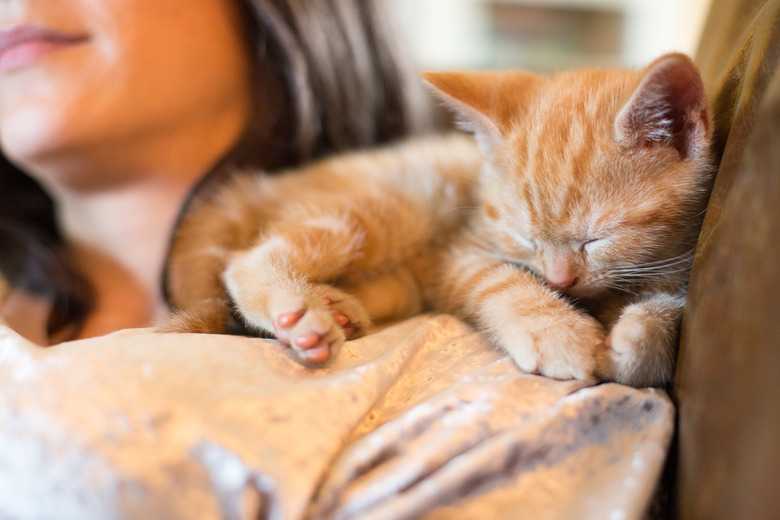
What Does It Mean When A Cat Sits On You?
CatsCat BehaviorWhat Does It Mean When A Cat Sits On You?ByKayleigh RobertsMay 23, 2019 4:07 pm ESTCats are known for a lot of things, but chief among them are their DGAF attitudes and their lazy, lazy love of sitting. Combined, these qualities have led many a cat to plop down on their owners over the years, but what does itmeanwhen a cat decides to sit on you? Here's everything you need to know about what cats are trying to tell us when they sit on a human.They feel safeNeil Petersen / EyeEm/EyeEm/GettyImages #pc719affaa4da7c2d74a944fcd5e00081, #pc719affaa4da7c2d74a944fcd5e00081 img { aspect-ratio: 5760/3840; height: auto; }They feel safeMore Like ThisCatsHow Do Cats Choose Their Favorite Person?DogsHow to Know When Your Pet Loves YouCatsWhy Do Cats Like to Sleep on Top of You?One thing cats are trying to say when they sit on you is a simple, "Hey, I feel very safe with you." This can be especially true if your kitty is laying on you when he's ready to take a nap—it means that your feline friend trusts you to keep him safe from predators while he's sleeping.Showing trustShowing trustSpeaking of trust, it's not just nap cuddles that show trust. Any time a cat decides to lay on you, it's a big sign of the trust you've developed.npdesignde/iStock/GettyImages #e95e16ee242f18eaedbfc3178dd4bded3, #e95e16ee242f18eaedbfc3178dd4bded3 img { display: block; aspect-ratio: 1.5"They really do have to trust you to sit on your lap," Marilyn Krieger, Certified Cat Behavior Consultant (CCBC), based in Redwood City, California, and author ofNaughty No More!,says. She stresses the importance of not making a cat sit on your lap and giving the cat the option to leave. "When you give them that choice of sitting on your lap or not and leaving when they want to, they become more trusting of you."You're one of their favorite peopleYou're one of their favorite peopleYes, cats play favorites and yes, they're more likely to lay down to rest on the person they like most in any given room.Elitsa Deykova/E+/GettyImages #e3386d768df687c268867bed79f60c3f3, #e3386d768df687c268867bed79f60c3f3 img { display: block; aspect-ratio: 1.5"There are a number of ways including head-butting, purring and sitting on laps. Proximity also can demonstrate favoritism. Some cats follow their people around the home or always choose to be near them," Marilyn told Cuteness.They want you to pay attention to themThey want you to pay attention to themCats will also lay on a person when they're craving attention. It's important not to overestimate cats' independence and to remember that even these aloof creatures crave affection from time to time.Hannah Mentz/Corbis/GettyImages #e0122fd85b9e627c1c3665986073cf470, #e0122fd85b9e627c1c3665986073cf470 img { display: block; aspect-ratio: 1.5As we've written before, "Cats can get lonely when you're not at home and most will seek out attention when you're around. While cats are undisputedly independent and may be aloof to some people or strangers, feline standoffishness is overestimated."They're stealing your body heatDaniloAndjus/E+/GettyImages #pf86af40898d9ee985ff7524a5c1f21e3, #pf86af40898d9ee985ff7524a5c1f21e3 img { aspect-ratio: 6016/4016; height: auto; }They're stealing your body heatCats love to lay around in warm places and the human body is pretty warm. According to Marilyn Krieger, cats sometimes lay on their owners because they're craving that warmth.They love the way you sound and smellIvanJekic/E+/GettyImages #p7cc3f95d7f05b9d51b9d072dd829a4db, #p7cc3f95d7f05b9d51b9d072dd829a4db img { aspect-ratio: 4829/3548; height: auto; }They love the way you sound and smellCats love to sleep and, it turns out, the sounds that the human body makes naturally (like the rhythm of the heart beating and the sound of our breath) can be really soothing and sleep-inducing for cats. So, yeah, your cat might be using you as nature's noise machine when she snuggles up to you. On a more personal note, however, your smell is unique to you and might put your cat in that safe, trusting mindset we discussed above, which is totally unique to your relationship.